
Things to do in Ilha Grande: a guide by the crew that anchors there weekly
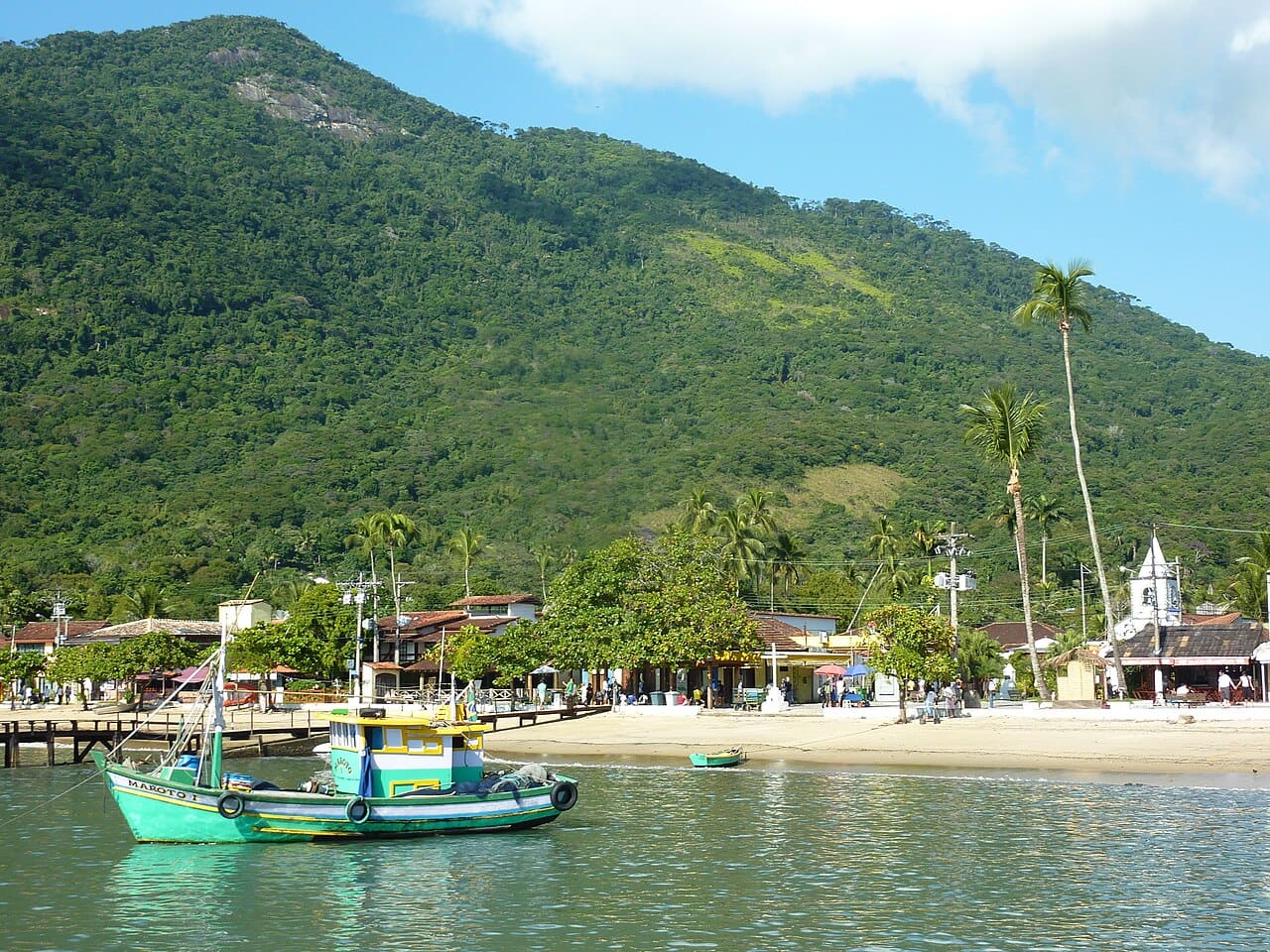
Fifteen kilometers off the coast of Angra dos Reis there is a 193 km² island where no car circulates. None at all: the streets of the main village are dirt and sand, transport means boat, bicycle or your own legs, and Atlantic Forest covers almost the entire territory. That preservation has a crooked history: for more than a century the island was a quarantine station and then a prison, which kept roads and speculation on the outside. When the last jail was demolished, in 1994, what remained was one of the largest continuous stretches of preserved forest on the Brazilian coast. In 2019, UNESCO recognized the whole, together with Paraty, as a World Heritage site, the first in Brazil listed for culture and nature at the same time.
We write from up close, and often from inside: the Albatroz, our group’s 23 meter schooner, sails out of Paraty and anchors in the island’s waters every week. This guide gathers what the crew answers in deck conversations: the beaches, the numbered trails, the lagoons, the village, and also the distant corners that take real work. At the end, we share the way we recommend getting to know the island and leave the full logistics for anyone who prefers to go on their own.
The island in five facts
- There are no cars and no paved roads. Everything happens on foot or by boat.
- Vila do Abraão, the only settlement with tourism infrastructure, has about 5,000 residents.
- There are more than a hundred beaches and coves, most reachable only by trail or by sea.
- Most of the territory is protected land, split between a state park and a biological reserve.
- The site has been a UNESCO World Heritage site since 2019, in the same dossier as Paraty’s historic center.
Vila do Abraão, where everything starts
Almost everyone sleeps, eats and boards in Abraão. The village is small: a waterfront with a pier and a little white church facing the sea, three or four dirt streets with guesthouses, restaurants and agencies, and the smell of fish on the grill from midday on. At night the tables spread onto the street and bare feet share space with wheelbarrows, which here play the role of luggage taxi.
The village’s nightlife is street tables and live music at one bar or another, with the movement dying early outside summer. The restaurants revolve around the fish of the day, and the coconut ice cream on the waterfront closes almost everyone’s evening. Do not expect a party scene: the most sought after night program on the island is looking at the sky from a dark stretch of the pier.
You can spend a whole day just in the surroundings. The island’s easiest walk leaves the village toward the Lazareto aqueduct, built in 1893 to supply the old quarantine hospital, with a freshwater swimming hole just above it that makes a good late afternoon dip. Along the way are the ruins of the Lazareto itself and Praia Preta, with genuinely dark sand, good for snorkeling at the rocky tip. The full village itinerary, including what to avoid on days when the ferry comes in full, is in our guide to things to do in Vila do Abraão.
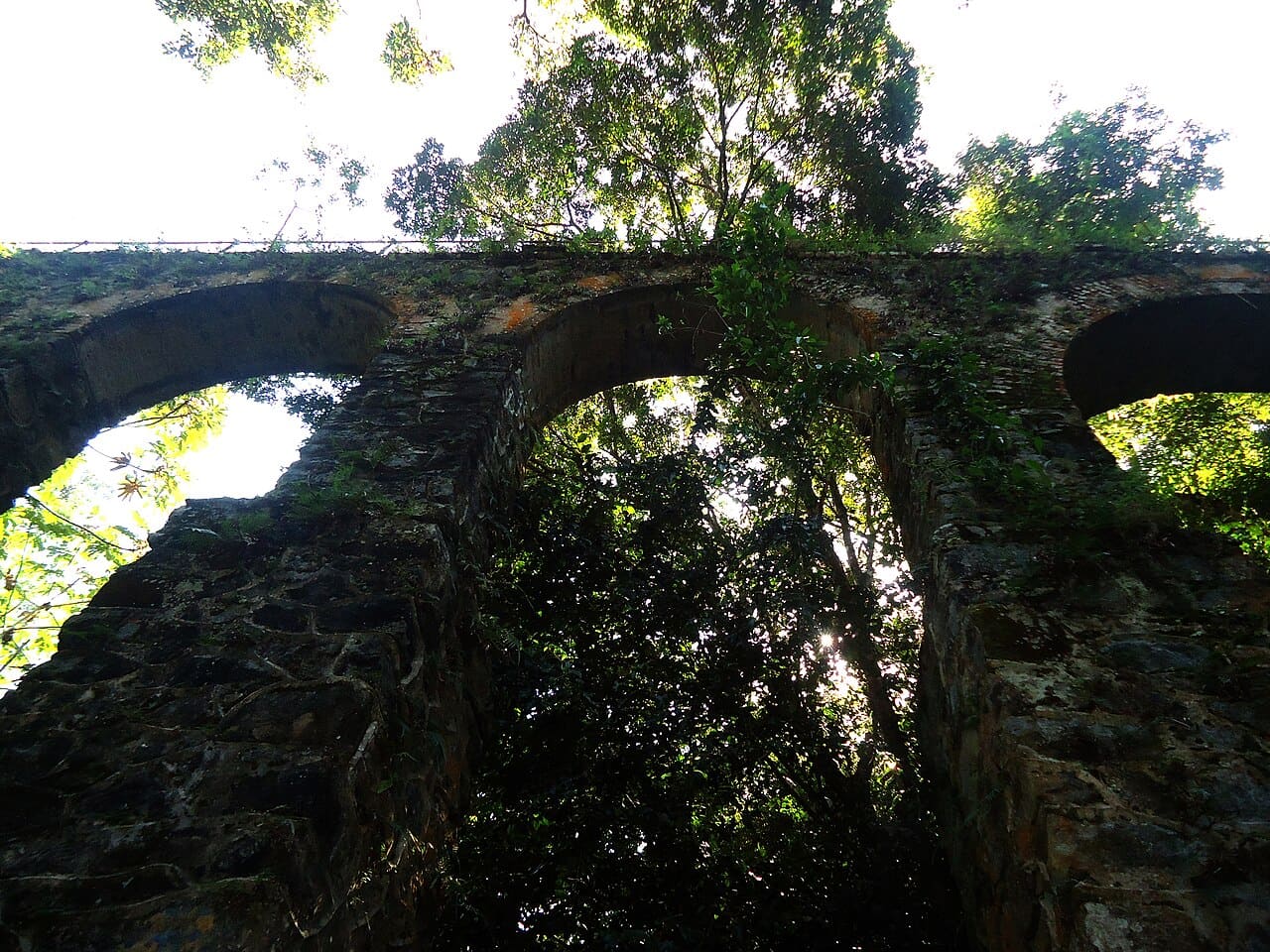 The Lazareto aqueduct, from 1893, the easiest walk out of Abraão. Photo: MBelu, CC BY-SA 4.0, Wikimedia Commons
The beaches that drive the trip
The most famous is Lopes Mendes: 2.5 km of fine pale sand, open sea with surfable waves and not one building on the shore. There are no kiosks, so water and snacks go in the backpack. The access sums up the island’s logic: taxi boat from Abraão to Praia do Pouso, then a 20 minute trail over the hill. The day trip schooners unload everyone there between late morning and mid afternoon; early in the morning, the beach belongs to whoever slept nearby.
Around Abraão, the east coast trail links Palmas and Pouso, village beaches with caiçara bars and coarse sand. In the opposite direction, Feiticeira has a waterfall that tumbles down near the sand. Farther out, Caxadaço is a fold of rocks with deep, transparent water that looks tiny on the map and enormous in your memory. And on the ocean side, Parnaioca keeps the ruins of a village that emptied out in the prison era. Saco do Céu, meanwhile, is a cove so enclosed the sea turns to mirror, where boats stop for a fish lunch and, on moonless nights, to watch the stars reflected in the still water. The full ranking, with how to reach each one, is in most beautiful beaches of Ilha Grande.
Lagoa Azul, Lagoa Verde and snorkeling
The island’s two most famous “lagoons” are not lagoons: they are sheltered patches of sea between islets and rocky shores, shallow and clear as a pool. Lagoa Azul, to the north, has a sandy bottom that turns the water turquoise and schools of sergeant majors that surround anyone who gets in. Lagoa Verde, tight against the west coast, is smaller and quieter, emerald toned, with visibility that tops 5 meters on a good day. Both can only be reached by boat, which makes them the best selling speedboat trip out of Abraão.
We compared the two, with the hours when each one empties out, in Lagoa Azul or Lagoa Verde. And if mask and snorkel are your thing, the map of the best spots is in snorkeling spots in Ilha Grande.
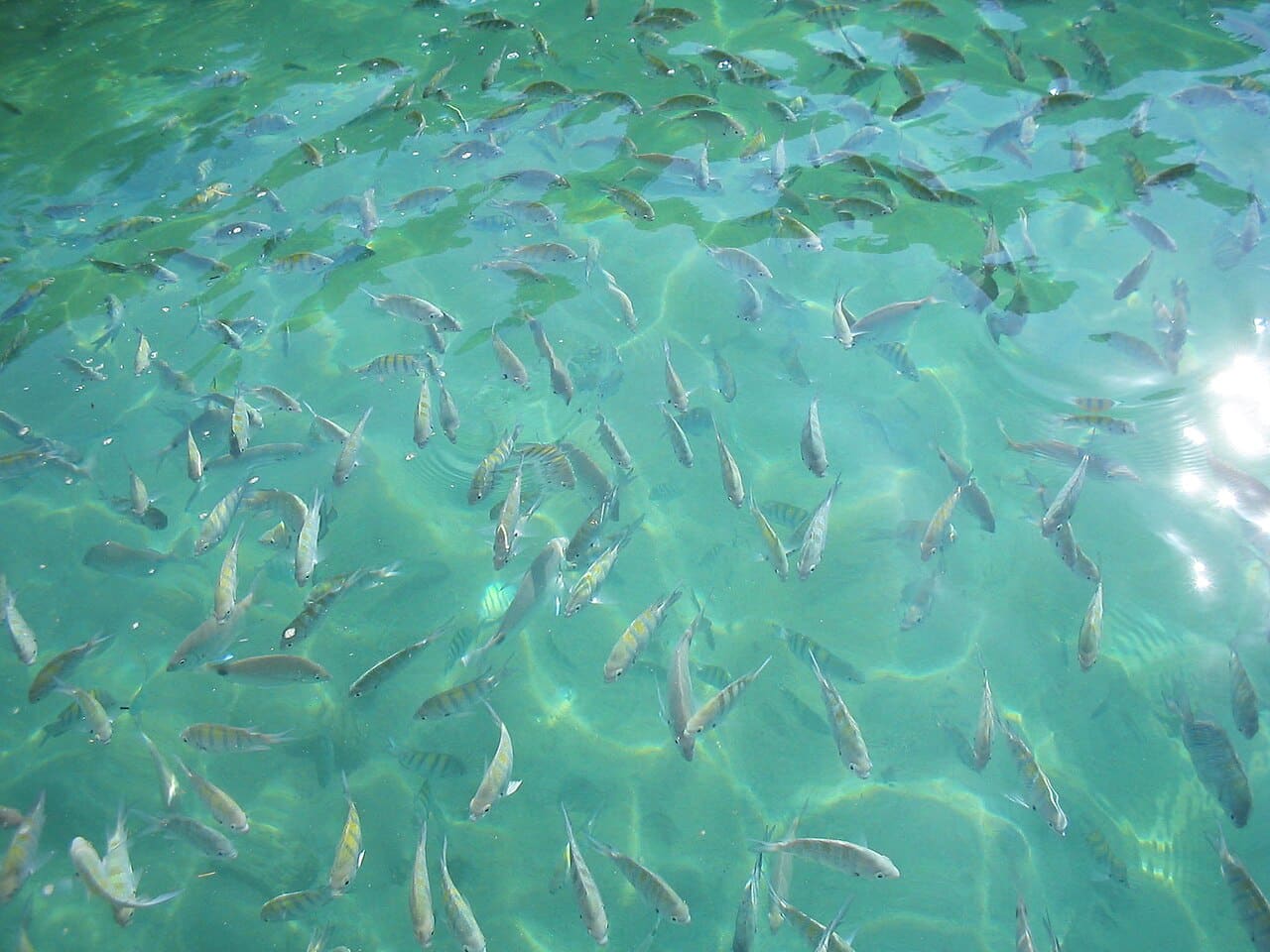 A school of fish in Lagoa Verde: the clear water makes snorkeling rewarding even for first timers. Photo: Ronaldo Leonardo, CC BY-SA 3.0, Wikimedia Commons
The numbered trails, T1 to T16
The state park signposted 16 official trails, numbered T1 to T16, and that network is the island’s true road system. The most used:
| Trail | Route | Distance | Time | Effort |
|---|---|---|---|---|
| T1 | Abraão circuit (Lazareto, aqueduct, Praia Preta) | 1.8 km | 1h | easy |
| T10 | Abraão to Pouso, via Palmas and Mangues | 6 km | 3h | moderate |
| T11 | Pouso to Lopes Mendes | 1.1 km | 20 to 50 min | easy, with a climb |
| T13 | Abraão to Pico do Papagaio | 6 km (one way) | 3h30 | hard, guide required |
| T14 | Abraão to Dois Rios | 8 km (one way) | 3h | moderate to hard |
| T15 | Dois Rios to Caxadaço | 4.2 km | 2h30 | hard |
Two rules from people who have watched a rescue on the T10: start early, because the forest gets dark before the clock does, and do not count on your phone, because the signal dies at the first bend. Sneakers work, flip flops do not. Repellent is backpack equipment, not fussiness. The trail by trail breakdown, with water points and honorable bail-out points, is in Ilha Grande hiking trails.
Pico do Papagaio, the 982 meter sunrise
The crooked rock that gives the peak its name shows from almost any point in the bay, and climbing it has its own liturgy: departure in the small hours, around 3 am, with an accredited guide (a park requirement), to reach the 982 meters before sunrise. From up there, the whole Ilha Grande bay lights up little by little, with Abraão’s lights switching off below.
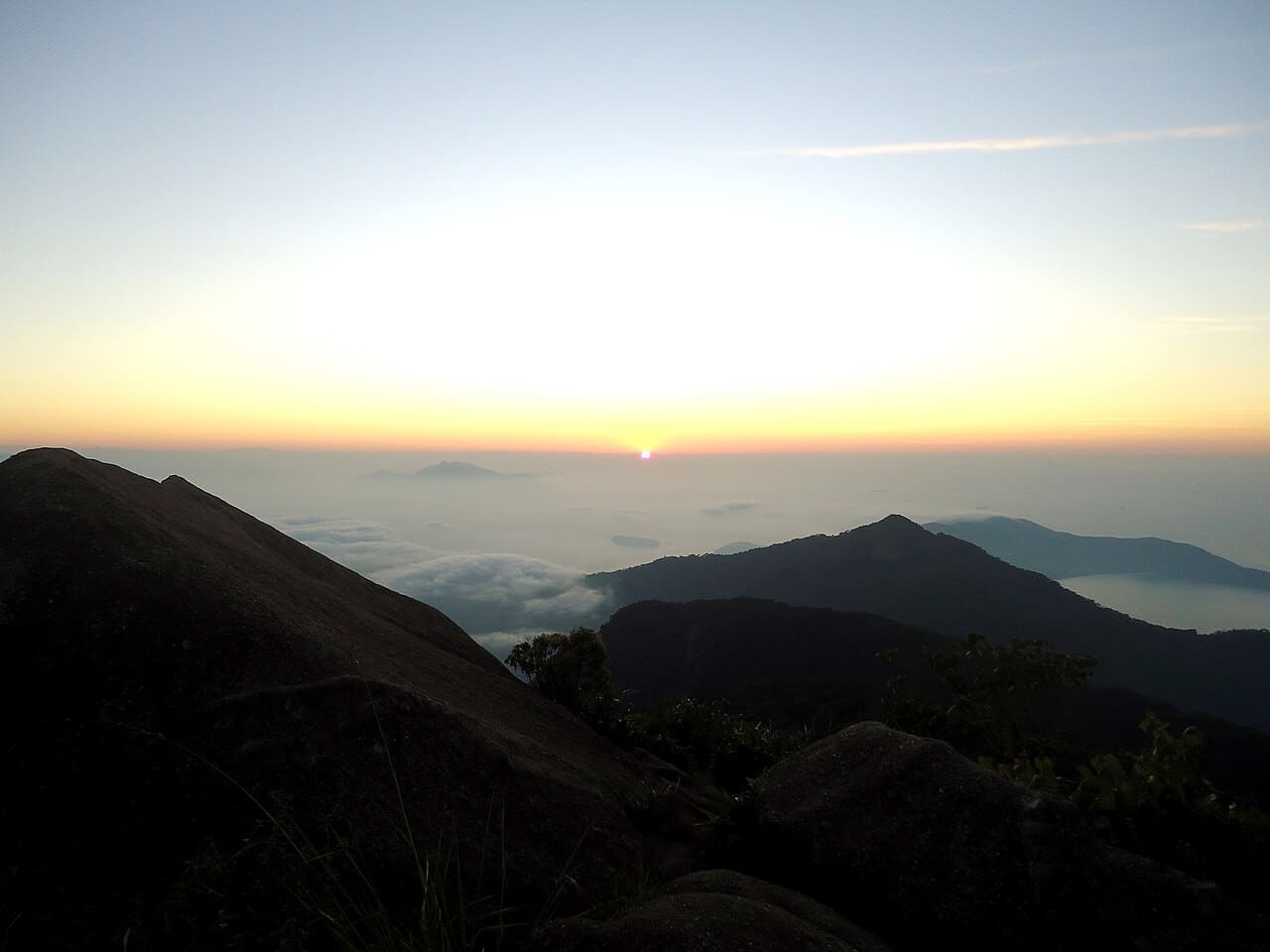 Dawn seen from Pico do Papagaio, 982 meters above the bay. Photo: MBelu, CC BY-SA 4.0, Wikimedia Commons
Honesty from people who operate on the island: Papagaio sits outside our expedition’s route, which is all sea and beach. The way to do it is to sleep in Abraão and arrange a local guide the evening before, on the village’s main street.
Dois Rios, the beach with a prison museum
On the other side of the mountain, the village of Dois Rios housed the Cândido Mendes Penal Institute from 1903 to 1994, the prison that locked up everyone from political prisoners to gang founders and was demolished in April 1994. In the buildings that survived, the Museu do Cárcere, a prison museum, has operated since 2009, maintained by UERJ, the state university, which also keeps a research center in the village. The beach in front, squeezed between the mouths of the two rivers that name the place, tends to hold half a dozen people on a sunny Saturday.
It also sits outside the expedition’s route. The reliable way in is on foot along the T14, 8 km of climbing and descending from Abraão, returning the same way. We tell the full story in Dois Rios beach.
Aventureiro, the wild end with rules
On the ocean coast, the village of Aventureiro has about 100 residents and a leaning coconut palm that became a symbol of the island. The place is a sustainable development reserve: visits are capped at 560 people per day, and overnight stays require a free permit issued by Angra’s tourism office, which records your return date and hands you a wristband. You sleep at campsites in the locals’ backyards, you eat the fish the owner of the house caught, and the party is the moon.
The expedition does not go there, and it is fair to explain why: Aventureiro asks for time and a good sea. The way in is by boat from Angra (about 1 hour by speedboat, considerably more by trawler) or by combined crossings on the island itself. The step by step for the permit is in Aventureiro beach.
The way we recommend: sleeping on the island from the sea
Most people meet Ilha Grande on a schooner day trip or over two nights in a guesthouse. That works, and this guide serves both. But if the choice were ours (and every week it is), the way to know the island is by sleeping on it from the sea. The 3 night Albatroz expedition boards in Paraty at 6 pm, with the first night docked and free to wander the historic center. The next day you wake up under sail, spend the morning at Lagoa Azul with the chef’s coffee still in hand and the afternoon loose in Vila do Abraão. On the third day, the boat drops you early at Pouso: 20 minutes of trail and Lopes Mendes is nearly empty, hours before the day trip schooners. The afternoon ends at Lagoa Verde, and the return is under sail to the bay of Paraty.
The contrast is the argument: whoever comes on a day trip sees Lagoa Azul shared with twenty speedboats and steps onto Lopes Mendes when the sand already has a line of beach towels. Whoever sleeps aboard gets the same places at the hours when they are nothing but sea. Upcoming departures and onboard videos are on the Albatroz Instagram. And it is worth repeating the earlier honesty: Papagaio, Dois Rios and Aventureiro are not on that route; for those, the chapters above have you covered.
On your own: crossing, time and budget
For anyone going by land and regular boat, the service information: the flexboat from Conceição de Jacareí crosses in 20 to 25 minutes, costs R$ 45 to 150 each way and leaves roughly every hour between 8 am and 5 pm. The ferry from Angra or Mangaratiba costs R$ 20.50 but has very few departures, and the return from Abraão to Angra leaves at 10 in the morning. Full timetables, parking and buses from Rio are in how to get to Ilha Grande.
Two practical warnings that apply to any itinerary: withdraw cash before boarding, because the village signal drops and takes the card machines with it, and book accommodation well ahead for holidays, because the island genuinely sells out, from guesthouses to campsites.
To size your stay, use how many days to stay; to close the spreadsheet, what the trip costs; to pick the month, best time to visit. And because a forest island is a rain island, keep what to do when it rains close too.
If the island is a chapter of a bigger trip, the definitive Costa Verde guide ties the whole region together, and the itinerary for Ilhabela, Paraty and Ilha Grande on one trip shows how to string the three together without backtracking.
Before you step onto the sand
Ilha Grande is that rare place where the map counts for less than the tide. At some point between a trail and a school of fish, you notice the clock has loosened: that is island time taking effect, and it never announces when it starts. The next step is practical: pick your entry point and your number of days in the guides above, and leave the rest to the sea.