
The definitive guide to Brazil's Costa Verde
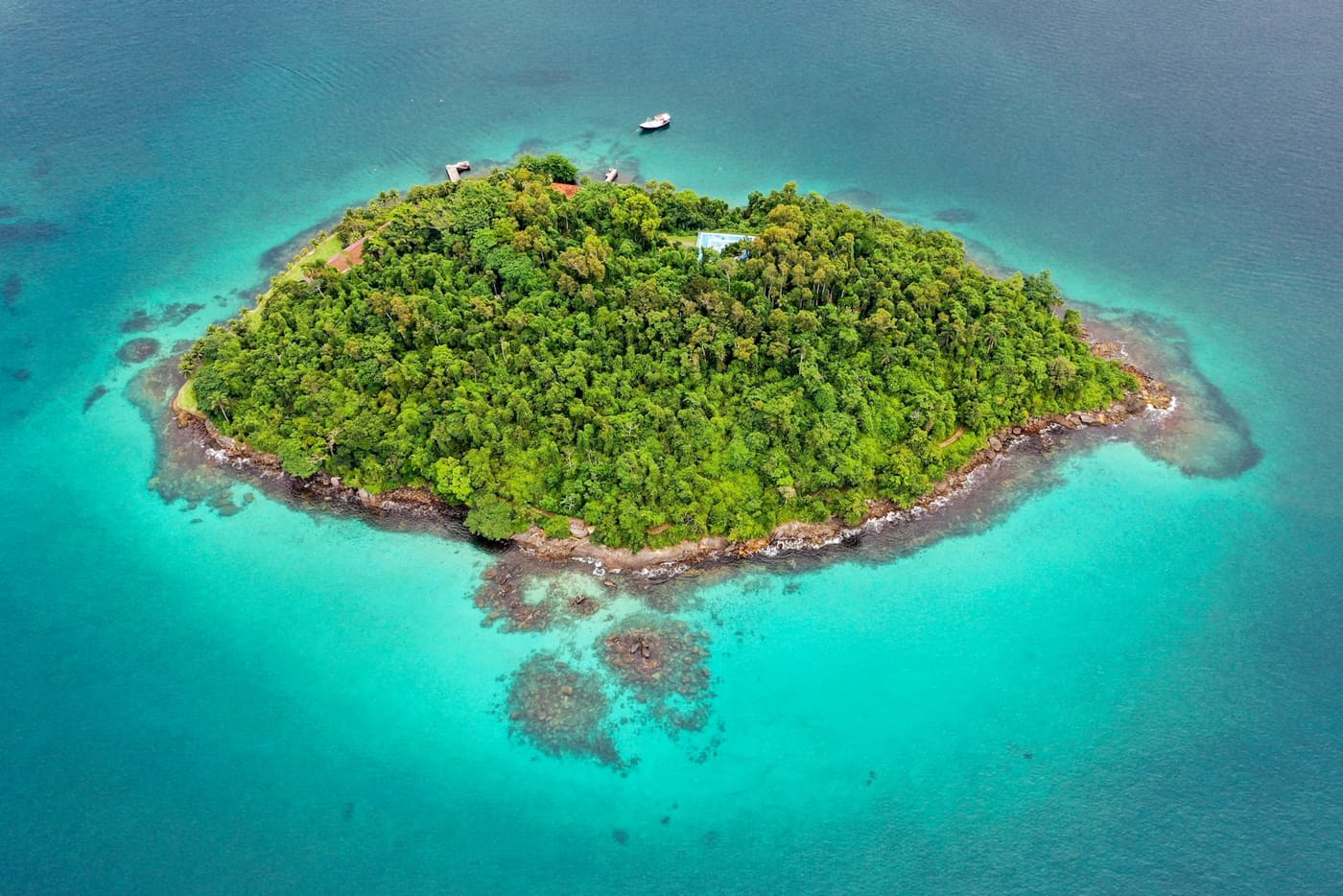
There is a stretch of the Brazilian coast where the Serra do Mar mountain range gives up keeping its distance and walks straight into the water. Rainforest closes over the road, beaches appear between curves, and on the same day you can have breakfast in a 17th century historic town and swim in a natural pool ringed by boulders. That stretch sits between Rio de Janeiro and São Paulo, and it has a name: the Costa Verde, the Green Coast.
We live and work here, so this guide is less a list of pretty places and more what we would tell a friend who asks “where do I even start?”. You will find an honest definition of the region, the destinations one by one, transport with real prices, the right season and route suggestions. Keep this article around: it is the starting point for everything else in our Costa Verde section.
What the Costa Verde actually is
On paper, the Costa Verde is an official region of Rio de Janeiro state, created by law in 2002 and made up of four municipalities: Itaguaí, Mangaratiba, Angra dos Reis and Paraty. That is how the state tourism office and Brazil’s Ministry of Tourism treat it.
In practice, travelers use a bigger map. Anyone driving the Rio-Santos highway (the BR-101) notices that the scenery does not change when Rio de Janeiro state becomes São Paulo state: the mountains stay green, the sea keeps cutting into coves, the caiçara fishing villages keep coming. So most itineraries treat the whole corridor between Mangaratiba (RJ) and São Sebastião (SP) as the Costa Verde, about 294 km of road that also takes in Ubatuba, Maresias and Ilhabela.
That wider reading stopped being a travel blogger’s invention in 2025, when the city governments of Angra dos Reis, Paraty, Ubatuba and Ilhabela jointly launched the Rota Verde Azul, selling the two states as a single destination with around 2,200 beaches between them. This guide uses the full version, because that is the trip worth taking.
The name is not marketing, either. This is continuous Atlantic Forest along one of the best preserved shorelines in the country, including a UNESCO World Heritage site covering Paraty and Ilha Grande since 2019, the first site in Brazil listed for both culture and nature at once.
The destinations, one by one
Paraty
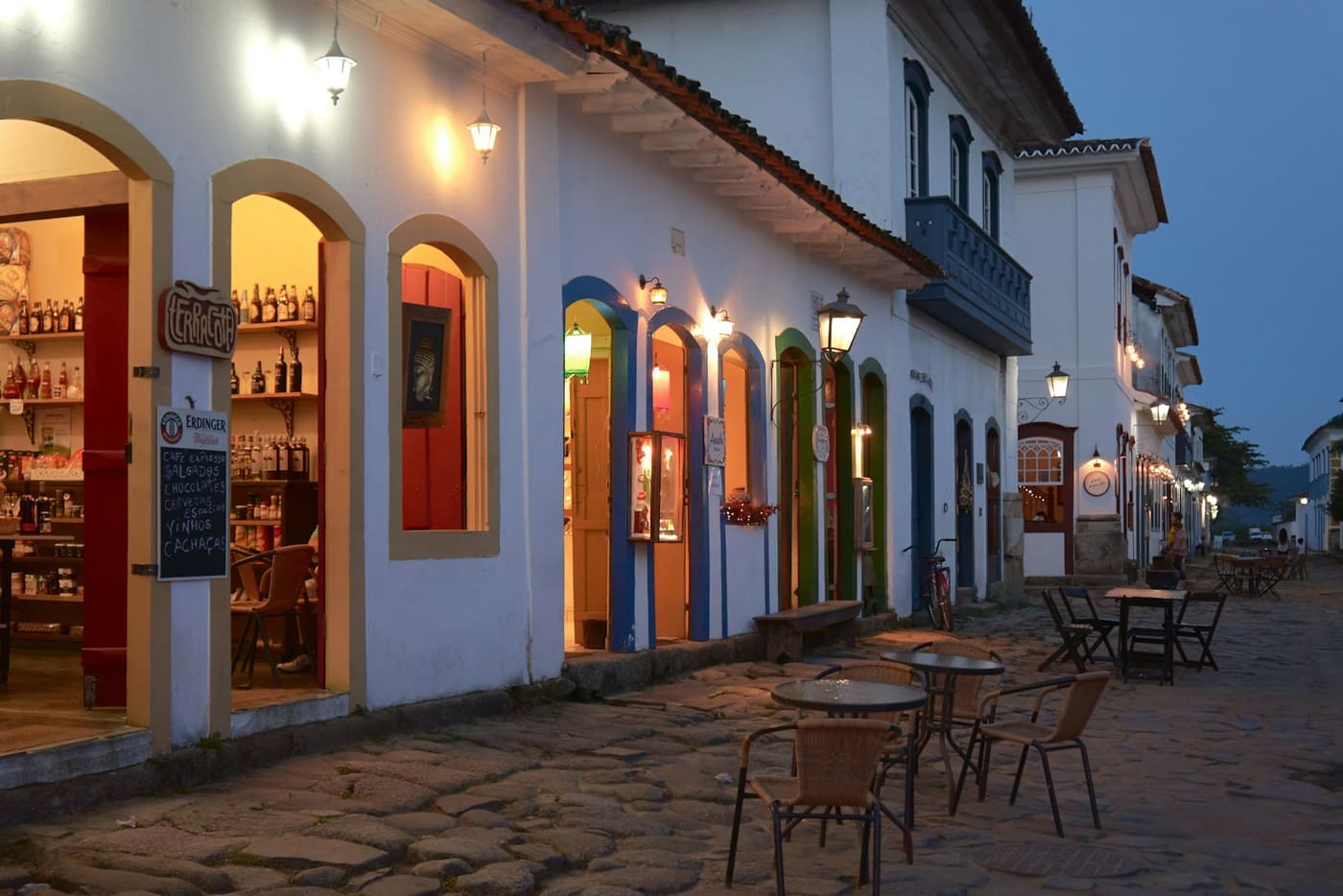 Paraty’s historic center. Photo: Gilberto Olimpio, Unsplash
Paraty was the port where gold from Minas Gerais left for Portugal, and its historic center froze in time in a way few places in Brazil managed. The irregular stone streets (locals call the paving “pé de moleque”, after a lumpy peanut brittle) were designed for the sea to come in: on the big full moon and new moon tides, water floods the lowest streets and drains back out, taking the dirt with it. Watching the tide rise on Rua do Comércio is still one of the best free shows in town.
The municipality has around 60 beaches and 65 islands, and the classic schooner tour leaves the pier every day for about R$ 60 per person. Give it at least two days: one for the historic center and one for the sea. With a third day, Saco do Mamanguá, a tropical fjord of calm water south of town, changes the level of the whole trip. We know the fjord by sleeping in it: the Albatroz, our group’s boat hostel, leaves Paraty on two to five night expeditions and anchors at the foot of Mamanguá’s Sugarloaf peak.
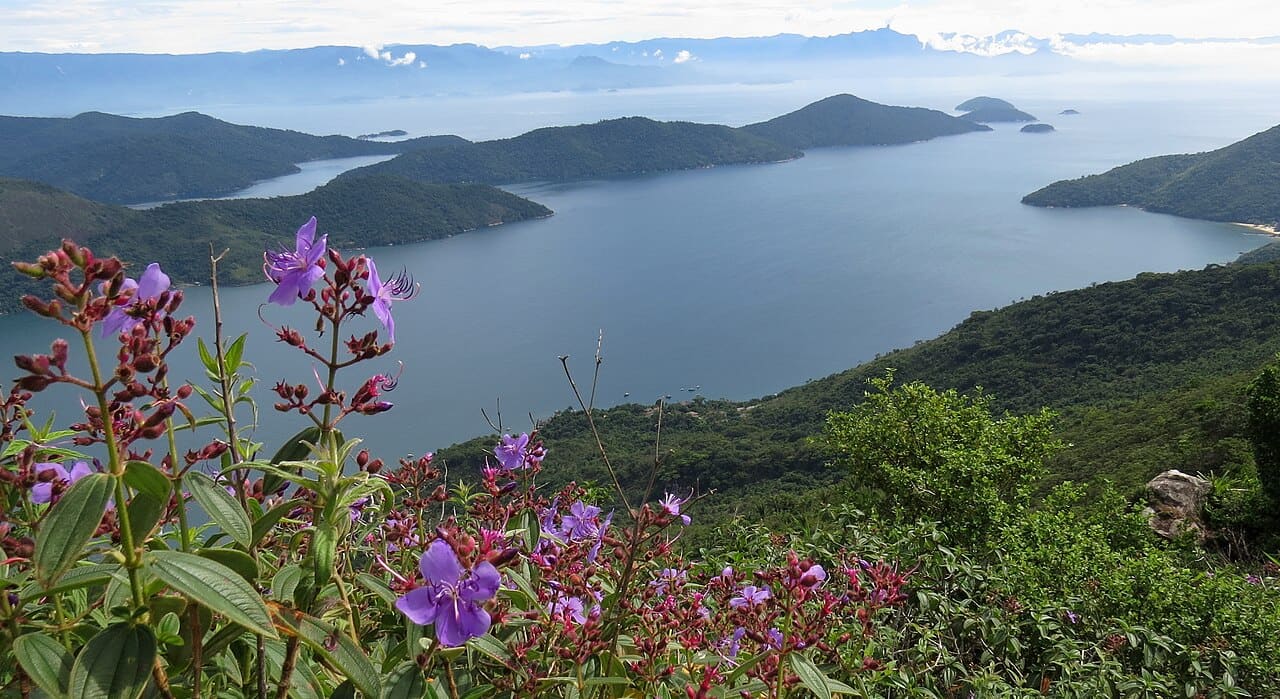 Saco do Mamanguá from the Pão de Açúcar trail. Photo: Pedro Gabriel Maciel, CC BY-SA 3.0, Wikimedia Commons
Trindade
Trindade is a district of Paraty, 27 km south of the center, and works almost as a destination of its own. It is a caiçara village squeezed between Serra da Bocaina National Park and a bay with four beaches plus one natural pool, the Cachadaço, where the water rarely passes your waist and fish swim around your shins. The municipal Colitur bus runs there from Paraty’s station for about R$ 5. On summer holidays, arrive early: the little access road jams solid.
Angra dos Reis and Ilha Grande
Angra is the town of 365 islands (the number is real, and the local marketing people are grateful for the coincidence with the calendar). For travelers it mostly works as a base and a jumping-off point: shared schooner tours around the Lagoa Azul and the Botinas islands cost between R$ 49 and R$ 109 per person, and it is from the ports around here that you cross to the star of the region, Ilha Grande.
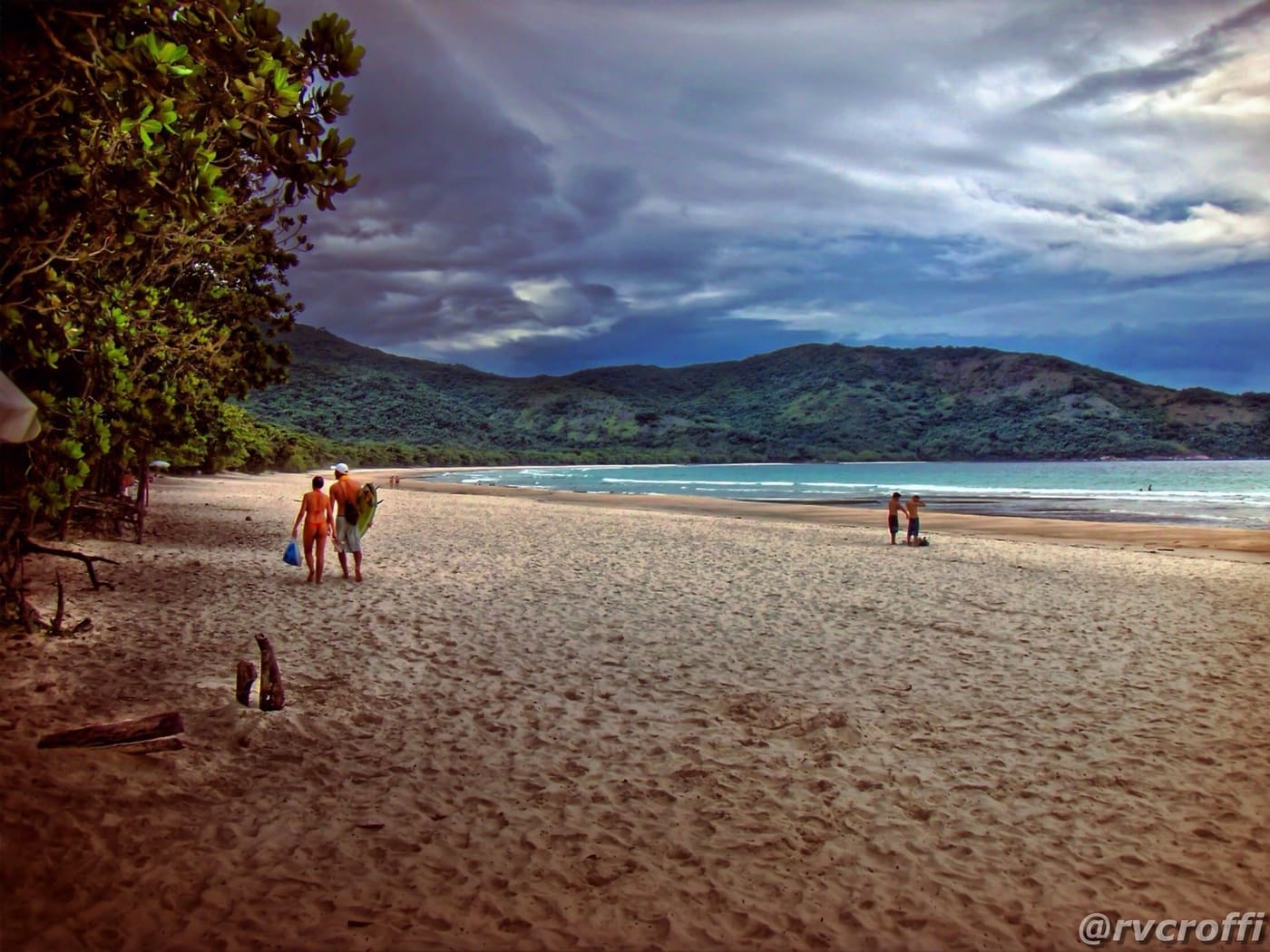 Lopes Mendes beach, Ilha Grande. Photo: Rafael Vianna Croffi, CC BY 2.0, Flickr
Ilha Grande has no cars. None. Everything happens on foot, by boat or by bike, and life is concentrated in Vila do Abraão, a village of dirt streets with about 5,000 residents. From there you reach the trails and the taxi boats to Lopes Mendes, a 2.5 km strip of white sand that keeps showing up on lists of the world’s most beautiful beaches, and to Pico do Papagaio, a steep 982 meter climb with a view over the whole bay.
On how to experience the island, this guide takes a side, and we own it: the way we recommend is from the water, sleeping on it. The three night Albatroz expedition, our group’s schooner, leaves Paraty, spends a morning at Lagoa Azul, an afternoon in Vila do Abraão, and wakes up at the trailhead to Lopes Mendes before the day boats arrive. Brazil’s most famous beach nearly empty, seen from the deck you woke up on, the chef’s coffee still in your hand: no day trip delivers that.
If you would rather go on your own and sleep in the village, here is the service information: the flex boat from Conceição de Jacareí crosses in 20 to 25 minutes and costs R$ 45 to 150 each way, and the ferry from Mangaratiba or Angra costs R$ 20.50 but runs only a few times a day. Check the return before you go: the ferry out of Abraão leaves at 10 in the morning.
Ubatuba
Cross the São Paulo state line and the first municipality is Ubatuba: more than 100 beaches along 106 km of shoreline, the most indented coast in the state. It has been the official “Capital of Surf” under state law since 2007, with national contests running at Itamambuca, and since 1991 it hosts a base of Projeto Tamar, Brazil’s sea turtle conservation project, where you can stand next to turtles of up to 130 kg. The classic boat trip leaves Saco da Ribeira for Ilha Anchieta, a state park island with the ruins of an old prison.
Maresias and São Sebastião
Maresias is the young beach of the Costa Verde: 5 km of open sea with proper waves at Canto do Moreira (the break that raised two-time world champion Gabriel Medina) and a nightlife that exists nowhere else on this coast. São Sebastião, the seat of the municipality, keeps a small colonial center of its own and the ferry landing for Ilhabela. Plenty of people use Maresias as the last stop before heading back to São Paulo city.
Ilhabela
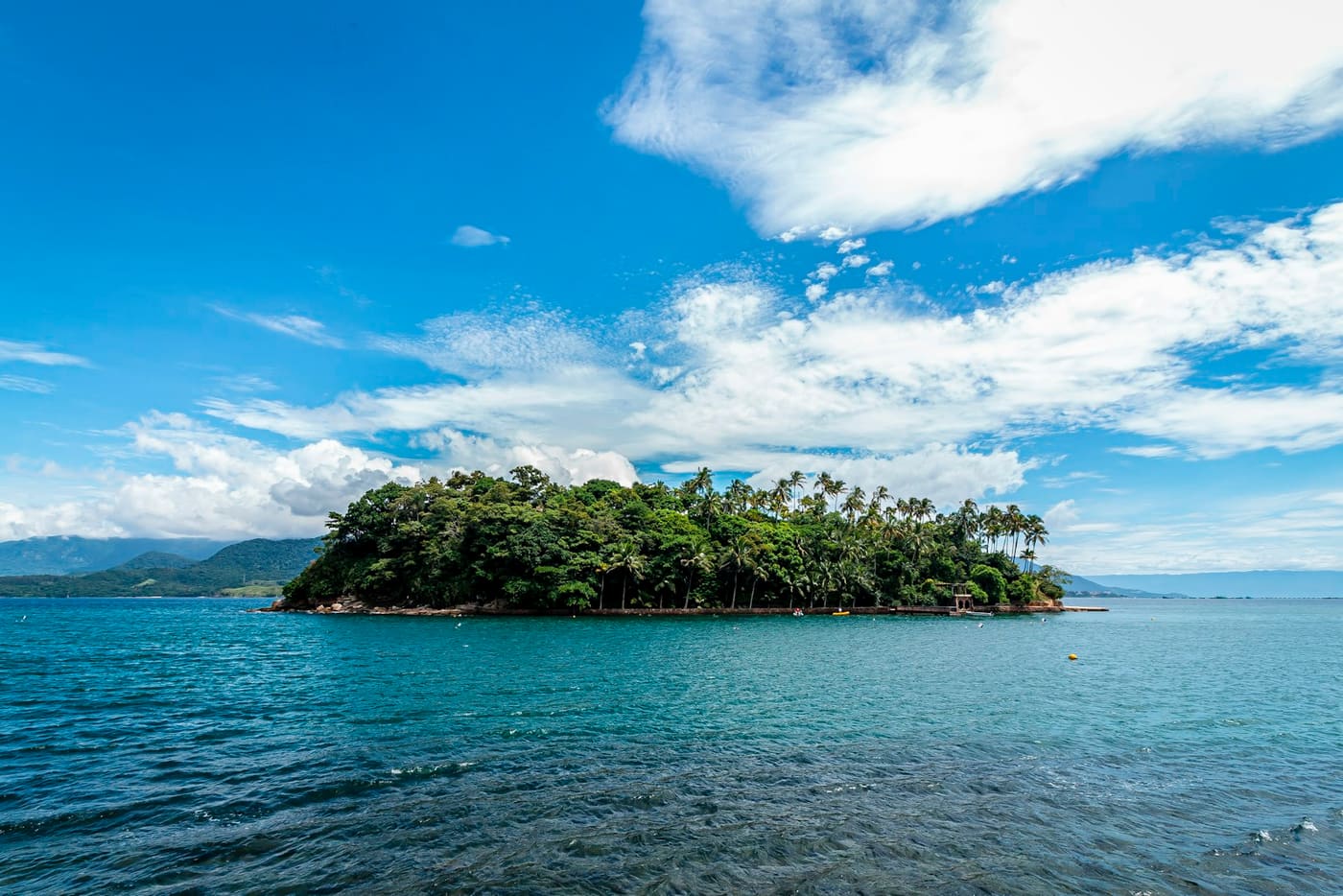 Ilhabela, on the São Sebastião channel. Photo: Marcos Assis, Unsplash
Ilhabela is Brazil’s largest sea island and the only island municipality in São Paulo state. The ferry crossing from São Sebastião takes about 20 minutes and is free for pedestrians and cyclists (a car pays R$ 19 on weekdays and R$ 28.50 on weekends). Most of the territory is a closed state park of Atlantic Forest, which explains the empty beaches, the dozens of waterfalls, and also the borrachudo, the tiny biting fly that has become the island’s unofficial mascot: it only lives where the water is very clean. Bring repellent and take it seriously.
There are more than 40 beaches, from the urbanized side facing the channel to Bonete, a caiçara community of 300 people reachable only by boat or by a 16 km trail, which The Guardian once ranked among the ten most beautiful beaches in Brazil. Between May and August, humpback whales pass through the São Sebastião channel on their way north, and you can sometimes spot them from shore. We keep a full guide of things to do in Ilhabela for anyone giving the island more days.
And it is fair to say where this guide comes from: it is written by the team of Hostel da Vila, an eco lodge in Ilhabela’s historic center, on the channel side of the island, open since 2016. The island is our home, and this blog is our notebook of recommendations.
Getting around
By car the logic is simple: the Rio-Santos highway (BR-101/SP-055) threads every destination together. It is a beautiful, slow road, single lane most of the way. Leaving Rio, Angra is about 2h30 away and Paraty about 4h. Leaving São Paulo, Ilhabela and Ubatuba are around 4h (via the Tamoios highway) and Paraty 5h or more. On holidays those times double without apology; we have watched the Rio-Santos sit still for hours on a July Sunday.
Without a car it works, and works well. The lines that matter:
| Leg | Company | Approx. price | Time |
|---|---|---|---|
| Rio → Angra | Costa Verde | R$ 53 to 117 | 3h to 3h30 |
| Rio → Paraty | Costa Verde | from R$ 120 | 4h30 |
| Angra ↔ Paraty | Colitur (L101) | R$ 27.50 | 2h |
| Paraty → Trindade | Colitur local | R$ 5 | 40 min |
| São Paulo → Ubatuba | Pássaro Marron | R$ 126 to 142 | 4h |
| São Paulo → Ilhabela | Pássaro Marron | R$ 101 to 123 | 4h30 + ferry |
The weak link of a car-free trip is the Paraty ↔ Ubatuba leg, which has few bus departures per day. If you are connecting the two states, plan that jump in advance. We explain the connections, apps and timetables in our guide to the Costa Verde without a car.
When to go
The best months are April, May, September and October: less rain, lower prices, emptier beaches. Summer is the famous season and the treacherous one, because it rains hard (January in Paraty can top 500 mm) and everything costs more.
Winter is the region’s badly kept secret. From May to August the sea gets clearer, the trails dry out and humpback whales cruise past the São Paulo north shore, with sightings peaking in June and July. During the season, the whale watching departures we run in Ilhabela are listed at baleias.hosteldavila.com.br. July 2026 stacks two big events: FLIP, Paraty’s international literary festival, July 22 to 26 (the town fills up and prices jump that week), and the 53rd Ilhabela Sailing Week, July 24 to August 1, with more than 100 boats on the water. If you want quiet, avoid those dates; if you want a party, aim for them. The month by month breakdown is in our guide to the best time to visit the Costa Verde.
What it costs
It depends less on the destination and more on your style. An honest 2026 reference: a hostel bed on Ilha Grande runs from R$ 46 to R$ 165 a night, and the pattern repeats in Paraty and Ilhabela. Mid-range guesthouses start around R$ 200. Shared boat tours sit between R$ 49 and R$ 109 in Angra and around R$ 60 in Paraty. Adding transport, a hostel bed, simple food and one boat trip per stop, you can do the whole Costa Verde on roughly R$ 150 to 250 a day. We did the full math, with three budget profiles, in how much a Costa Verde trip costs.
How many days, and in what order
A week is the minimum to do the whole corridor without suffering. The shape we recommend for anyone arriving through Rio: Angra or Mangaratiba on day 1, two nights on Ilha Grande, two in Paraty (with half a day in Trindade), one in Ubatuba and the finish in Ilhabela, leaving through São Paulo. It works just as well in reverse. That plan is broken down day by day in our 7 day Costa Verde itinerary.
With ten days, Ilha Grande gets room to breathe and Trindade becomes an overnight stop (10 day itinerary). With fifteen, you can add Mamanguá, Bonete and still have a hammock day left over (15 day itinerary). And if your question is the more basic “I can’t see everything, what do I pick?”, we wrote a straight comparison answering Ilhabela or Ilha Grande and a guide to seeing Ilhabela, Paraty and Ilha Grande on one trip.
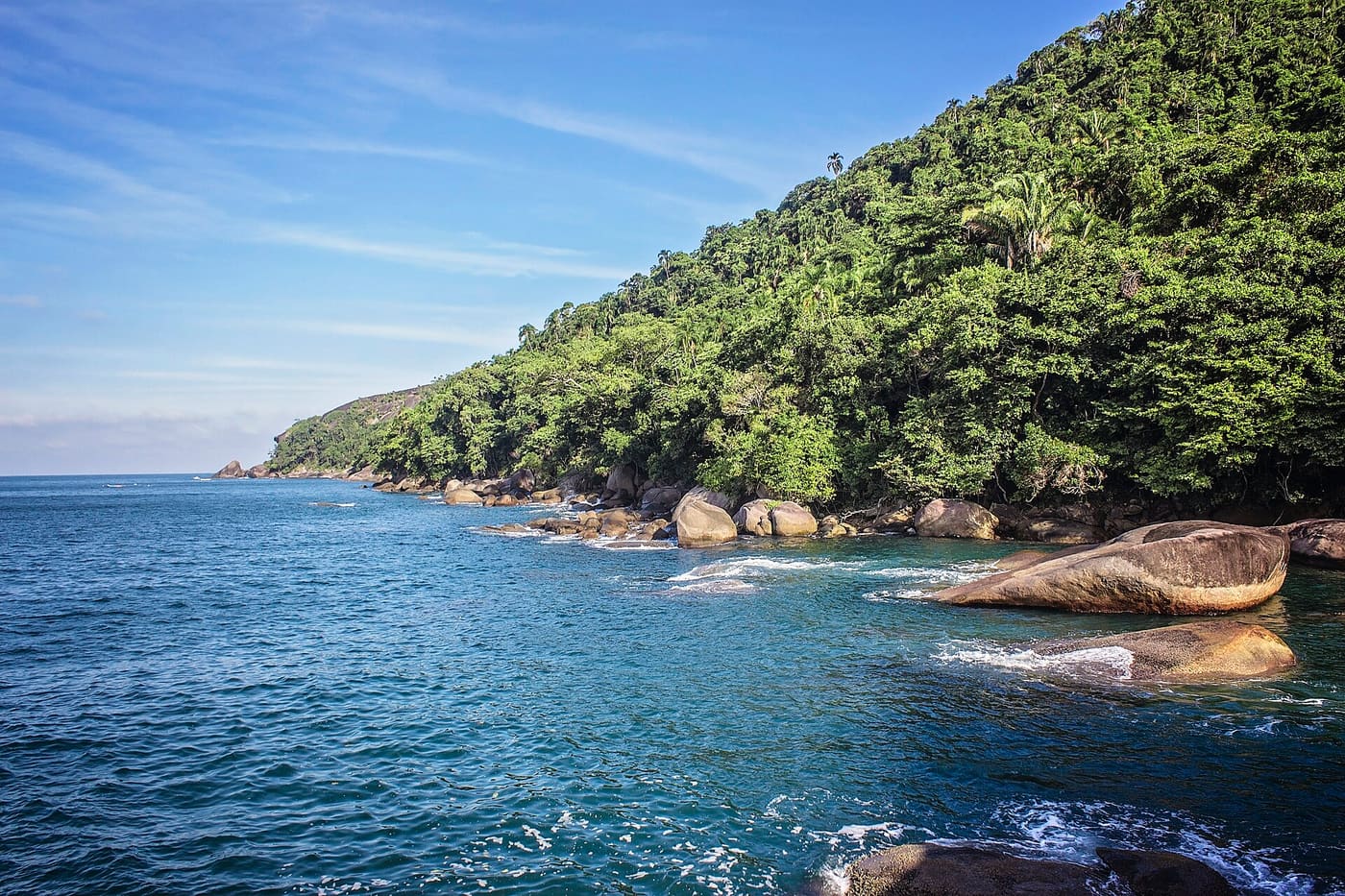 Cachadaço beach, Trindade. Photo: Eduardo Gabão, CC BY-SA 3.0, Wikimedia Commons
Before you pack
Three warnings from people who live here. First: book your bed before arriving on Brazilian holidays and in July, because the region is small and genuinely sells out. Second: carry cash for villages like Trindade, Bonete and parts of Ilha Grande, where the phone signal fails and the card machines depend on it. Third: the weather turns fast at the foot of the mountains; a rainy day is not a lost day, it is a historic center day in Paraty, a full waterfall day in Ilhabela, or a long lunch looking at the sea.
The rest of this guide unfolds across the articles in our Costa Verde section. Start with the itinerary that fits your days and go deep on the stops that stay on your list. The road does the rest.