
Ilhabela or Ilha Grande?
This is the question that shows up most often in our inbox, and we may be the only blog on this coast licensed to answer it from both sides: the people writing this live in Ilhabela, where our group’s hostel has welcomed travelers in the historic center since 2016, and work in the waters of Ilha Grande, where our group’s schooner drops anchor every week. The bias exists and we own it. The lucky part is that it pulls in both directions at once, which in practice becomes balance.
The two islands are close relatives: Atlantic Forest giants on the same stretch of coast, both almost entirely protected, both without an airport, both capable of carrying a week of travel on their own. Ilhabela is Brazil’s largest sea island and the only archipelago municipality in São Paulo state. Ilha Grande covers 193 km² without a single car and has been a UNESCO World Heritage site since 2019. From there, they part ways.
The quick answer
A technical tie, decided by your profile. Ilha Grande is the wilder experience: no cars anywhere on the island, trails as the road network, a dirt-street village where the phone signal drops and nobody complains. Ilhabela is the island with infrastructure: a real town on one side of the channel, a closed state park on the other, and a ferry that crosses in 20 minutes and charges nothing if you walk on. If your trip is about switching off from the world, Ilha Grande. If it is about raw nature by day and a good bed, a restaurant and some nightlife after dark, Ilhabela. And there is a third answer, outside the box, that we are saving for the end.
The duel, criterion by criterion
Beaches
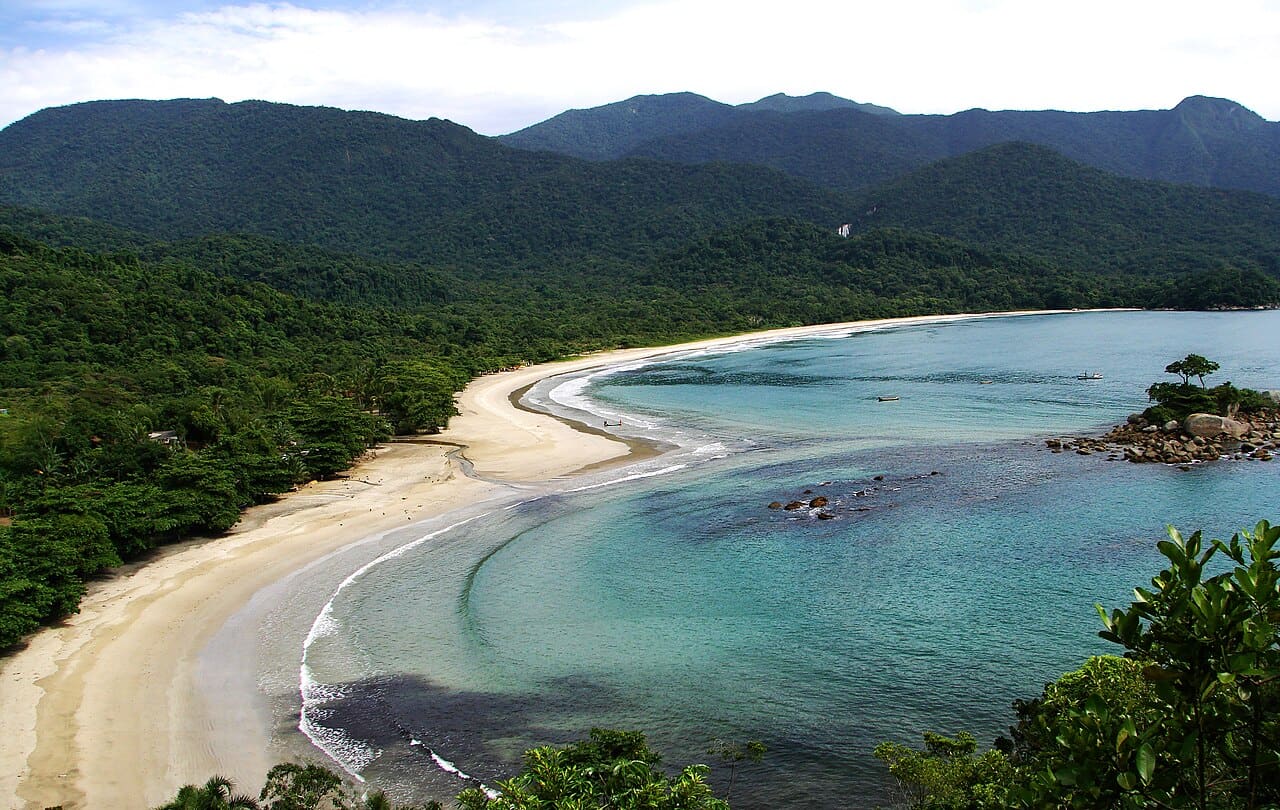
Ilha Grande plays its ace: Lopes Mendes, 2.5 km of pale sand, open sea and not one building on the shore, reached by taxi boat and a 20 minute trail. Behind it come Lagoa Azul and Lagoa Verde, sheltered patches of sea as clear as a pool, and more than a hundred beaches and coves where almost none has a road.
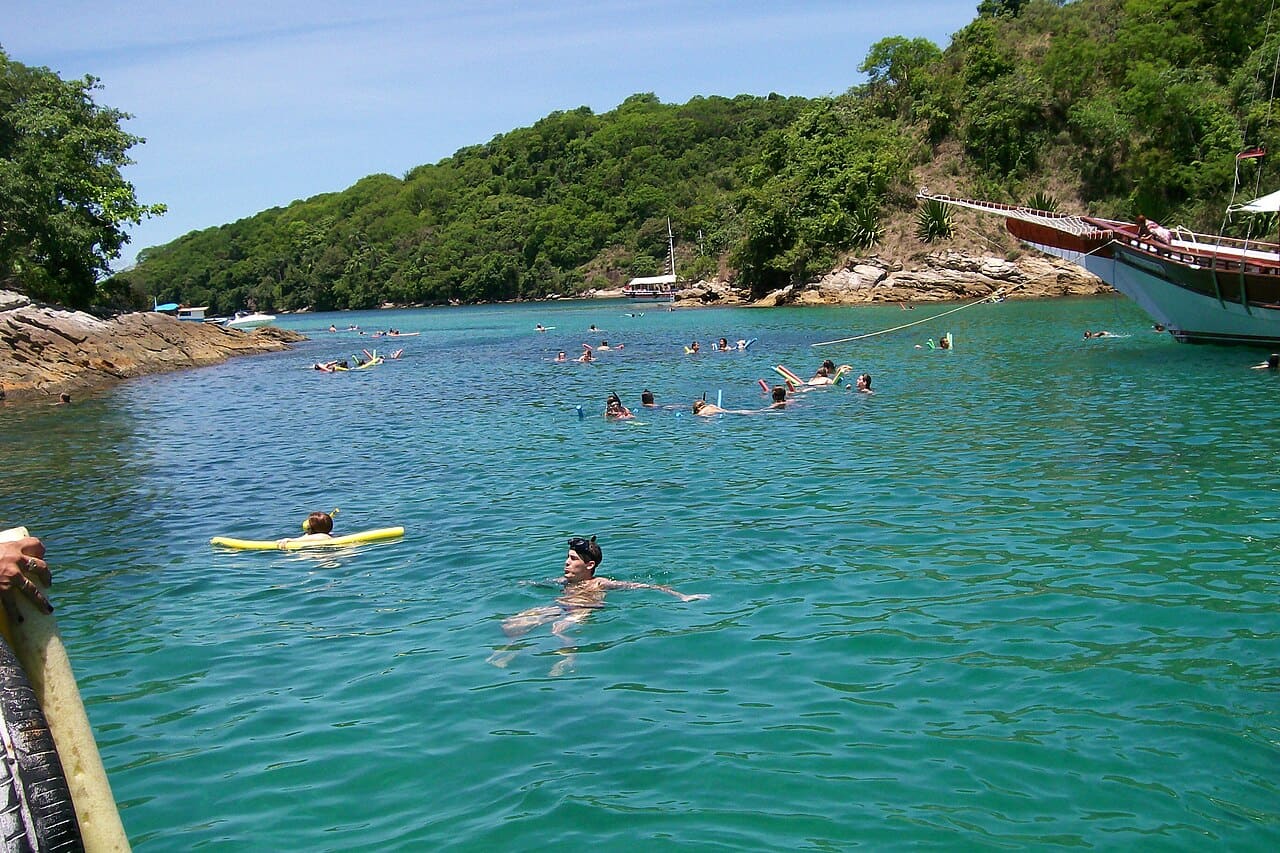 Lagoa Azul, Ilha Grande: shallow, clear sea between islets. Photo: Marcio Sette, CC BY-SA 3.0, Wikimedia Commons
Ilhabela answers with 42 beaches listed by the city, and here is the resident’s honesty: the channel beaches are everyday beaches, calm and practical, not the postcard kind. The cinematic ones sit on the ocean side and have to be earned: Castelhanos, the heart-shaped bay at the end of 17 km of dirt road, and Bonete, which The Guardian once ranked among the ten most beautiful beaches in Brazil, after a 16 km trail or a speedboat leg. The full ranking is in the most beautiful beaches in Ilhabela.
Winner: Ilha Grande, by a small margin. On the pure beach yardstick (sand, water, scenery with nothing in the way), its open sea wins. Ilhabela fights back with beach and waterfall in the same day, but its best beaches demand a 4x4, a boat or your legs.
Trails
On Ilha Grande, the network of 16 numbered trails, T1 through T16, is the actual road system: you walk to get places, not just for the view. The high point is Pico do Papagaio, 982 meters climbed before dawn with an accredited guide to watch the day break over the entire bay.
In Ilhabela, the signature trail is Pico do Baepi, 1,048 meters with a monitor and advance booking, a genuine 7 to 8 km effort with the whole channel as the prize. But the island holds a card its neighbor cannot match: the Água Branca trail is self-guided, free and ends at five natural river pools, and the best hikes in Ilhabela almost always finish in fresh water.
Winner: tie. On Ilha Grande, walking is the very way you live the island; in Ilhabela it ends at a waterfall. If you travel in hiking boots, you cannot go wrong with either.
Infrastructure
Ilhabela is a working municipality: supermarkets, pharmacies, a municipal bus at R$ 10, lodging from dorm bed to hotel, food from set-menu lunch counters to chef-run restaurants, and the Vila with its promenade, the church at the top of the staircase and live music at night. Ilha Grande concentrates everything in Vila do Abraão, a village of 5,000 residents with three or four dirt streets, luggage traveling by wheelbarrow and card machines that go down along with the signal.
Winner: Ilhabela, comfortably. With the honest caveat that, for many people, the lack of infrastructure is exactly what Ilha Grande is selling. If “wheelbarrow instead of taxi” sounded charming to you, flip this score.
Cost
2026 numbers, from our budget guides. On Ilha Grande, a backpacker day closes between R$ 180 and 260, with hostel beds from R$ 46 to 165 and the crossing weighing on the total: flex boat at R$ 45 to 150 per leg, or the R$ 20.50 ferry with a single departure per day. Everything consumed there arrived by boat, and the prices remember it. In Ilhabela, a backpacker day runs between R$ 130 and 240, with hostels from around R$ 57 in low season, set-menu lunches at R$ 30 to 35 and a free ferry for pedestrians. The full spreadsheets are in Ilha Grande travel costs and Ilhabela travel costs.
Winner: Ilhabela, especially for anyone traveling without a car: the free walk-on ferry has no equivalent on the other side.
Access
From São Paulo, Ilhabela takes one move: a bus for R$ 101 to 123 to São Sebastião, 4h30, then the ferry across the channel in 20 minutes, free on foot, running 24 hours. From Rio, the logic favors the other island: a bus for R$ 53 to 117 to the piers at Conceição de Jacareí or Angra, then a 20 to 25 minute flex boat, operating from 8 am to 5 pm. The detail that matters: heavy swell from a cold front cancels the flex boats; the Ilhabela ferry almost never stops. The details live in where is Ilhabela and how to get there and how to get to Ilha Grande.
Winner: depends on your starting city. From São Paulo, Ilhabela runs away with it. From Rio, Ilha Grande is closer. On predictability, Ilhabela wins every time.
Who each one is for
Ilha Grande is for anyone who wants to vanish from the map for a few days, is fine with a soft backpack and dirt streets, treats hiking as the main event and dreams of a beach without a single kiosk. It is also the natural choice for anyone already in Rio de Janeiro.
Ilhabela is for anyone who wants raw nature by day and infrastructure at night, travels without a car and needs simple logistics, mixes profiles in the same group (someone wants a trail, someone wants a beach kiosk) or visits the coast between May and August, when humpback whales cross the channel.
The summary table
| Criterion | Winner | Margin |
|---|---|---|
| Beaches | Ilha Grande | narrow |
| Trails | tie | each in its own style |
| Infrastructure | Ilhabela | wide |
| Cost | Ilhabela | medium |
| Access | depends on origin | SP: Ilhabela; Rio: Ilha Grande |
| End-of-the-world feeling | Ilha Grande | wide |
How we would do each one
Picked Ilhabela? The base we recommend is our own house, said with the usual transparency: Hostel da Vila sits in the historic center, on the channel side, a few minutes from the ferry, with 8,000 m² of forest climbing behind the property, a pool heated to 32°C all year and rooms like the dome with the sea framed in its window. From there, the channel axis works on foot and by bus, and the complete island guide organizes your days.
Picked Ilha Grande? The way we recommend is to sleep on it from the water: the 3 night Albatroz expedition leaves Paraty from R$ 1,491 in 2026, with a chef on board, spends the morning at Lagoa Azul before the day boats arrive and drops you early at Pouso, with Lopes Mendes nearly empty on the other side of the trail. Upcoming departures are on the Albatroz Instagram.
And the answer outside the box, the one we give when the traveler has time: why choose? The geography works in your favor. The expedition touches one island, and the ferry delivers you to the other: both destinations hang on the same Rio-Santos corridor, and you can string them together with no backtracking.
The verdict
If you have a single window and need to commit: total-disconnection trip, Ilha Grande; nature trip with comfort and easy logistics, Ilhabela. Neither is the downgraded version of the other, which is why we, who live off both, have never managed to settle the tie for good.
The next step is a single one: count your nights. If six or more fit, open the itinerary for Ilhabela, Paraty and Ilha Grande on one trip and stop choosing.