
Things to do in Ilhabela: the guide from people who live on the island
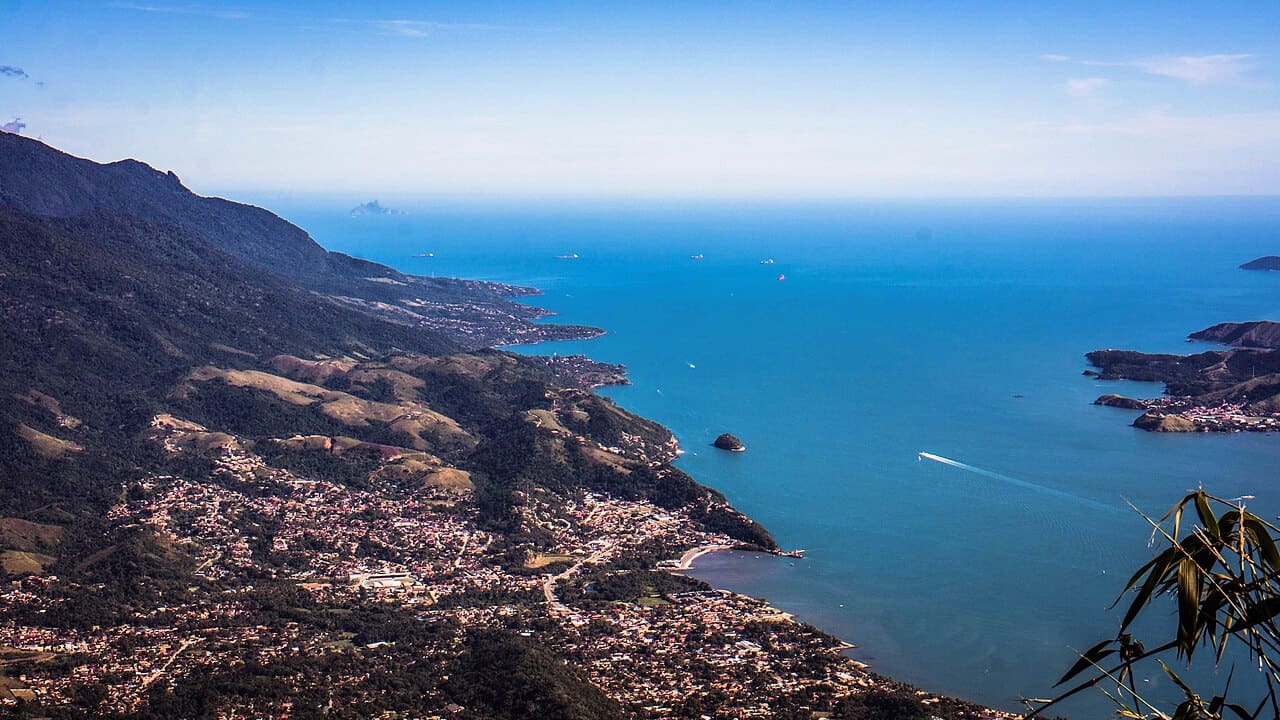
This guide is different from the others we write for a simple reason: Ilhabela is where this blog lives. It is signed by the team of Hostel da Vila, an eco lodge in the historic center, on the channel side, hosting travelers since 2016. Over ten years, 65,000 guests have asked the same question on arrival: “what can’t I miss here?”. This article is the long answer, the one we give when there is time and a coffee in hand.
The short answer would be: it depends on how many days you have and how much sweat you are willing to put in. Ilhabela is Brazil’s largest sea island and the only archipelago municipality in the state of São Paulo, and most of the territory is a closed state park of Atlantic Forest. That means the island has two modes: the channel side, urbanized, with calm beaches and restaurants, and the rest, which you only reach by boat, by 4x4 or on your own legs. Both are worth it. The trick is to combine them.
Before the list itself, two local warnings. First: the borrachudo is real. It is the tiny biting fly that became the island’s unofficial mascot, and it only lives where the water is very clean. Bring repellent and reapply. Second: long holiday weekends genuinely fill the island up, with ferry lines that pass two hours. If you can choose, come outside them (or embrace the party, which is also a way to live the island).
The channel beaches: the ones you reach on foot or by bus
The side facing the mainland concentrates the island’s life. The city government lists 42 beaches in the archipelago, and a good share of the most accessible ones are here, threaded together by the avenue that runs along the channel. The municipal bus covers this axis for R$ 10 full fare (2026 price), which makes this strip the natural territory for anyone who came without a car.
Near the center, Itaguaçu, Itaquanduba and Saco da Capela are calm-water beaches, good at the end of the day. Heading south, Feiticeira and Praia Grande have more structure, and Curral is summer’s meeting point, with kiosks, music and a gentle sea. Perequê, long and windy, sits right next to the ferry and is where many people see the island for the first time. None of them is the most beautiful beach in the archipelago, and it is honest to say so: these are beaches of convenience and of company, with the channel sending boats past in the background. The truly cinematic ones require some travel, and we ranked them all in our guide to the most beautiful beaches in Ilhabela.
The right way to use this side is to treat it as a neighborhood, not an attraction. Early in the morning the channel wakes up flat and becomes a lane for SUP and canoe paddling; at midday the kiosks take over the shift; and at the end of the afternoon comes the island’s daily ritual, when the sun drops behind the Serra do Mar and the water changes color in minutes. Our team stops whatever it is doing to watch, and after ten years nobody has tired of it.
The northern beaches: dirt road and lighthouse
The north is the region that people in a hurry skip, which is exactly why it keeps the emptiest beaches you can reach by land. Armação, next to the lighthouse at Ponta das Canas, has 200 meters of sand, trees at the water’s edge and the constant wind that turned it into the island’s kitesurfing spot. From there the asphalt ends: it is about 8 km of dirt road to Jabaquara, 22.5 km from the ferry, and a regular car makes it with care. The reward is a wide cove with fish kiosks and water that changes color with the passing clouds.
On the way, Pacuíba asks for a short trail of about 200 meters through the forest and has no kiosk at all, which already filters the crowd. And beyond Jabaquara there is Praia da Fome, reachable only by sea or by a 1h40 trail: the name (“hunger beach”) comes from the era when slave ships anchored there, and that heavy history coexists with some of the clearest water on the island. We mapped these and others in our guide to the secret beaches of Ilhabela.
The ocean side: Castelhanos and Bonete
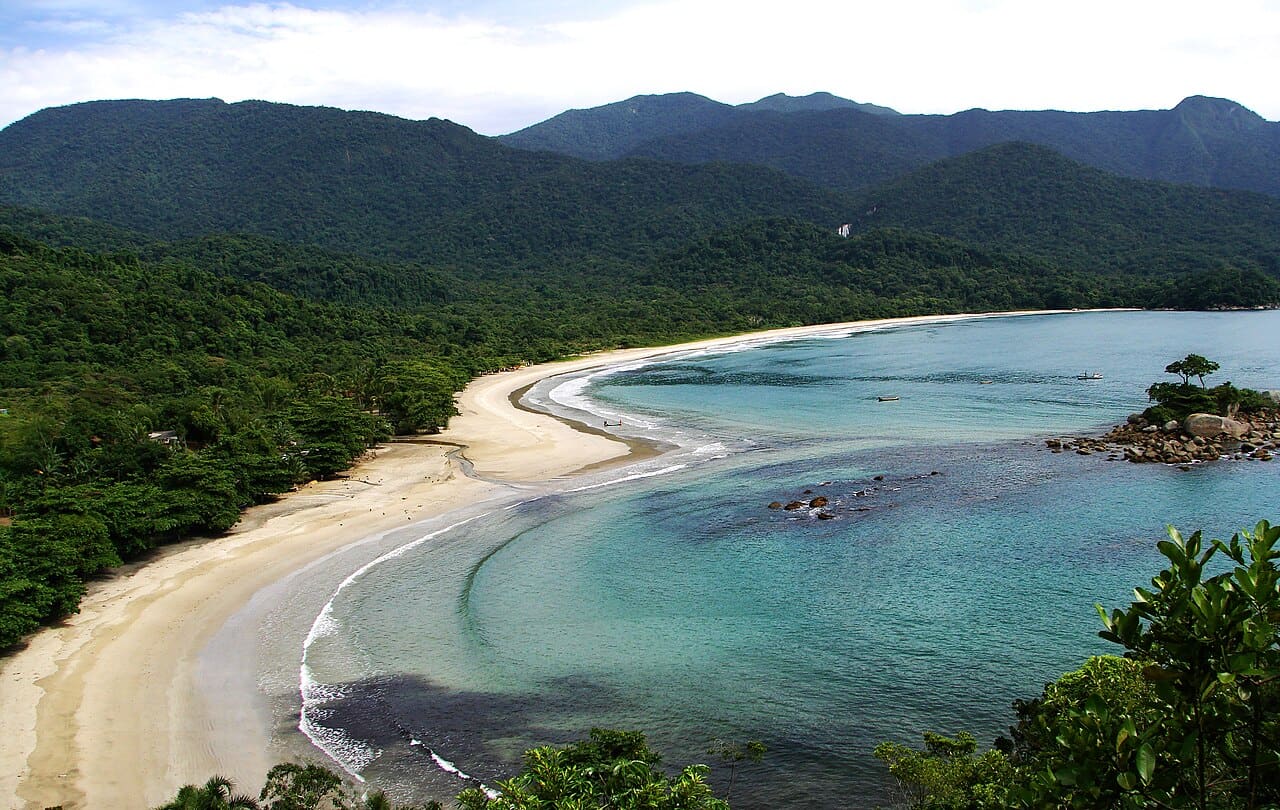 Castelhanos bay and its heart-shaped curve. Photo: Diego F. Gonçalves, CC BY-SA 4.0, Wikimedia Commons
On the other side of the ridge, facing the open ocean, sit the two beaches that justify the trip on their own. Castelhanos is a heart-shaped bay at the end of 17 km of dirt road inside the state park: only 4x4s get in (the jeep tour runs between R$ 110 and R$ 150 per person in 2026), or you arrive by boat. Inside there is a caiçara fishing village, a sea with proper waves and the Gato waterfall tucked into the corner of the beach.
Bonete, at the far southern tip, is another story: a caiçara community of 300 residents that The Guardian once ranked among the ten most beautiful beaches in Brazil. You get there by speedboat or by the 16 km trail that leaves from Ponta da Sela and crosses the Laje and Areado waterfalls. It is a full-day walk, with mud, climbs and that rare feeling of arriving somewhere no road reaches. Those who sleep there hear the generator switch off and the sea take over the sound of the night.
Trails: the island from above and from inside
The same mountains that hide the beaches produce the best hikes on the São Paulo coast. The signature trail is Pico do Baepi, which the sign at the top puts at 1,048 meters: 7 to 8 km round trip, some 5h30 to 6h of real effort, and the park requires an accredited guide and advance booking. The view pays back every step: the entire channel, the Serra do Mar across the water and, on a clear day, the Alcatrazes archipelago on the horizon.
For forest without mountaineering effort, the Água Branca trail is self-guided, free and well marked: 4 km round trip past five natural river pools. And there are longer crossings for anyone who likes worn boots, all gathered in our guide to the best hikes in Ilhabela. Always carry water, shoes with good soles and repellent. Entry to the park trails closes early; start in the morning.
Waterfalls: fresh water after the salt
Ilhabela has dozens of cataloged waterfalls, and most cost nothing. Três Tombos, near Feiticeira beach, is the easiest on the island: 720 meters round trip, doable with a small child. Água Branca drops 60 meters and is admired from a lookout, because swimming there is forbidden, with good reason. Toca was adapted with ramps and became the first wheelchair-accessible waterfall in Brazil. On the ocean side, the Gato waterfall in Castelhanos and the Laje and Areado falls on the way to Bonete reward those who went the distance. The full route, with difficulty levels for each one, is in our guide to Ilhabela’s waterfalls.
Whales: the show of the season
From May 16 to August 16, humpback whales move up the coast toward Brazil’s Northeast and cross the São Sebastião channel, with sightings peaking in June and July. On a lucky day you can spot the spout from shore, but the real encounter happens at sea. We run our own whale watching departures in winter: R$ 320 per person, 3h30 on a flexboat (a rigid inflatable) leaving from the Pier da Vila, in the historic center, with the Whale Friendly Seal and children from age 6. And the usual honesty: sightings are not guaranteed, whales do not keep appointments. When one shows up, nobody on the boat breathes.
Anyone who does not want (or cannot) go out to sea still takes part in the season: on clear June and July days, spouts and tails show from the shore itself, and any high point facing the channel becomes an observation post. Binoculars in the backpack stop being overkill at this time of year.
The historic center: the Vila
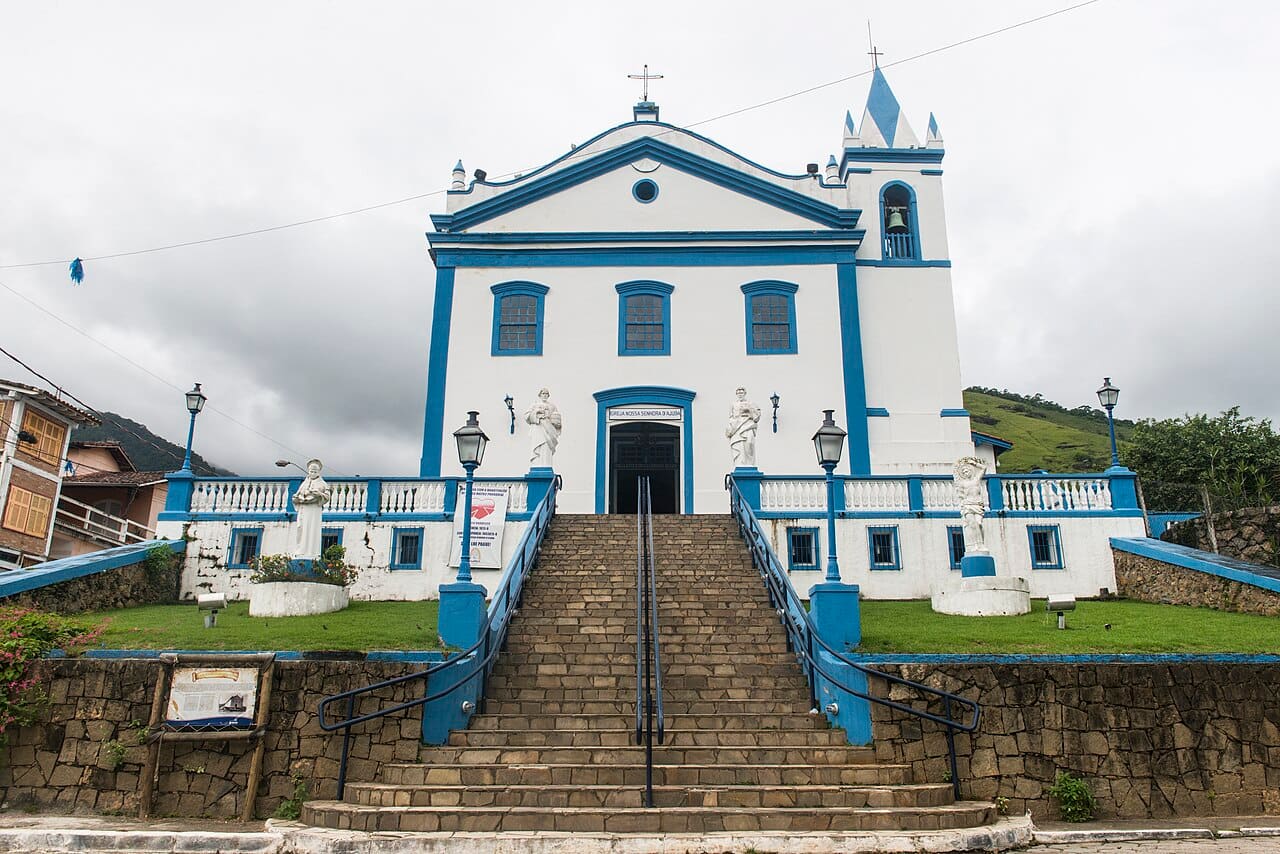 The mother church of the Vila, in the historic center. Photo: Maristela Colucci/MTur, public domain, Wikimedia Commons
The Vila is the island’s old heart: low houses, the mother church at the top of its staircase, the pier reaching into the channel and the waterfront promenade that fills at the end of the day, when the sun drops behind the Serra do Mar and paints the channel orange. It is small, you can walk all of it, and it is where the island happens away from the beach: ice cream, the craft fair, music spilling out of doorways. We dedicated a full article to the historic center, including the best times to walk it without the crowds.
The Vila is where our house is. The grounds of Hostel da Vila climb from the historic center into 8,000 m² of Atlantic Forest, with a pool heated to 32°C all year, a 20 meter waterslide and rooms that exist nowhere else: a geodesic dome with the sea in the window, a treehouse, a kombi van, a sailboat beached in the middle of the garden. Plenty of people come to sleep and end up staying for the program, which changes every week: yoga, climbing, live music. The behind-the-scenes and the schedule go out on our Instagram.
The night
Ilhabela is not a beach party town, and anyone expecting that will be disappointed. Nights here mean bars with music, long tables and conversations that mix accents. The Vila concentrates the movement, with options running from the no-frills caiçara boteco to the chef-run restaurant. On our corner, the Floresta Bar lights up when the sun disappears: signature drinks, good food and live shows under the trees, with Na Moita as its smaller, more tucked-away sibling. In summer and on holidays the calendar grows into parties that run through the small hours. The full map, neighborhood by neighborhood, is in our guide to Ilhabela nightlife.
The sea from the inside: paddling, sailing and snorkeling
Between the beach and the trail there is a third Ilhabela, lived on the water. The wind-sheltered channel is one of the best sea schools in the country: outrigger canoe at sunrise, SUP on the morning mirror, sailing all year round (the island is Brazil’s national capital of the sport and hosts Latin America’s biggest regatta week every late July). Along the rocky edges of the cleaner beaches, snorkeling delivers colorful fish two meters from the sand, and winter, with its clearer water, is the divers’ season. You do not need to be an athlete: a good share of the waterfront operators rent boards and kayaks by the hour.
Traveling with kids
Ilhabela works well for families that accept the island’s rule: nature takes effort and gives back double. The channel beaches are shallow and calm, the Três Tombos waterfall is an easy 720 meter walk away, the jeep to the ocean side is a full-day adventure kids retell at school afterwards, and the whale departures take children from age 6. What does not work: stretching a long trail with a small child, and forgetting the repellent, which here is a basic necessity at any age.
When it rains (and it rains)
An island with high mountains holds clouds, and you can catch gray days in any month. It is not a lost trip: rain fills the waterfalls, empties the short forest trails (the self-guided ones stay open and look better wet) and makes room for a slow coffee in the Vila. We stored the ideas tested over years of storms in our article on things to do in Ilhabela when it rains.
Putting it together: how long, when and for how much
If you are building the trip from scratch, this is the order we suggest: first decide how many days to stay (honest spoiler: two days only scratch the channel side; five deliver the real island). Then pick the season: April, May, September and October have the best balance of steady weather, prices and empty beaches, and winter has the whales. Then close the budget, which varies more with your style than with the island. Finally, sort the logistics in our guide to how to get to Ilhabela: the ferry from São Sebastião takes 20 minutes and is free for pedestrians.
Living here has not worn out the spell, and maybe that is the best recommendation we can give: after ten years, the whole team still drops what it is doing when someone shouts there is a whale in the channel. Choose your days, start with the itinerary that fits them and leave a margin for the unplanned. The island is kind to people with time to spare.