
Ilhabela without a car: free ferry, buses and what you can do on foot
Every week someone writes to us with the same question: “can I visit Ilhabela without a car?”. The answer comes from the team at Hostel da Vila, which has hosted travelers in the island’s historic center, on the channel side, since 2016. A good share of our guests step off the ferry on foot, backpack on, and many only realize at check-in that they crossed for free. So the short answer is: yes, you can, and in several cases the trip gets even better. The long answer is this guide, with 2026 prices, the legs that work on foot or by bus, and the two corners of the island no asphalt reaches.
The ferry: free if you cross on foot
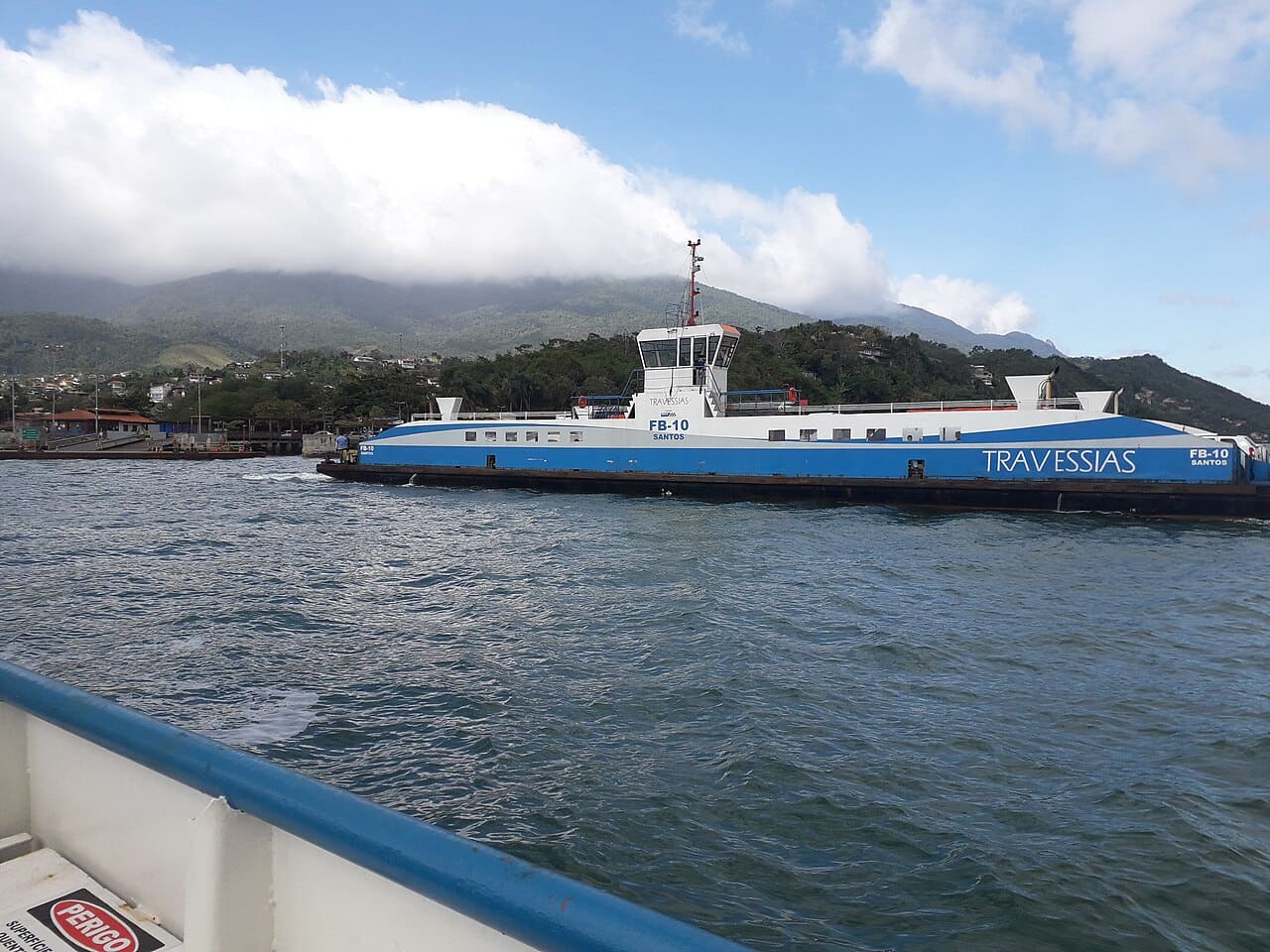
Let’s start with what almost nobody tells you: the crossing from São Sebastião to Ilhabela is free for pedestrians and cyclists. You enter through the side of the terminal, board the ferry along with the cars and 20 minutes later you are on the other side of the channel. Drivers pay R$ 19 on weekdays and R$ 28.50 on weekends, and face the island’s true toll, which is not the price: it is the line. On long holiday weekends, the wait to board a car easily passes two hours, while the pedestrian gets on the next ferry, always.
Ferries leave every 30 minutes, from 5:30 am to 11:30 pm, in both directions. The crossing itself is half an outing: the channel is usually flat early in the morning, the island’s mountains grow in front of you and, between May and August, it is not rare for someone to point at a whale spout along the way. We wrote in detail about every access route in the guide to where Ilhabela is and how to get there.
Arriving from São Paulo without a steering wheel
From São Paulo to São Sebastião it is about 200 km on the Tamoios highway, around 4 hours when the road cooperates. Without a car, Pássaro Marron runs the leg straight from the capital, with tickets between R$ 101 and R$ 123 in 2026. The bus drops you near the ferry terminal, and from there the previous section’s rule applies: you cross on foot, for free.
We did the full math on transport, lodging and food in the article on what a trip to Ilhabela costs. And if your trip is bigger than the island, stringing together Paraty or Ilha Grande, our guide to the Costa Verde without a car covers the connections between the states.
The municipal bus: R$ 4.80 with the right card
Inside the island, public transport exists and works better than its reputation suggests. The operator is Expresso Fênix, and since January 2026 the fare has two prices: R$ 10 paying cash and R$ 4.80 with the rechargeable electronic card. If you are staying more than two days, getting the card pays for itself quickly.
The lines follow the logic of the geography: Ilhabela is long, the inhabited part is a strip of shoreline, and the buses run that axis between south and north on the paved road, passing the ferry, Perequê and the historic center. Official timetables are on the city government’s website, and it is worth photographing the table for your stretch, because frequency drops a lot at night and on Sundays. There is also the Aquabus, a public water bus that costs R$ 20 full fare and the same R$ 4.80 with the card: few destinations in Brazil have a “bus” that travels inside the channel.
What the bus does not do: dirt road. The asphalt ends shortly after Armação, in the north, and at Borrifos, in the south. Everything beyond that requires another plan, and we will get there.
Taxis and ride apps
Ride apps work along the urbanized strip of the island, but the driver pool is small compared to any big city. In practice: by day, on the stretch between the ferry and Curral, you get a car within minutes; late at night or on a packed holiday, waits grow and prices climb with them. The island’s taxis cover the same stretches, and the advice from people who live here is simple: if you are having dinner far from your lodging, arrange the ride back in advance, with the same driver who took you. Every summer we help travelers who spent an hour waiting for a ride at 11 pm on a Saturday.
What the Vila solves on foot
Here lives the secret of visiting Ilhabela without a car: choosing your base well. The historic center, which everyone just calls the Vila, packs into a ten minute walking radius the 18th century mother church, the craft fair, the pier, the restaurants, the bars and the boats that leave for nearly every tour. At night, the street is the program: people strolling the waterfront, music coming out of doorways, the dark channel with the lights of São Sebastião on the other side. The week’s schedule, from live shows to parties, goes out on our Instagram.
 The sunset happens over the channel, right in front of anyone on the waterfront. Photo: Vitor Camilo, Unsplash
Ilhabela has a rare advantage for an island: since the inhabited face looks toward the mainland, the sun sets over the water, in front of you, every day. From the Vila and the channel beaches you watch it without needing a viewpoint or a car; we listed the best spots in the guide to where to watch the sunset in Ilhabela.
And there is the real sea, not just the waterfront. Between May 16 and August 16, humpback whales cross the São Sebastião channel and the whale watching departures we operate leave from the Pier da Vila, in the heart of the historic center: R$ 320 per person, 3h30 at sea on a flexboat (a rigid inflatable), walking from the street to the boat. It is probably the strongest experience on the island that starts and ends on foot.
The beaches closest to the Vila are the channel ones: calm water, good for families, with kiosks and shade. For the more famous sand, Curral sits about 9 km south of the ferry and works by municipal bus or ride app. The general guide to things to do in Ilhabela organizes all of it by region.
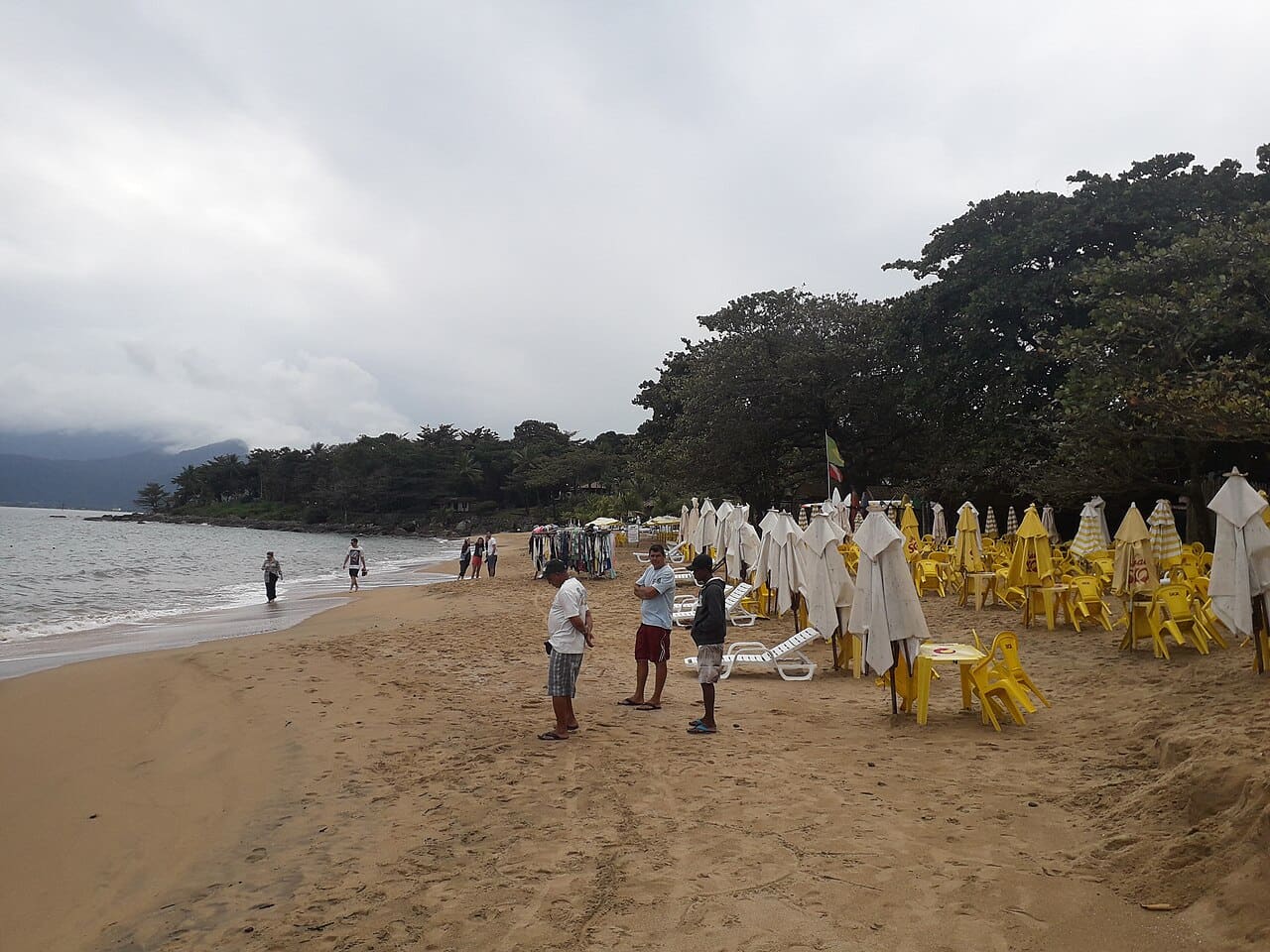 Curral beach, in the south of the island: reachable by municipal bus. Photo: Clonefox19, CC BY-SA 4.0, Wikimedia Commons
Where the 4x4 and the speedboat still rule
Now the honest part missing from many guides: more than 80% of Ilhabela is closed state park of Atlantic Forest, and the island’s most impressive places sit exactly where the road does not go. With or without a car, it makes no difference: a rented sedan also solves nothing of what comes next.
Castelhanos, the heart-shaped bay on the ocean side, sits at the end of 17 km of dirt road crossing the park. Only vehicles with traction get in: the agencies’ jeeps and 4x4s make the trip daily, and the alternative is arriving by sea, by boat. In other words, the traveler without a car books exactly the same tour the traveler with a regular passenger car would book.
Bonete, the caiçara fishing village of 300 residents at the far southern tip, has never seen asphalt: either you go by speedboat, or you take on the 16 km trail that starts at Ponta da Sela and takes 4 to 6 hours, crossing waterfalls along the way. The municipal bus helps you reach the trailhead, and that is the full contribution public transport can make there.
In the north, the ruler is similar. The asphalt ends and about 8 km of dirt remain to Jabaquara beach; the road accepts a regular car with patience, but without a car the natural path is the boat tour up the coast. Praia da Fome, next door, is even more direct: speedboat or nothing, about 20 minutes at sea from Perequê. There are more of these in our guide to the secret beaches of Ilhabela.
Honest verdict
After ten years of hosting both traveler profiles, our conclusion is this: for anyone coming for two to five days who accepts booking the island’s far ends as organized tours, a car is almost a nuisance. You pay for the crossing, face the ferry line, fight for parking at Curral on a sunny day and, when it is time to see Castelhanos or Bonete, hire the 4x4 or the speedboat all the same. On foot and by bus, the island moves at its own pace, and you move with it.
A car starts to pay off in two scenarios: a family with a small child and a different beach every day, or a long trip with time to explore every corner of the asphalt without depending on schedules. If that is your case, just do not underestimate the holidays; the ferry line shows no mercy. To figure out how many days make that math work, we have a whole article on how many days to stay in Ilhabela.
An island you can cross for free, on foot, opens the conversation well. The next step is building the days: our 3 day Ilhabela itinerary was designed to work exactly like this, with no steering wheel.