
The Bonete trail step by step: Ilhabela's classic crossing
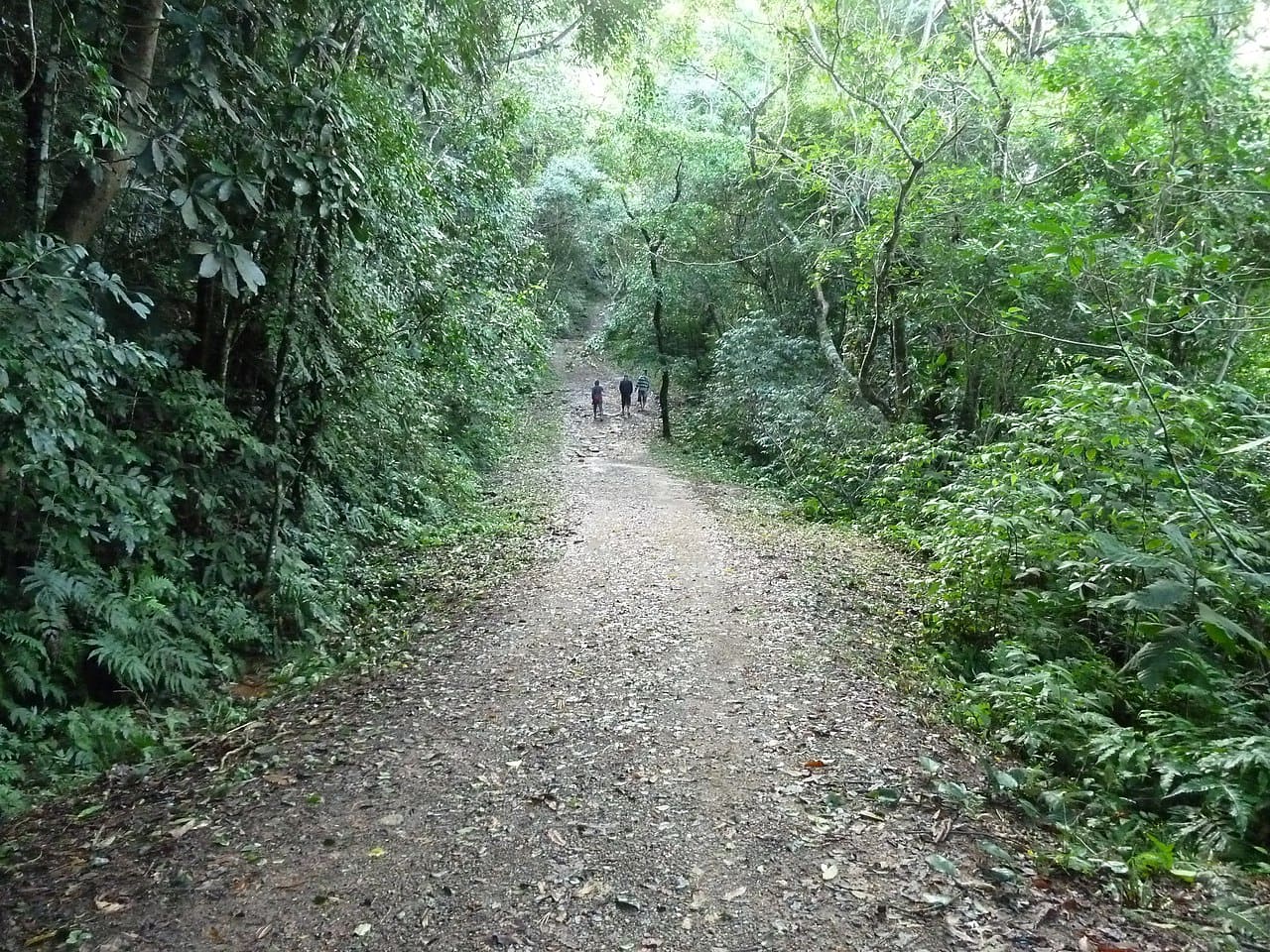
There is an honest test to find out whether the Bonete trail is for you: how does “16 km of ups and downs through the Atlantic Forest, no phone signal, two waterfall swims along the way and a caiçara fishing village waiting at the end” sound to your ears? If it sounds like an invitation, keep reading. If it sounds like a threat, take the speedboat and be happy: the beach is the same and nobody checks for blisters on arrival.
We write from Ilhabela, where we have lived and hosted travelers for ten years, and this crossing is probably the adventure our team has recommended more than any other. It is also the one that produces the most avoidable suffering: people starting at noon, people in flip flops, people without cash for the boat back. This guide exists so you walk into the forest knowing exactly what comes in each section.
The facts, no sugarcoating
- Route: about 16 km between Ponta da Sela, where the road on the south of the island ends, and the village of Bonete, at the southern tip.
- Time: 4 to 6 hours at a walking pace with breaks. Strong hikers do it faster; groups with little practice take longer.
- Profile: up and down almost the whole way, inside Ilhabela State Park. There is no technical climbing, but there are long slopes, roots, rocks and mud.
- Difficulty: moderate if you walk often, heavy if your exercise routine started the day before yesterday. The number deceives: 16 km in these hills tire you like 25 on flat ground.
- Waymarking: a marked, well-trodden trail, the most used on the island. Even so, download an offline map first: there is no 4G in there to rescue you.
- Water: you can refill at the waterfalls along the way, the two classic stopping points.
Section 1: Ponta da Sela to the Laje waterfall (km 0 to 2.5)
The starting point is the end of the southern road. Taxis and transfers drop you there; arrange the time so you are walking early, ideally before 8 am. The first stretch is an honest warm-up: the forest closes in fast, the engine noise disappears and your body discovers that “coastal trail” does not mean “flat trail”.
At km 2.5 comes the first reward: the Laje waterfall, with good swimming holes and slabs of rock that work as a sundeck. It is the most accessible swim on the route and the first water point. A tip from people who have made the mistake: do not stretch the break here. Most of the walk is still ahead, and Laje has a gift for convincing travelers to forget the clock.
Section 2: Laje to Areado (km 2.5 to 5)
The trail keeps climbing and dropping through the forest, the sea appearing in occasional windows between the trees. Around km 5 you reach the Areado area, the second classic stop and second water point. Refill even if your bottle is not empty: the next stretch is the longest without support.
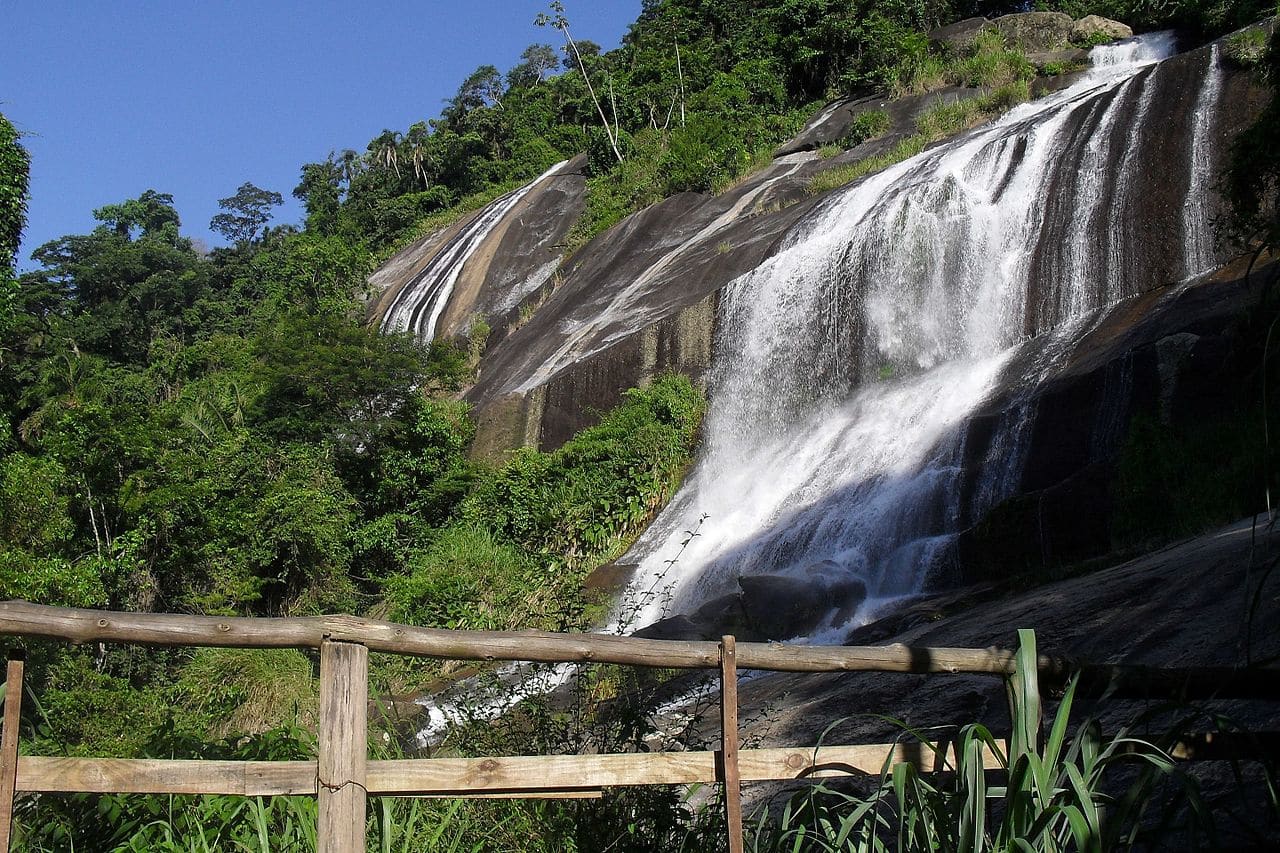 The waterfalls along the way double as swimming stops and water points. Photo: Iuri Bertolini, CC BY-SA 4.0, Wikimedia Commons
Section 3: the heart of the crossing (km 5 to 13)
This is where the truth of the Bonete trail lives. It is the longest, loneliest and most beautiful stretch: hill after hill, descents that punish the knees, patches of forest so dense the day darkens a shade. It is also where your head settles into that rare long-walk rhythm, when thought moves at the pace of your steps. There is no navigation puzzle, but there is accumulated fatigue: manage the breaks, eat something every hour and do not let the group spread out too far.
At the high points, the open ocean appears on your left, not a single building in sight. Stop for it. Few stretches of the São Paulo coast still look like this.
Section 4: the arrival (km 13 to 16)
The final descent delivers you at the back of the village. The sign that it is over reaches your ears before your eyes: the crash of the shorebreak. Then the forest opens and the houses appear, the school, the wooden canoes lined up on the sand. About 300 residents live here from fishing and community-based tourism, and the arrival etiquette is simple: say hello, take your earbuds out, walk in slowly. We wrote a whole guide to the village, where to sleep and how to visit it right: Bonete beach.
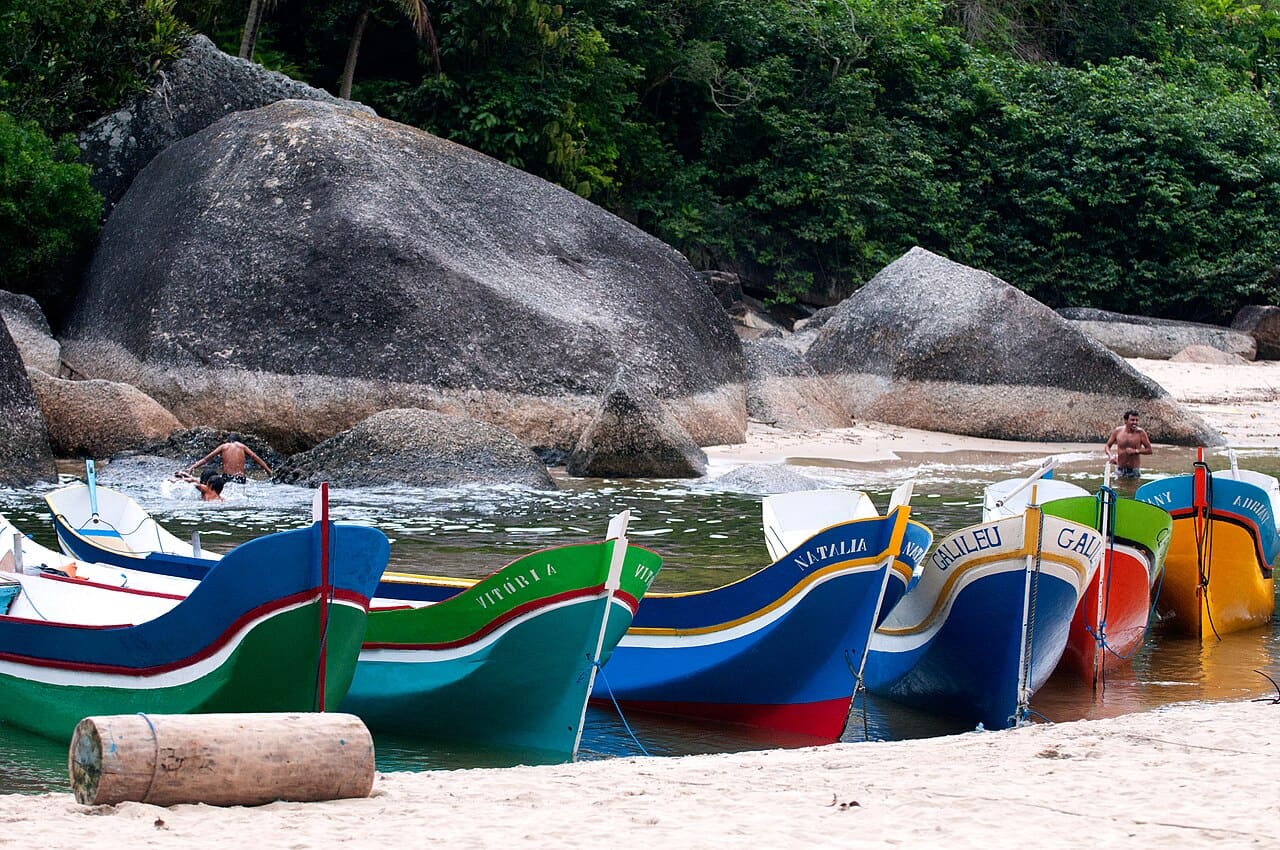 The finish line: canoes on the sand and 500 meters of beach. Photo: João Lara Mesquita, CC BY-SA 4.0, Wikimedia Commons
Returning by boat: the smart ending
You can walk back the next day, of course. But the return we recommend is by speedboat, arranged in the village itself with the community’s boatmen: half an hour of ocean coastline on parade, legs at rest and the whole crossing seen from the sea, like a replay. Three practical warnings:
- Bring cash for the boat. No signal, no guaranteed Pix (Brazil’s instant payment system).
- The sea decides. With a big swell, boarding through the shorebreak does not happen, and the plan becomes one more night in the village or walking back. Do not schedule anything unmissable for the return day.
- Arrange the boat when you arrive, not when you are ready to leave. On busy days, the morning departures fill up.
What to bring
- 2 liters of water per person to start, refilling at Laje and Areado.
- Real trail food: fruit, nuts, a sandwich, something sweet for km 12.
- Sneakers or boots with grippy soles, already broken in. Flip flops on the trail are mistake number one, and we see it every week.
- Repellent, and be generous with it: the borrachudo, the tiny biting fly that only lives near very clean water, is a founding partner of the ocean side. Reapplying after each swim is not fussiness, it is ankle survival.
- A rain jacket and a dry bag for your phone, documents and a dry change of clothes.
- A flashlight or headlamp, even if you leave early. Delays happen, and the forest goes dark an hour before the clock does.
- Cash for the whole village: bed, food, boat.
- Sunscreen for the open stretches and the beach at the end.
When to go (and when to call it off)
The ideal window is the dry season, May to August: firm ground, crossable rivers, walking temperatures. April, September and October also work well. The trail after days of heavy rain becomes a different sport: deep mud, rocks like soap and swollen rivers. And the golden rule of any crossing with waterfalls: if it rained hard in the hills, it is not the day. Water that darkens or rises suddenly is an order to leave, not a phenomenon to film. The month by month weather picture is in our guide to the best time to visit Ilhabela.
A bonus of the dry window: it is also whale season on the north coast of São Paulo, from May 16 to August 16, with humpbacks crossing the region. Whale watching trips leave from the historic center pier and the dates are at baleias.hosteldavila.com.br.
The classic mistakes, in order of frequency
- Starting late. After 10 am you walk through the hottest hours and flirt with nightfall in the forest.
- Underestimating the ups and downs. “I run 10 km” is not a credential for these hills. Respect your own pace and the group’s.
- Too little water and no food. The math stops working at km 12.
- Wrong footwear. We said it already, but it bears repeating because it keeps happening: no flip flops.
- Arriving without a booking on a holiday. The village is small on purpose; secure your bed or campsite before entering the forest.
- Going alone without telling anyone. The trail is busy, but forest is forest: leave your plan with someone on the outside.
- Bringing a speaker. The forest has its own soundtrack and so does the village. Do not be that person.
If you are calibrating the level, compare it with the island’s other routes in our guide to the best hikes in Ilhabela; and if waterfalls are what move you, the full map is in Ilhabela waterfalls. To fit the crossing into a longer trip, the 5 day itinerary reserves the right slot for it, and anyone traveling without a car solves the ride to the trailhead with a taxi or a transfer arranged the day before.
The night before and the day after
A good crossing starts the night before: a decent dinner, a packed bag, an early alarm. Our base for that is in Ilhabela’s historic center, on the channel side, on the opposite side of the island from the trailhead: Hostel da Vila, our team’s eco lodge, with 8,000 square meters of forest on the property to warm your eyes up for what is coming. Early coffee, excess luggage stored, and on your return the ritual your legs will ask for: a pool heated to 32°C, dinner at the Floresta Bar and a bed that does not rock like a speedboat.
On the last hill before the final descent, when the sea appears open and the village does not yet, there is a second of silence that no photo carries. That is what you walk 16 km for. The next step is picking a date in the dry window and reading the guide to the village waiting at the end.