
Ilhabela waterfalls: the ones worth the hike and how to reach each one
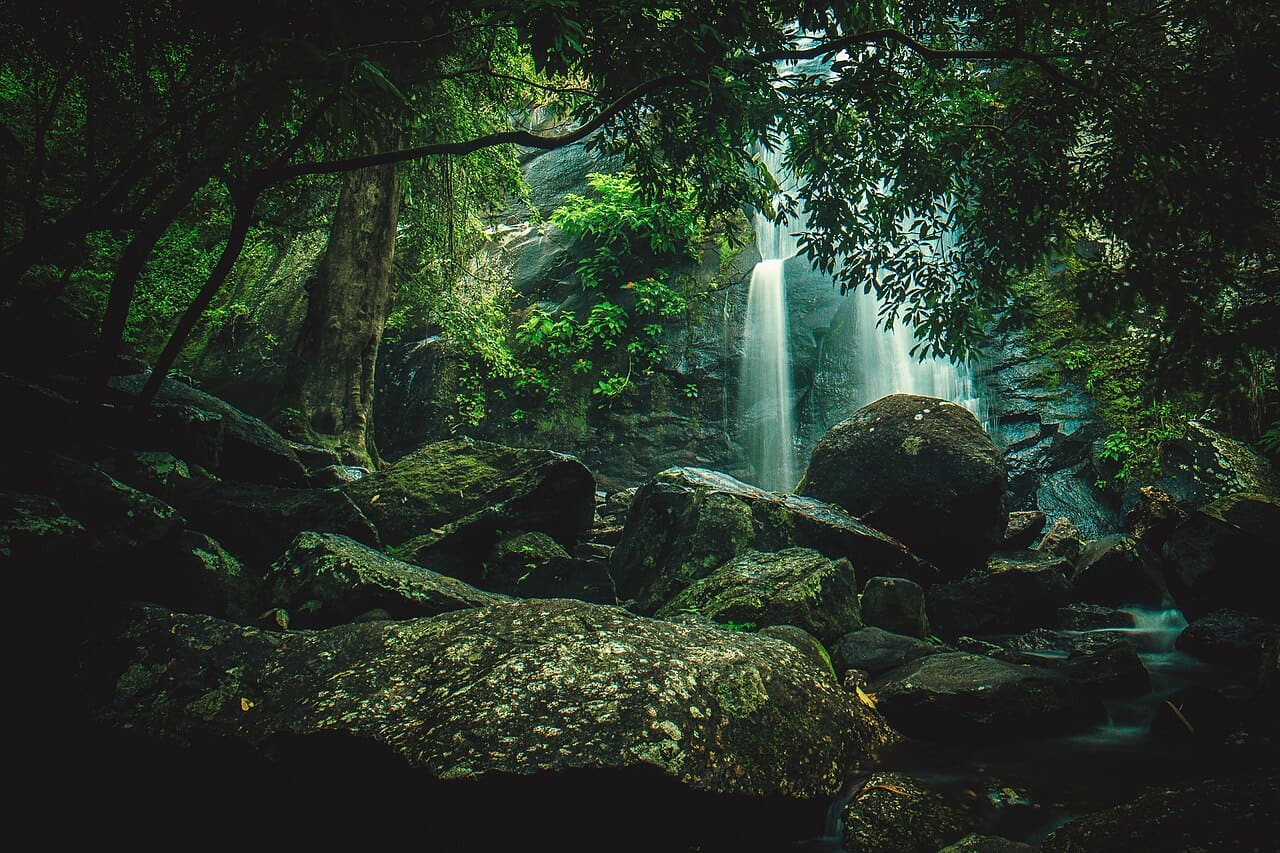
The official count says 38 cataloged waterfalls in Ilhabela; local legend, with its usual affectionate exaggeration, says 365, one for each day of the year. The usable truth sits in the middle: the island has fresh water tumbling off the mountains in a volume no other destination on the São Paulo coast can match, and a good part of it, like the Sete Quedas falls in the photo above, does not even appear on the usual itineraries. We live here, swim in waterfalls all year round and wrote this guide with the filter that matters: which ones deserve your time, what it costs to reach them (spoiler: almost all are free) and when the water is at its best.
Before the list, the context that changes everything: most of the island is a state park, and it is this protected forest that manufactures so much clean water. The side effect has a name: borrachudo, the tiny biting fly that only lives where the rivers are healthy. Repellent in your bag, always, reapplied after every swim.
Água Branca: the best effort-to-reward ratio (free)
If you only have time for one, this is it. The Água Branca trail starts at the state park gatehouse, at the beginning of the road that crosses the island, is self-guided, free and has real facilities at the entrance: restrooms, showers and parking. It is about 4 km round trip following the stream, with five swimming holes named one by one: Poço da Pedra, da Escada, da Ducha, do Jequitibá and do Jabuti. The path starts gentle and demands more as it goes, so it works both for families with kids and for anyone who wants to sweat a little: everyone picks their own pool. Early in the morning on a weekday, you will probably have the first pool to yourself.
Cachoeira da Toca: the natural slide (paid)
Near the start of the same road, the Toca waterfall sits on private property and charges admission. What you are buying: a set of falls and pools where the water runs through a rock hollow and down a natural slide carved into the stone, plus easy access with no long hike. It is the option for a lazy day, for anyone with small children or for anyone who wants a waterfall without earning a blister. If paying to see a waterfall offends you on principle, Água Branca is right there for free; Toca competes on comfort, not on grandeur.
Cachoeira do Gato: the most imposing one you can actually reach
On the other side of the island, at the left corner of Castelhanos bay, a 2 km trail with bridges and handrails leads to the rock face of the Gato waterfall, a drop of around 40 meters falling into a pool of icy water. The walk is easy; the challenge is logistical, because the bay can only be reached by jeep along the park road or by speedboat. Treat it as a full-day combo: an open-sea beach, a caiçara lunch cooked by the local fishing community and the waterfall as the high point. Thirty to forty-five minutes per stretch of trail and, in our honest opinion, the most scenic swim on the island.
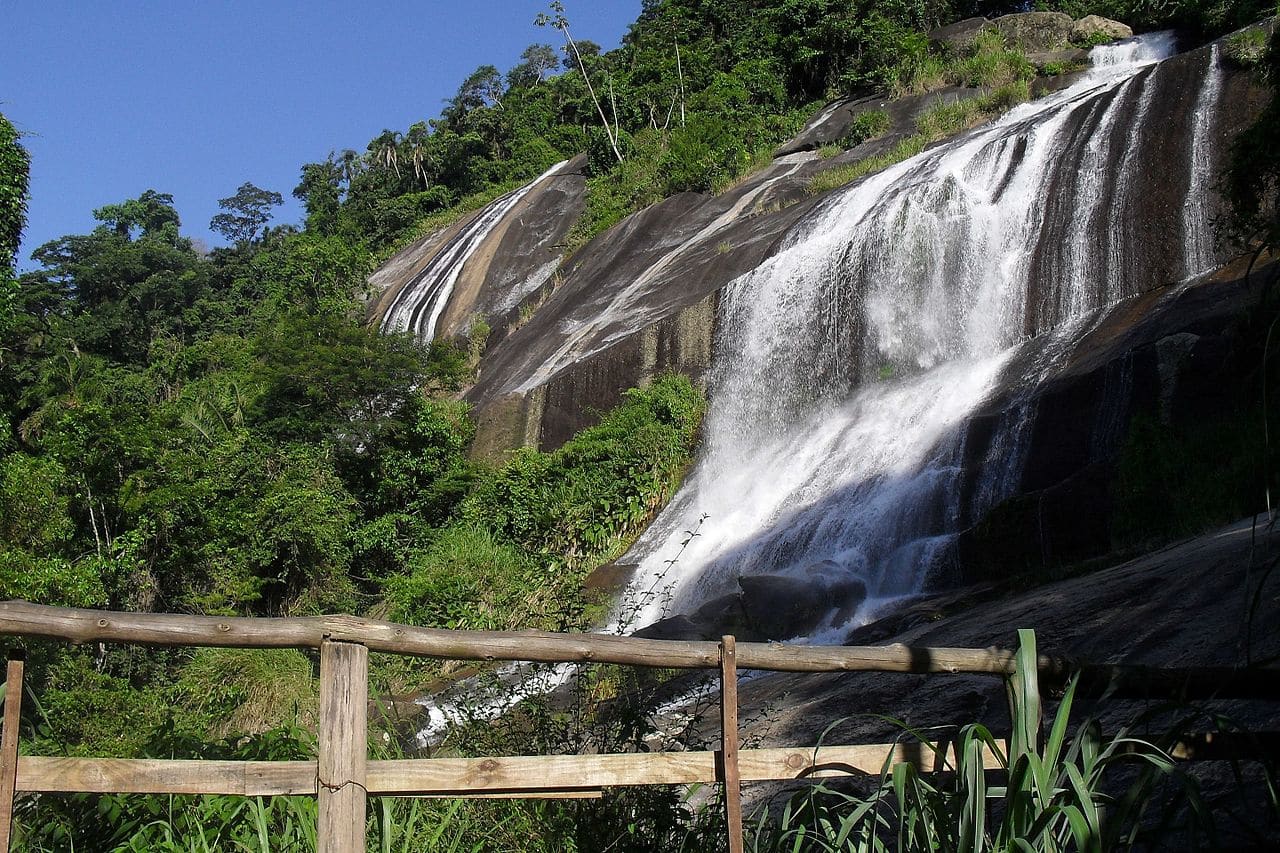 Cold water, dark rock and forest all around: the signature of the island’s falls. Photo: Iuri Bertolini, CC BY-SA 4.0, Wikimedia Commons
Laje and Areado: the waterfalls you earn on foot
These two are not visited; they are earned. They punctuate the 16 km crossing that links Ponta da Sela to the village of Bonete, at the southern tip. The Laje waterfall appears at km 2.5, with swimming holes and slabs of rock to dry off in the sun; you can even do it on its own, as a short out-and-back from the trailhead, which makes it the perfect gateway for anyone who wants to test their legs. Areado comes around km 5 and marks the last swim before the longest stretch of the walk. At both, the function is double: swim and water point. The complete step by step of the route, with times and common mistakes, is in the Bonete trail guide.
Três Tombos: the quick one in the south
Very close to Feiticeira beach, with 720 meters of total path across steps, bridges and handrails, the Três Tombos waterfall is the answer to “I want a waterfall but I only have an hour”. Three falls stacked one above the other: the first around 14 meters with a swimming hole, the tallest at 21. It pairs well with a day at the southern beaches and is one of the few that fit the plans of anyone here for just a weekend.
Poço Fundo: the reward for sleeping in the village
Ten minutes of easy walking from the caiçara village at the southern tip, Poço Fundo is the waterfall that rinses the salt off after the pounding surf. Dark, cold, untouched water, the way only places without a road preserve it. It comes as part of the package for anyone spending the night there, along with the starry sky at 11 pm, when the generator switches off.
The ones for the next level
The park’s catalog runs far beyond these six: Veloso, Friagem, Ribeirão, Paquetá and dozens of others, some without an open trail, others reachable only with an accredited guide who knows the way. Sete Quedas, which opens this guide, belongs to that team: deep state park forest, off the common circuit. If your relationship with waterfalls is serious, hire a local guide and ask for their full repertoire; it is also the safest way to see the forest from the inside. And if your trip continues along the coast, the subject pays off across the whole region: see the best waterfalls of the Costa Verde.
When to go: waterfall physics
It helps to understand the mechanism. In summer it rains a lot, so the falls run full, voluminous, photogenic; in exchange, access gets worse, the water clouds up and the risk rises. In the dry season, May to August, the volume drops, but the pools clear, the ground firms up and every trail is at its best. April, May, September and October are the island’s happy middle ground in everything, as our guide to the best time to visit Ilhabela shows.
Our preference, since you asked: the dry season. The best waterfall is not the fullest one, it is the one that lets you in.
Safety: the golden rule of rain
Once a season we repeat this to some guest, and we would rather repeat it here too. A waterfall with rain at its headwaters is a real flash flood risk: the volume can rise in minutes, even if the sky is open and sunny where you are swimming. The immediate exit signs are two: the water darkening or the level rising suddenly. It is not the moment to finish your sandwich or to film; it is the moment to leave. Complete the common sense kit: do not jump without knowing the depth, wet rock is soap, and a child in a deep pool is the responsibility of an adult paying full attention. Heavy rain in the morning? Swap the waterfall for another plan and come back tomorrow: fresh water does not run away.
Building the perfect freshwater day
The combo we suggest most for one day: Água Branca early in the morning, lunch in town and a calm beach in the afternoon. For two days: add the full day on the ocean side with the Gato waterfall. For five or more: the southern crossing with Laje, Areado and Poço Fundo along the way, which the 5 day itinerary slots in neatly. The trails that lead to all of this are ranked by effort in the guide to the best hikes in Ilhabela, and the island’s overall picture, salt water included, is in things to do in Ilhabela.
The base with hot water at the end of the day
After a day of icy pools, the body asks for contrast. Our base is in Ilhabela’s historic center, on the channel side: Hostel da Vila, the eco lodge our team has run since 2016, with 8,000 square meters of Atlantic Forest on the property and, delicious irony for this guide, the warmest water on the island: a pool heated to 32°C all year round. Waterfall days end there, soaking, comparing swimming holes with whoever came back from another trail, before dinner at the Floresta Bar.
Fresh water tumbling from the mountains straight into the sea is Ilhabela’s geological summary, and no beach tells that story alone. Pick one fall from this list for your next morning; if it is your first, start with Água Branca and let the five pools decide how far you go.