
Things to do in Ilhabela when it rains
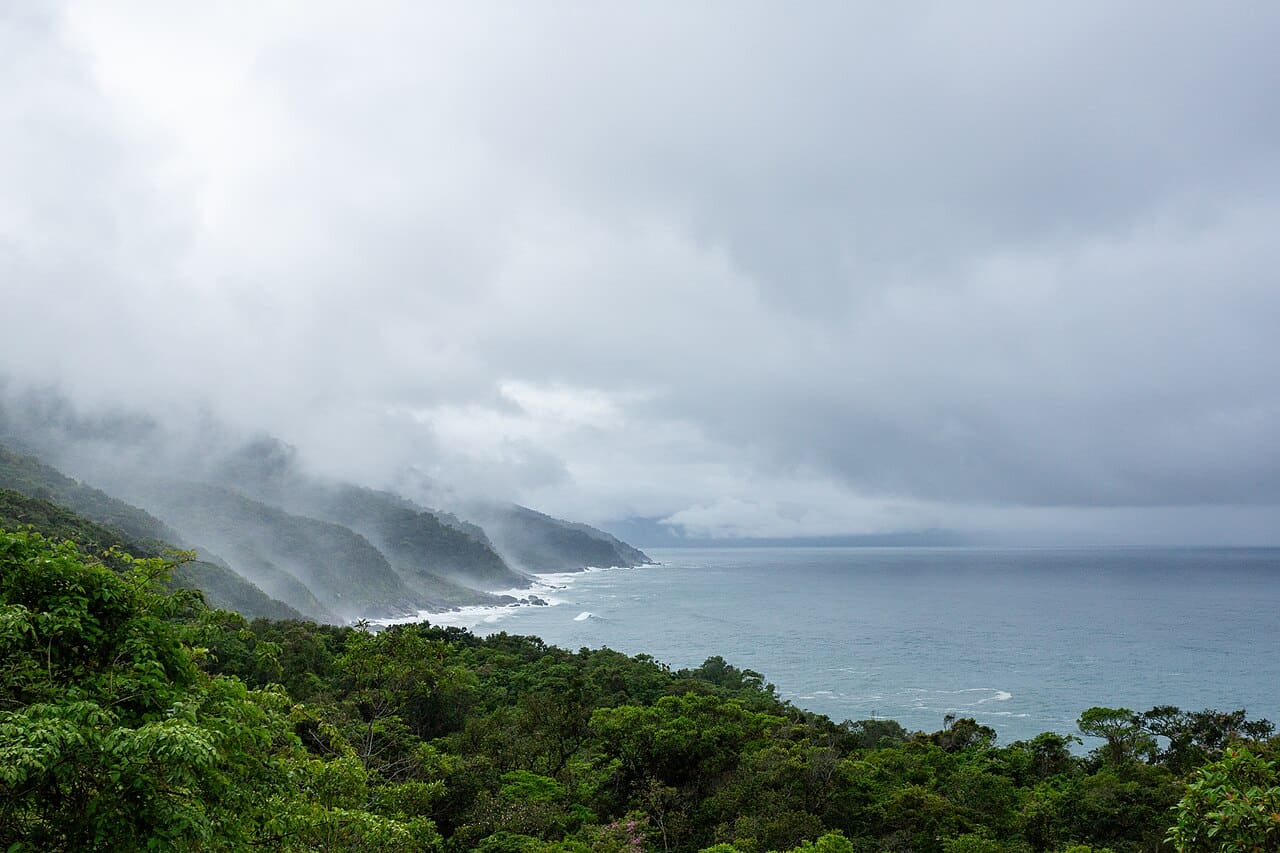
Let’s start with what nobody writes in the pretty caption: in Ilhabela it rains, and it rains because the island is what it is. More than 80% of the territory is Atlantic Forest state park, and that forest exists because the mountains hold the clouds that come in from the sea. The same rain that ruins your beach day is the one that feeds the dozens of waterfalls, keeps the rivers clean enough to breed borrachudo, the local biting fly, and paints everything in that absurd green that brought you here in the first place. We live in the middle of this forest and learned long ago: a rainy day is not a lost day, it is the island running in its original mode.
This is the plan we hand our guests when the forecast turns. No forcing it: there are things the rain improves, things it only allows with caution, and storm days when the right move is to accept the window-watching program. Let’s go in order.
First, understand which rain this is
Ilhabela’s rain has a personality per season, and that changes the plan. In summer, it is usually the classic late-afternoon storm: the day dawns blue, the mountains manufacture cloud after lunch and dump everything between 4 pm and 7 pm. In that scenario, the beach day exists, it just ends earlier. Cold fronts, more common between fall and spring, bring the all-day gray of drizzle that cannot make up its mind. That second type is the one this article’s plan is for. The distribution across the year is in our guide to the best time to visit Ilhabela, but the summary is: January and February are the wettest months, June to August the driest, and it is one of the reasons we argue that Ilhabela is worth it in winter.
Waterfalls on a rainy day: when yes, when no
The answer everyone wants first: yes, a full waterfall is a spectacle, and no, it is not always a good idea. The rule we follow and repeat is the flash flood rule: heavy rain in the mountains can come down the river suddenly, even if it is not raining where you are standing. If the water starts to rise, cloud up or carry leaves and branches, leave immediately, without waiting for confirmation.
In practice: with drizzle or light, steady rain, the easy-access waterfalls get more beautiful and stay safe enough. Cachoeira da Toca, near the start of the road that climbs the mountains, is the best pick on those days: natural pools, falls close to the entrance and visitor facilities. Três Tombos, in the Feiticeira area, has a short, well-marked trail. Cachoeira da Água Branca, with drops reaching 60 meters, is a contemplation visit: you do not swim there, and the lookout facing the fall gets even more dramatic with rain volume behind it.
With heavy rain or a storm forecast, waterfalls come off the menu, and long trails too. No drama: the island has more fresh water than any trip can cover, and our guide to Ilhabela waterfalls helps you reschedule for the next day.
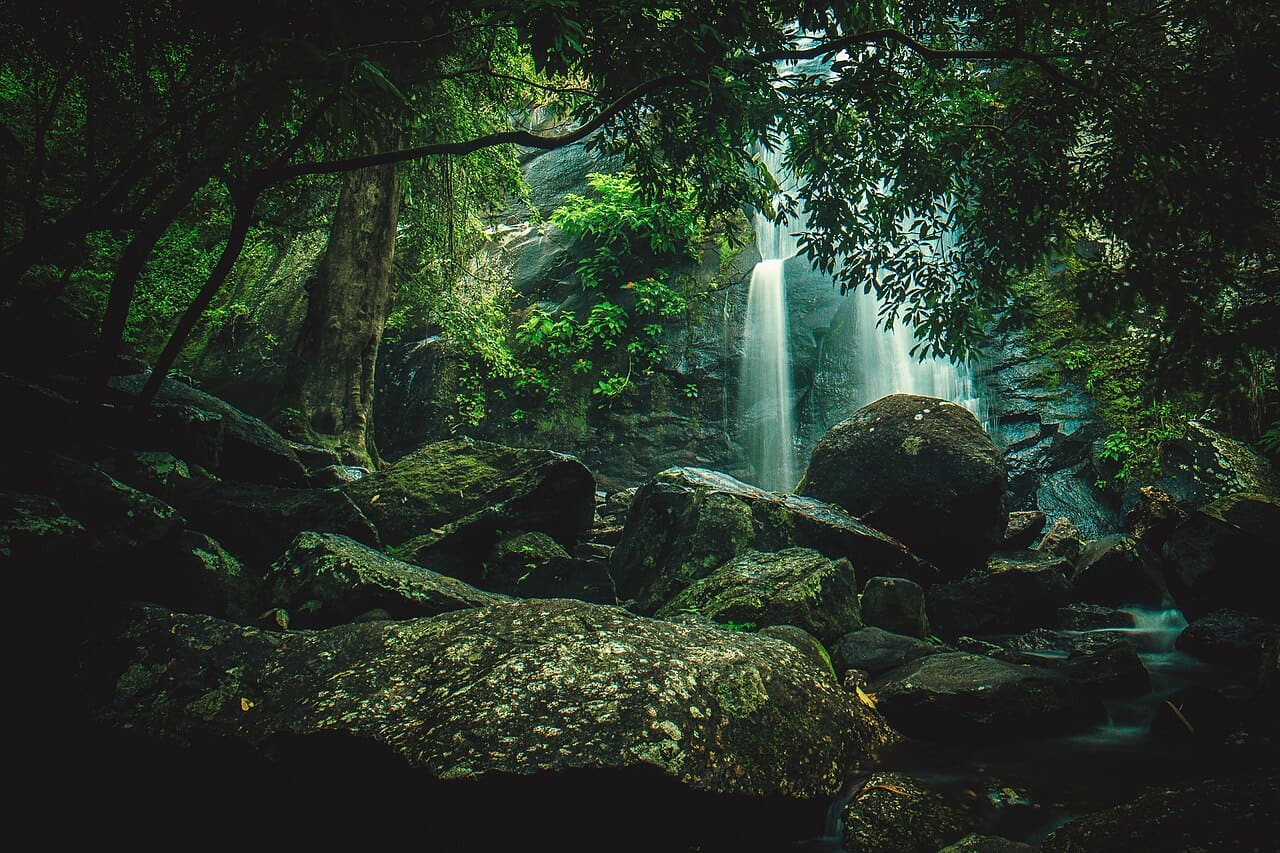 After the rain, the falls double in volume. Photo: Igorh84, CC BY-SA 4.0, Wikimedia Commons
The historic center asks for exactly this weather
The Vila, Ilhabela’s historic center, was made for cloudy days. Under the January sun, you cross the stone streets running for shade. Under light rain, the colonial houses take on the right color, the crowds thin out and there is finally room to look slowly: the mother church at the top of its staircase, the art galleries, the little craft shops, the cafes serving hot things.
The under-a-roof circuit delivers more than it seems. The island keeps small, good museums for a wet morning, among them the nautical collection that tells the island’s relationship with the channel’s shipwrecks, more than twenty recorded in these waters, and the historic Engenho d’Água farm, a legacy of the sugarcane era. Follow with a slow coffee and a bookshop and the morning is gone. And notice a detail the sunny day hides: with rain, the mist slides down the mountains and stops halfway up the slopes, and the island gains a layer of mystery that produces the most beautiful photos of the trip, no filter and no effort. Our guide to Ilhabela’s historic center lists everything with addresses.
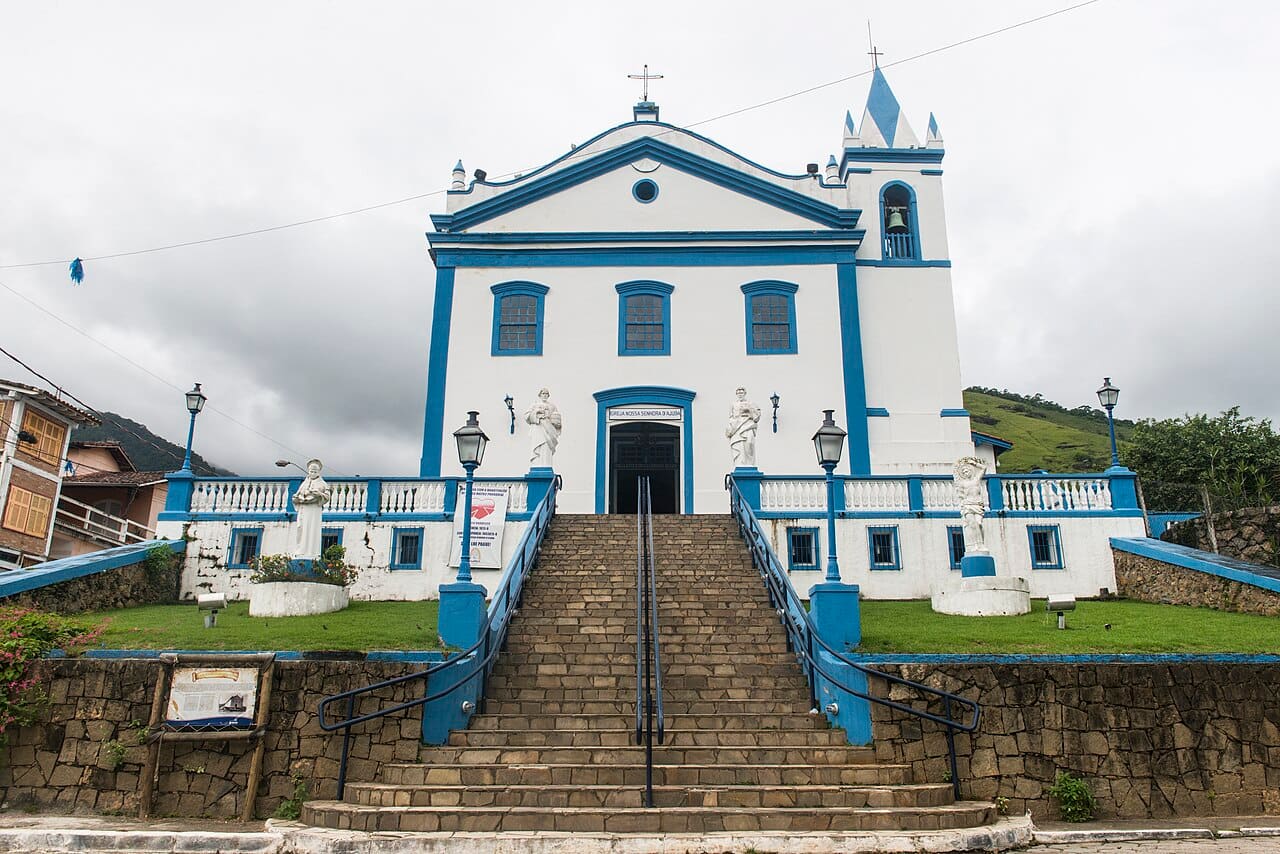 The Vila’s mother church: the historic center looks better under a loaded sky. Photo: Maristela Colucci/MTur, public domain, Wikimedia Commons
A day to eat well, guilt-free
Rain on the coast is a free pass for the long table. It is the day to sit down without hurry and go for food that warms: a caldeirada (a seafood stew of octopus, squid and fish in one broth), a caiçara moqueca (the local fish stew), a cup of hot seafood broth watching the fogged-up channel. A lunch that starts at noon and ends at three is not excess in this scenario, it is the program. The island’s traditional cooking was born on days like these, of fishermen waiting for the weather to open, and the dishes built on fresh fish with banana and cassava flour make more sense with rain hitting the window than at 35 degrees. We mapped the types of cooking and the regions to find them in our guide to where to eat in Ilhabela.
At the end of the afternoon, our openly biased suggestion: the Floresta Bar, our group’s bar inside the forest, gets particularly beautiful in the rain. The roof becomes a percussion instrument, the forest around it releases that smell of wet earth, and a signature drink with good food sorts the whole evening without you needing an umbrella between one thing and the next. Some nights the live music happens with the rain in the background, and nobody complains.
The ace up the sleeve: 32°C water while the sky pours
Yes, we are talking our own book, but with an argument that convinces any skeptic: swimming in a heated pool while it rains is one of the best experiences this island offers, and almost nobody plans for it. The pool at Hostel da Vila stays at 32°C all year, surrounded by the property’s 8,000 square meters of forest. On a rainy day, the contrast is the program: warm water on your body, cold drops on your head, steam rising and the dark green forest all around. Guests who discover this do not leave the water. If your trip caught an unstable week, it is the kind of base that turns a bad forecast into a footnote.
What the rain truly cancels
Service honesty: a rough sea and low visibility cancel boat trips, diving and a safe crossing to the ocean side. A long trail becomes unnecessary risk, because wet roots are soap and a lookout socked in by cloud shows nothing. And the Vila at night goes quiet when it rains, with fewer sidewalk tables and less music. If your plan had those on the wet day, swap the pieces around: the 3 day Ilhabela itinerary we built was designed to allow those swaps without breaking the trip, and anyone with more days on the island absorbs a storm without feeling it.
A serious warning to close this part: a summer storm in Ilhabela can be violent, with streets flooding fast and waterfalls rising in minutes. On those days, the plan is no plan: stay where you are, leave the mountains alone and wait it out. It usually passes quickly.
The ready-made plan, one line per part of the day
Morning of light rain: an easy-access waterfall or the Vila’s museums. Afternoon: a slow coffee in the historic center, or the heated pool if your lodging has one (ours does, and we warned you we would talk our own book). Evening: a long table of caiçara food and, if the rain gives a truce, a walk through the wet stone streets, which turn beautiful in a way the dry day does not deliver. Storm: window, book, nap.
Rain in Ilhabela is not a flaw of the destination, it is its signature. Whoever accepts that travels lighter, because no day turns into frustration: it turns into a different kind of day. And when the weather opens, and it does open, the island will be washed, the falls full and the air transparent. It is the best version of the place, and you will be there to see it. The next step is knowing everything the island offers to rebuild your plan with the sun back.