
3 days in Ilhabela: the channel, southern beaches and one big sea day
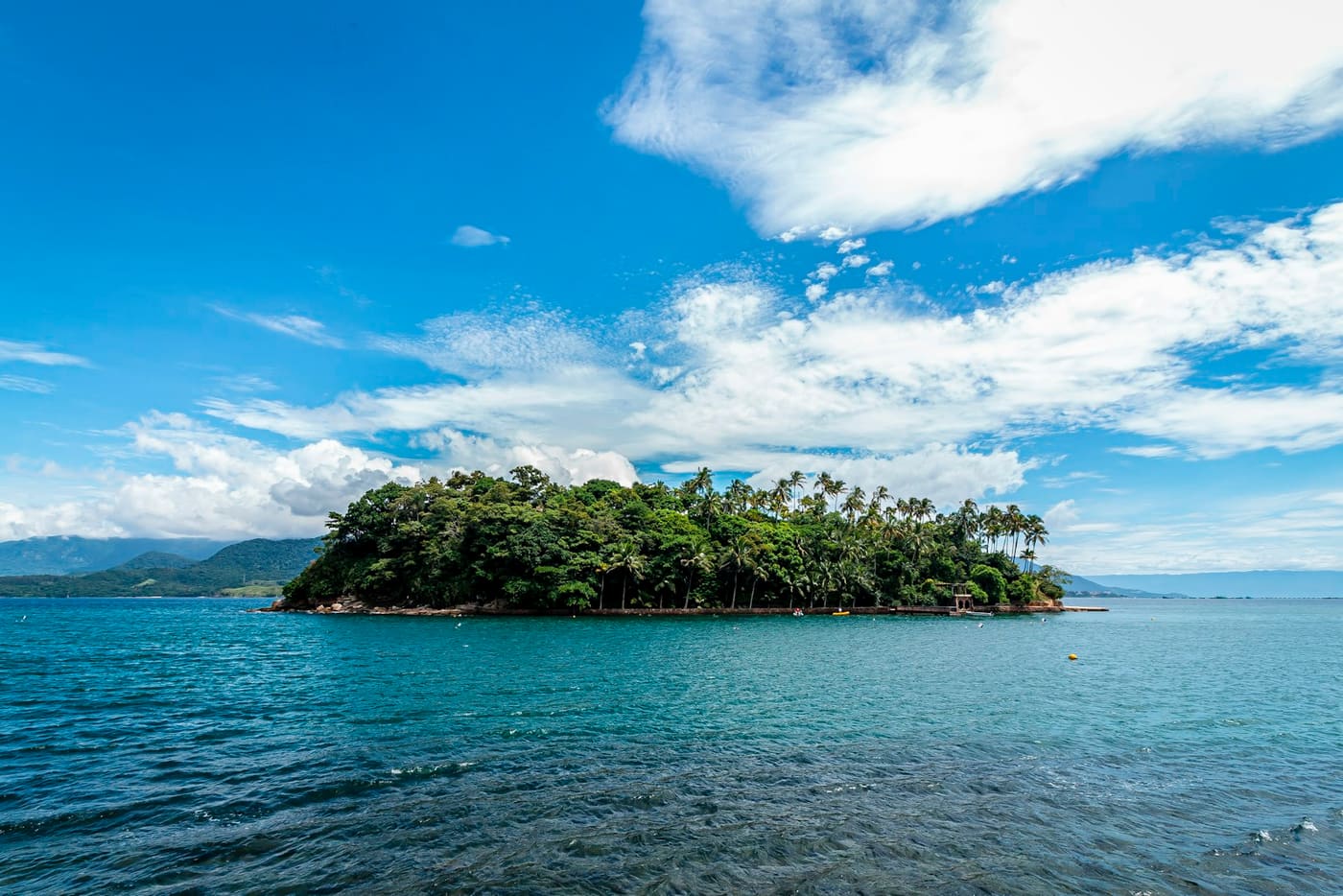
Three days is what most travelers give Ilhabela on a first visit, and it is enough to understand why so many come back. We write from here: our team has hosted guests in the island’s historic center for ten years, and this itinerary is what we sketch at the front desk when someone arrives with the classic question, “I have three days, what do I do?”. It is not a list of everything; it is a choice. More was left out than made it in, because the island has more than 40 beaches, dozens of waterfalls and a state park covering most of the territory. What made it in has been tested: a day to arrive and feel the Vila, a day of beach and waterfall in the south, and a day of big sea, which changes its face with the time of year.
Before starting, two practical warnings. First: bring repellent and take it seriously, because the borrachudo (the tiny biting fly) is the island’s oldest resident and only exists where the water is clean. Second: this itinerary works without a car, as we explain in detail in the guide to Ilhabela without a car; where a 4x4 or a boat is mandatory, we say so.
Day 1: the crossing, the Vila and the sun dropping into the channel
The arrival is already part of the itinerary. The ferry from São Sebastião takes 20 minutes, leaves every 30 minutes from 5:30 am to 11:30 pm and is free for anyone crossing on foot or by bicycle; a car pays R$ 19 on weekdays and R$ 28.50 on weekends. Coming from São Paulo, it is about 200 km on the Tamoios highway, around 4 hours, or the direct bus for R$ 101 to R$ 123. Every route is detailed in the article on where Ilhabela is and how to get there.
Drop the bags and go meet the historic center, which everyone here calls the Vila. It is small in the best sense: the mother church raised at the turn of the 17th to the 18th century, the craft fair on the street facing the Cultural Center, the pier with its fishing and tour boats, all within ten minutes on foot. Plan nothing for this afternoon beyond walking slowly and choosing where to have dinner.
Our recommended base is our own house, and we say it with the transparency of those who sign the text: Hostel da Vila sits inside the historic center, on the channel side, on an 8,000 m² property where the Atlantic Forest climbs behind the rooms. You can sleep in a geodesic dome with the sea in the window, in a treehouse or in a kombi van, and end the afternoon in the pool heated to 32°C while the Floresta Bar warms up across the garden.
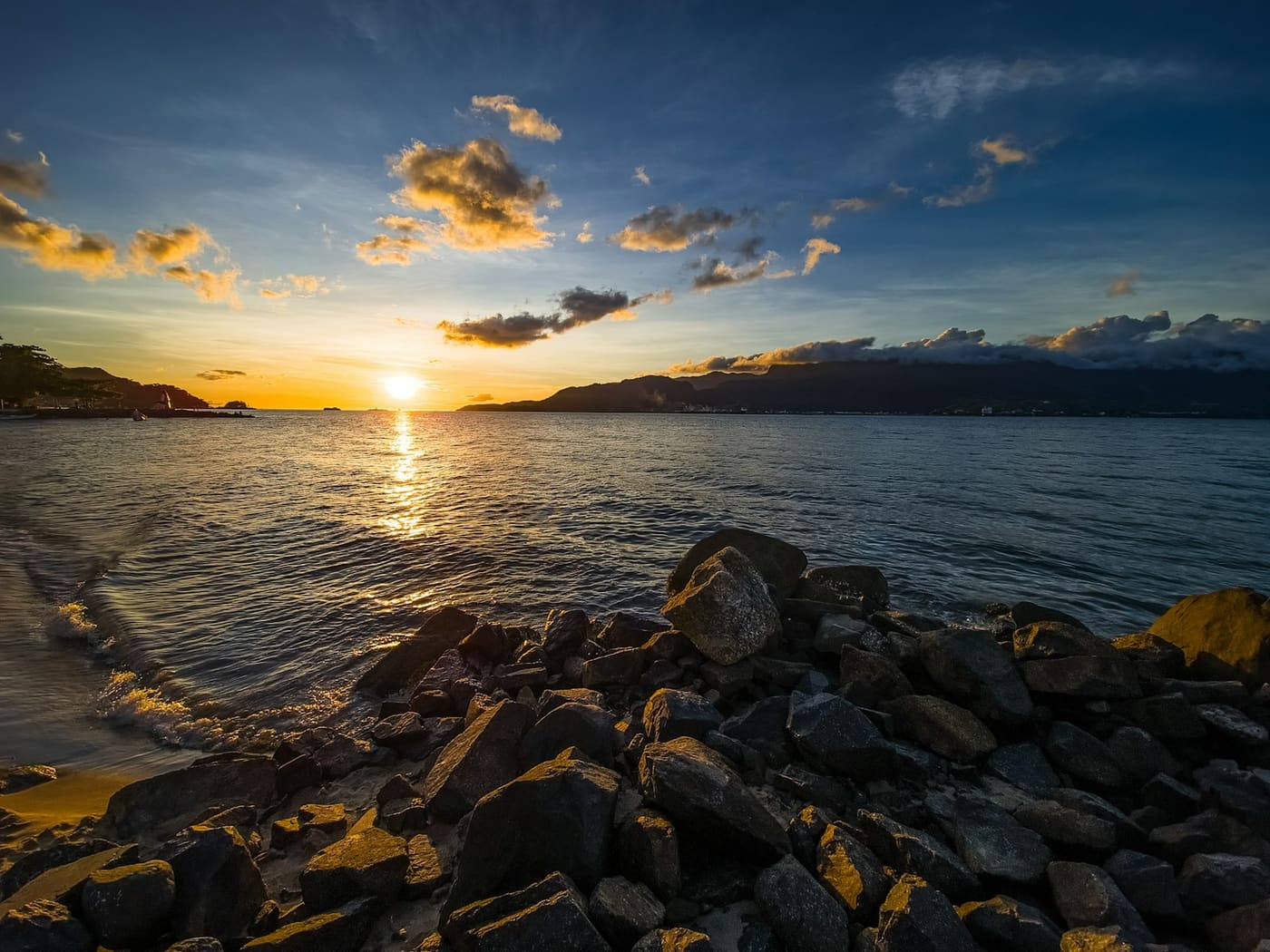 The classic late afternoon of day one: the sun drops over the channel. Photo: Vitor Camilo, Unsplash
The day’s closing act is geographic: since Ilhabela’s inhabited face looks toward the mainland, the sunset happens over the water, a rare thing on a Brazilian island. Around 5:30 pm in winter and 6:30 pm in summer, walk down to the Vila’s waterfront or the pier and watch. The best spots are mapped in the guide to where to watch the sunset in Ilhabela. At night, the Vila handles dinner and the rest: bars with music, people in the street, the dark channel dotted with the lights of São Sebastião.
Day 2: southern beaches in the morning, waterfall in the afternoon
The second day heads down the island. The southern road strings together the beaches that are Ilhabela’s classic image: Curral, with 400 meters of wide sand, kiosks and the most complete structure on the island; Feiticeira and Praia Grande on the way, smaller and quieter. Our honest suggestion: in high season, Curral fills up and parking runs out before 10 am, so arrive early or take the municipal bus, which runs the whole paved road for R$ 4.80 with the electronic card. On a weekday outside summer, the same Curral is nearly all yours. The full comparison between the beaches is in the guide to the most beautiful beaches in Ilhabela.
On the way back, trade salt water for fresh. The Água Branca trail starts at the state park gate, at the beginning of the road that climbs toward Castelhanos, some 6 km from the ferry: about 4 km round trip, self-guided, past five pools of cold, clear water formed by the stream. The first pool comes easy, the last ones ask for a bit more leg, and the entrance area has bathrooms and a shower. It is the perfect introduction to the island’s forest side, and our guide to Ilhabela’s waterfalls lists the other options, including the ones on private land that charge entry.
If rain gets in the way, do not fight it: a full waterfall is a show, and the article on things to do in Ilhabela when it rains has the complete plan B.
Day 3: the big sea, in two versions
The third day is the high point of the itinerary, and the time of year decides which version you live.
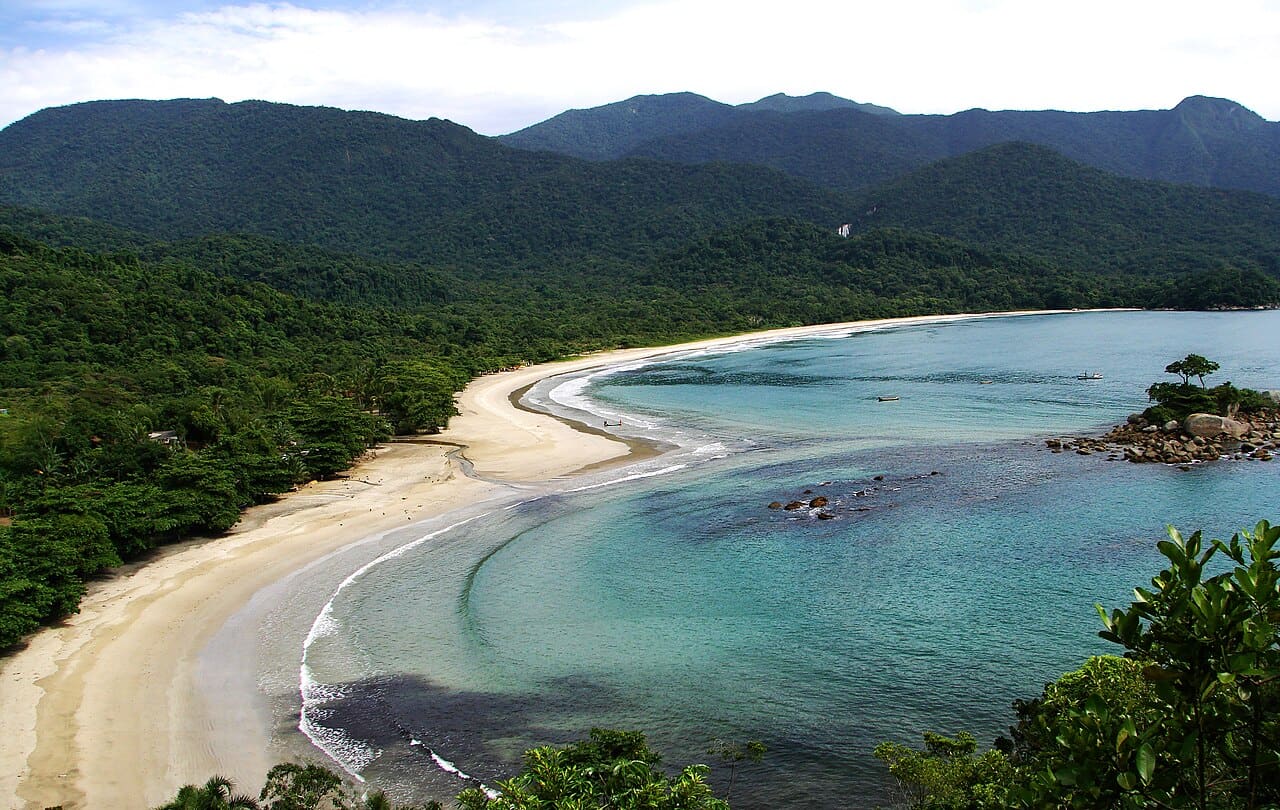 Castelhanos bay and its heart shape, on the ocean side. Photo: Diego F. Gonçalves, CC BY-SA 4.0, Wikimedia Commons
The version that holds all year is Castelhanos, the ocean-side beach that shows up in every aerial photo of the island because of the bay’s heart shape. There is no asphalt out there: 17 km of dirt road cross the state park, open only to vehicles with traction, so the way in is booking a 4x4 with an agency or going by sea. The classic tour leaves in the morning, stops at the Coração viewpoint for the photo that explains the name, drops down to the beach and leaves the afternoon free; anyone up for a walk has the 2 km trail to the Gato waterfall, a tall drop in the middle of the forest that many people consider the most beautiful on the island. On the way back, the dirt road’s rocking is half program, half endurance test: it is part of it.
The winter version competes as an equal. Between May 16 and August 16, humpback whales cross the São Sebastião channel on their migration to the Northeast, and we run whale watching departures from the Pier da Vila: R$ 320 per person, 3h30 at sea on a flexboat (a rigid inflatable), with encounters peaking in June and July. The usual warning, because honesty is house policy: whales are wild animals and sightings are not guaranteed. But watching a 35 ton humpback leap a few meters from the boat reorganizes the memory of the whole trip.
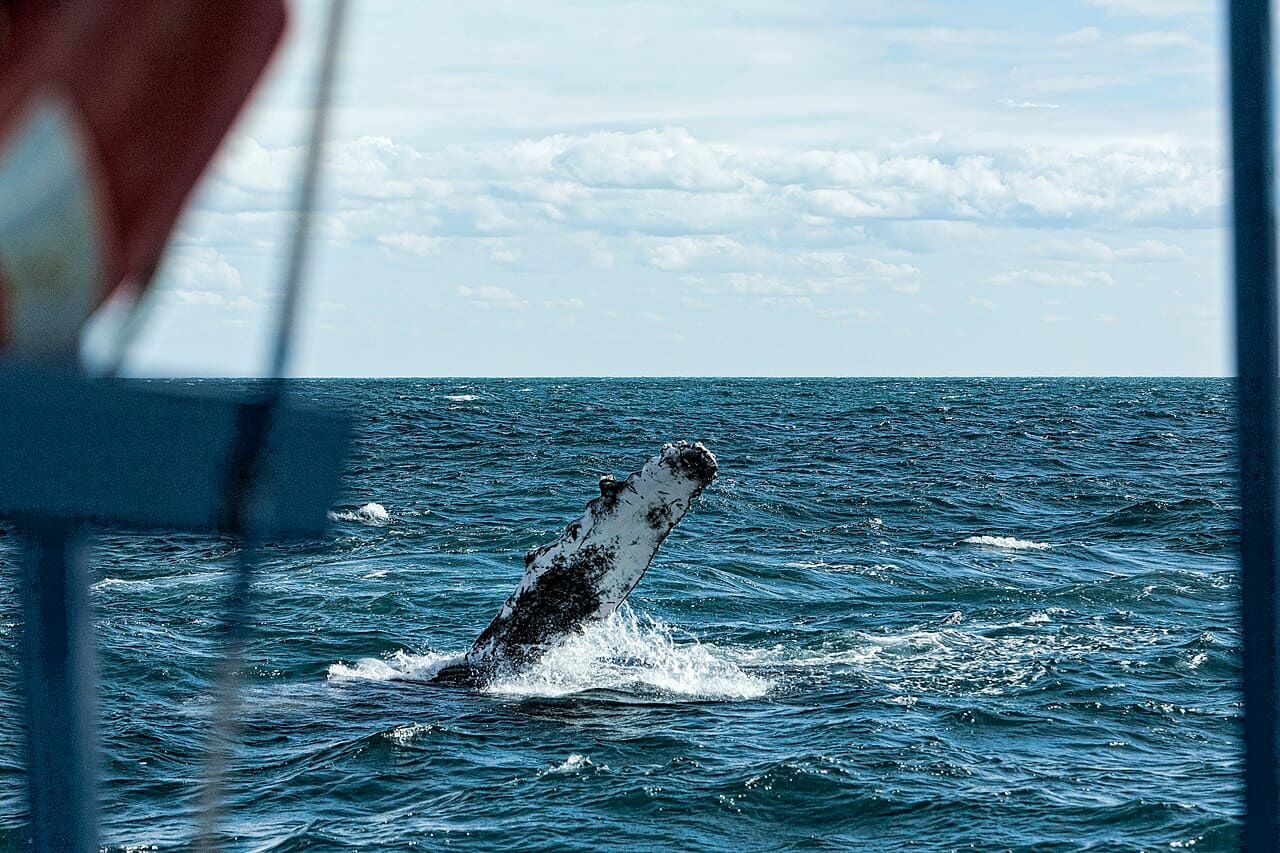 A humpback photographed in Abrolhos, Bahia: the same species that crosses the São Sebastião channel between May and August. Photo: Jonathan Wilkins, CC BY-SA 3.0, Wikimedia Commons
How to decide? If your trip falls outside the season, Castelhanos, no question. If it falls inside, our suggestion as people who have done both a thousand times: whales, because Castelhanos will still be there on your next visit, and the humpback window closes in August. The overview of each season is in the guide to the best time to visit Ilhabela, including the winter chapter, which is when the island most surprises people who arrive without expectations.
The mistakes we see every week
After ten years of check-ins, some stumbles repeat so often they deserve their own paragraph. The first: trying to fit Castelhanos and Bonete into the same three day itinerary. They are the island’s two most remote destinations, each eats a full day, and whoever forces both goes home without having seen the Vila or the channel. Choose one and keep the other as a reason to come back.
The second mistake is a scheduling one: arriving on the Friday night of a holiday with nothing booked. The island is small, the 4x4 and boat tours sell out a day ahead in high season, and the car ferry line passes two hours. Book lodging and the day 3 tour before crossing. The third is a wallet one: the island’s most beautiful corners have no phone signal, and a card machine with no signal is a decoration. Cash in the backpack, always.
And the fourth is one of expectations: underestimating the distances. Ilhabela covers almost 350 km² and has one road; what looks close on the map takes time. That is why this itinerary groups by region, one territory per day, instead of chopping the island up. The complete trip math, with three budget profiles, is in the article on what a trip to Ilhabela costs.
If you have more time
Three days show the island; they do not come close to exhausting it. With one or two extra days come the northern beaches, a real hike and the Vila’s nightlife at a calm pace, and that is exactly what our 5 day Ilhabela itinerary organizes. With a week, in comes Bonete with an overnight stay, which is another trip inside the trip: it is in the 7 day itinerary. And if you are still unsure about the right length of stay, we wrote a straight-to-the-point article on how many days to stay in Ilhabela.
On the third day, in the ferry line home, almost everyone thinks the same thing: I should have stayed longer. Save the thought for next time and start with the simple step: see things to do in Ilhabela and build your own version of these three days.