
The perfect 7 day Costa Verde itinerary
Every summer we welcome travelers in Ilhabela who are finishing the Costa Verde crossing: some step off the ferry in one piece, others arrive needing a vacation from their vacation. The difference is almost always in how the week was designed. Seven days is the minimum to cross the region without turning the trip into a luggage marathon, and there is no slack, we will say that up front: this is an itinerary for people who wake up early. But the essentials fit: Ilha Grande, Paraty, Trindade, Ubatuba and Ilhabela, in the right order and with the crossings sorted out.
The plan below runs Rio to São Paulo, which is what works best for most people (the boat crossings come at the start, while you still have energy). Leaving from São Paulo, just flip it. It was built by crossing our experience as residents with published itineraries, like the 7 day plan from Guia Viagens Brasil and National Geographic’s week on the Costa Verde, and it talks constantly with our definitive guide to the Costa Verde, which explains the region as a whole.
Before you leave: the decisions that define the week
Three choices solve 80% of the planning. First: car or bus. With a car you gain freedom on the São Paulo coast; by bus you save money and pay no parking on island days (the lines and prices are in the article on traveling between Rio and São Paulo along the coast). Second: the season. April, May, September and October bring less rain and fewer people; the full comparison is in the guide to the best time to visit. Third: book your beds ahead, especially on Ilha Grande, where supply is genuinely limited.
Day 1: from Rio to Vila do Abraão
Before the logistics, we will show our hand: if the choice were ours, the Ilha Grande days of this week would be lived from inside a boat, not a flex boat. The three night expedition of the Albatroz, our group’s 23 meter schooner, covers this stretch sleeping on the water: you go from Rio straight to Paraty, board at the marina from 6 pm, spend the next morning at Lagoa Azul with a snorkel and the late afternoon loose in Vila do Abraão. The following morning, the boat drops you early at Praia do Pouso and the 20 minute trail ends at a Lopes Mendes still empty, hours before the day-trip schooners unload their crowds on the sand. In that shape, days 1 to 3 become sea with a chef on board, and you rejoin this itinerary on day 4, stepping off at the Paraty marina around 10 am.
For anyone who would rather make the crossing independently and sleep in the village, the classic path: leave Rio early, by car or on the Costa Verde bus (R$ 53 to 117 to Angra, 3h to 3h30). The destination is Conceição de Jacareí, about 130 km along, where the flex boat to Ilha Grande departs: a 20 to 25 minute crossing, R$ 45 to 150 each way, departures roughly every hour between 8 am and 5 pm. Drivers leave the car in one of the village parking lots and forget about it for two days, because the island has no cars at all.
Arriving in Vila do Abraão before lunch, the day still delivers. Drop the backpack, eat something in the village’s dirt streets and walk to Praia do Abraãozinho, half an hour on an easy coastal trail, to break in the sea. In the late afternoon, the movement at the pier and the boats coming back from tours already set the tone of the place.
Day 2: Lopes Mendes
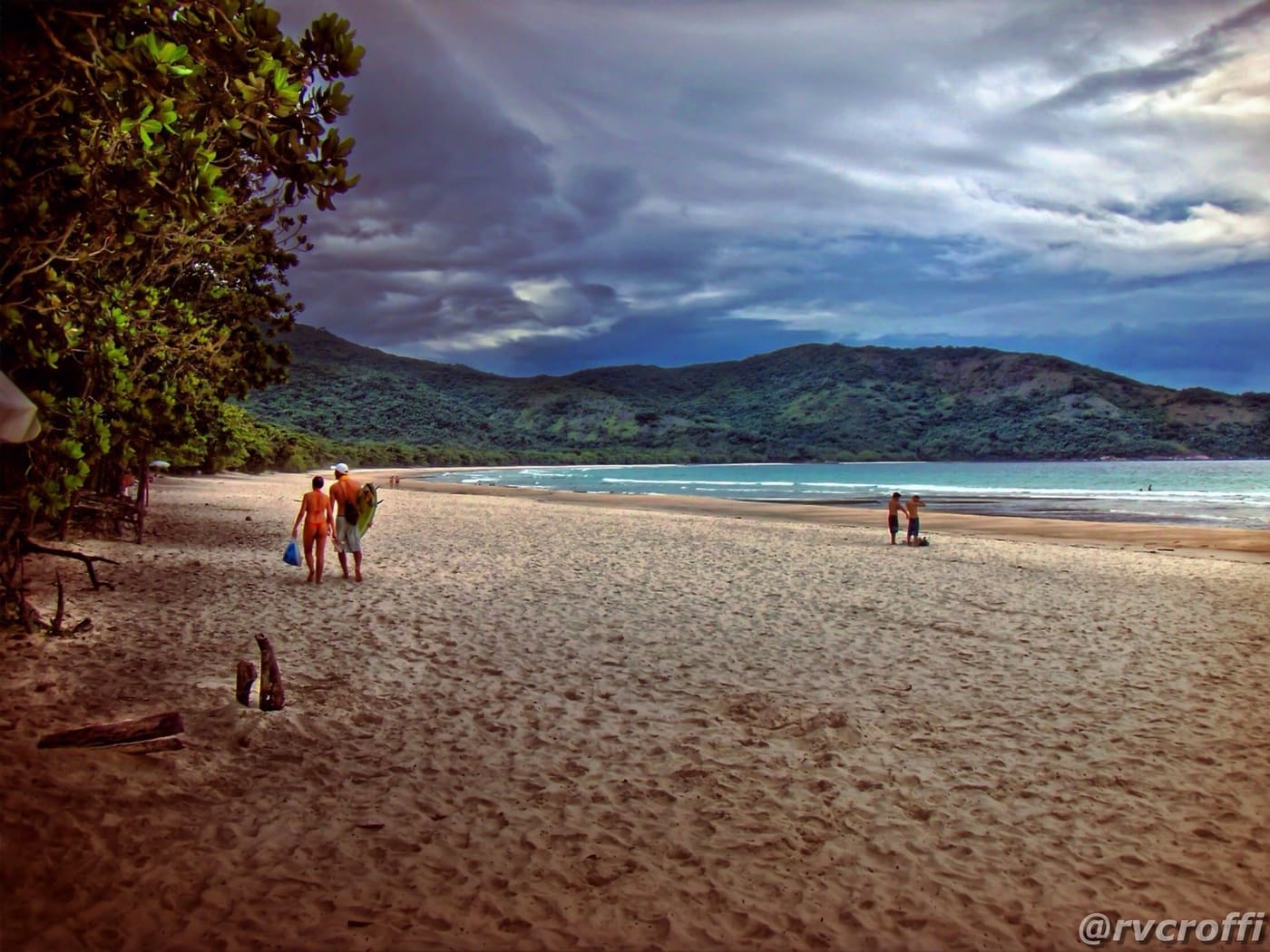
The whole day goes to Lopes Mendes, the beach that usually represents Ilha Grande on lists of Brazil’s most beautiful: 2.5 km of fine pale sand, open sea and not a single building. You cannot arrive by boat directly. The classic way is the taxi boat from Abraão to Praia do Pouso and, from there, 20 minutes of trail through the forest to the sand. Anyone who likes walking can go overland from Abraão, about 3 hours of trail passing other beaches, and return by boat from Pouso.
Bring water and snacks: at Lopes Mendes the infrastructure is minimal, and that is exactly what keeps the place beautiful. Head back mid-afternoon and confirm the time of your next day’s crossing at the pier.
Day 3: crossing over and arriving in Paraty
In the morning, a farewell swim (Praia Preta and the natural aquarium at Palmas are options near Abraão) and the flex boat back to the mainland. From Conceição de Jacareí, drivers head straight down to Paraty, about 1h30 of Rio-Santos with the Serra do Mar falling into the sea. By bus, the way is to reach Angra and take Colitur’s L101 line (R$ 27.50, about 2 hours).
Arrive in Paraty mid-afternoon and save the end of the day for the historic center. That is when it is at its best: the day-trip groups leave, the lamps come on and the “pé de moleque” stone streets go nearly empty. If the moon is full or new, check the tide table: seawater coming in through the lowest streets is a phenomenon that exists only there, and it was designed that way in the 18th century.
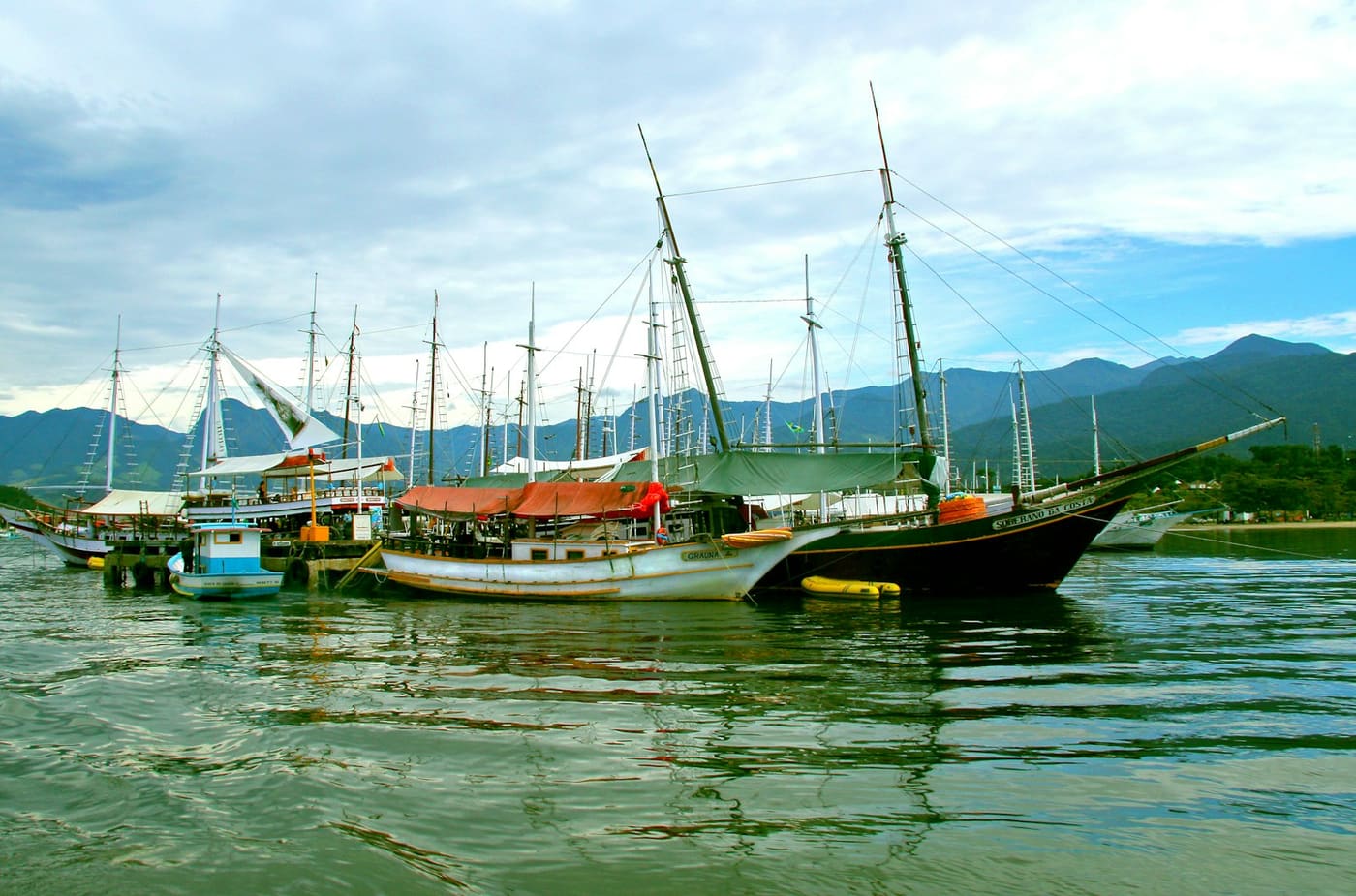 The Paraty pier, departure point for the schooners. Photo: Nareeta Martin, Unsplash
Day 4: the sea of Paraty
Paraty has around 60 beaches and 65 islands, and the simplest way to prove it is the schooner tour that leaves the pier every day, around R$ 60 per person, with swimming stops at islands and coves around the bay. Take the morning boat and you will be back by mid-afternoon. Anyone who followed our day 1 recommendation steps off at the marina today with Lagoa Azul, Abraão and an empty-sand Lopes Mendes already lived, and gains the whole day in town with no bags to unpack: the bed has been the same since boarding.
Use the rest of the day for what got left out yesterday: the Forte Defensor Perpetuo, on a hill overlooking the bay, the churches of the center and the galleries. At night, have a slow dinner in the historic center. It is your last night on the Rio side.
Day 5: half a day in Trindade, night in Ubatuba
Early in the morning, go to Trindade, the caiçara district 27 km south of Paraty, squeezed between Serra da Bocaina National Park and the sea. The municipal Colitur bus costs about R$ 5 and takes 40 minutes. The target is the Cachadaço natural pool: water at waist height, fish circling between the rocks, open sea breaking outside. Go early because the village fills up and the little access road jams in high season.
After lunch, continue to Ubatuba. By car it is the prettiest stretch of the state line, with the Rio-Santos snaking past deserted beaches. By bus, pay attention: Paraty to Ubatuba is the weak link of transport in the region, with few departures per day, so confirm yours as soon as you arrive in Paraty, not at the last minute. Sleep in Ubatuba.
Day 6: morning in Ubatuba, afternoon ferry to Ilhabela
Ubatuba has more than 100 beaches and would deserve a week of its own, so the morning is an appetizer. Two options that fit the clock: Itamambuca, the beach that made Ubatuba the Capital of Surf by state law, or the Projeto Tamar base, running since 1991, where you can see sea turtles of more than 100 kg up close. Anyone who prefers calm water can stay at the beaches around Lázaro, in the south of the municipality.
In the early afternoon, hit the road: it is about 75 km to São Sebastião, passing through Caraguatatuba, and from there the ferry crosses the channel in about 20 minutes. Pedestrians and cyclists ride free; a car pays R$ 19 on weekdays and R$ 28.50 on weekends, with departures every half hour. Arriving in Ilhabela in the late afternoon has a bonus: the sunset over the São Sebastião channel, facing the mainland, is the right way to close the day. We watch that sunset every day: Ilhabela is home to Hostel da Vila, our group’s eco lodge, open in the historic center since 2016, with 8,000 m² of Atlantic Forest and a pool heated to 32°C that pairs well with anyone carrying six days of backpack on their shoulders.
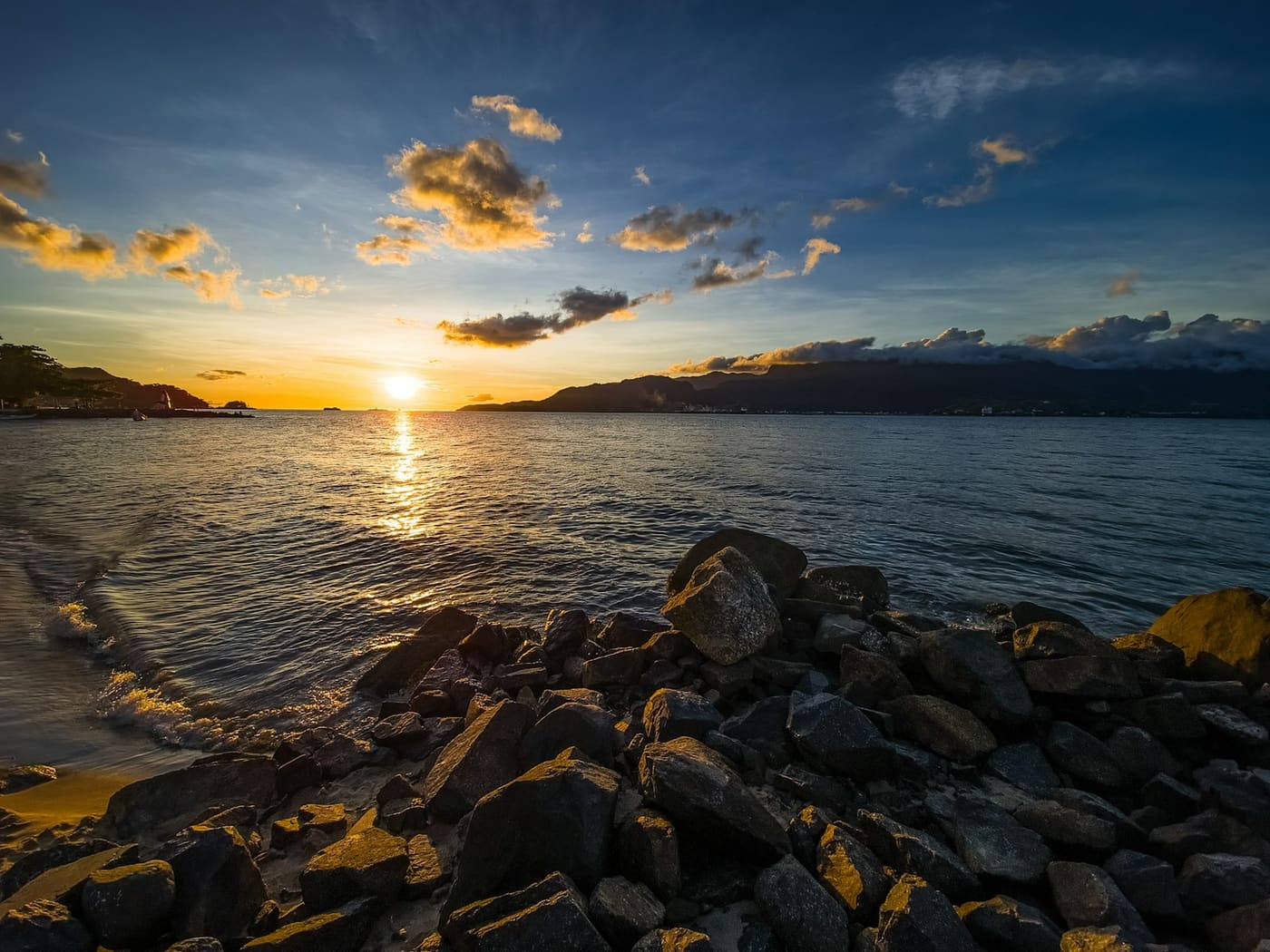 The São Sebastião channel at the end of the day. Photo: Vitor Camilo, Unsplash
Day 7: Ilhabela and the road home
The last day belongs to Brazil’s largest sea island. With a single day, the honest choice is between two programs. The first: channel-side beaches and a waterfall, like Cachoeira da Toca, with cold water pools and a cachaça distillery next door. The second, for anyone who wakes up ready: the 4x4 crossing on the dirt road through the state park to Castelhanos beach, on the side facing the open sea. Bring repellent either way: Ilhabela’s borrachudo, the tiny biting fly, is not a legend, it is a resident.
In the late afternoon, ferry back and up the mountains toward São Paulo, about 4 hours of travel. If you can sleep one more night on the island and leave in the morning, better: the Rio-Santos and the Tamoios at night are not a good plan.
What gets left out (and how to include it)
Seven days cross the Costa Verde, but they leave scheduled longing behind: Saco do Mamanguá, the overnight in Trindade, Pico do Papagaio on Ilha Grande, the wild side of Ilhabela. With three more days, all of it fits without rushing; the plan is in our 10 day Costa Verde itinerary. And if the doubt is about budget, we did the math on what this week costs, by traveler profile, in the article on Costa Verde travel costs.
One last piece of local advice: resist the temptation to squeeze one more stop into this itinerary. It already runs at the limit. The Costa Verde rewards whoever picks fewer places and stays longer in each one, and that is exactly why the longer versions exist.