
How to travel between Rio de Janeiro and São Paulo along the coast
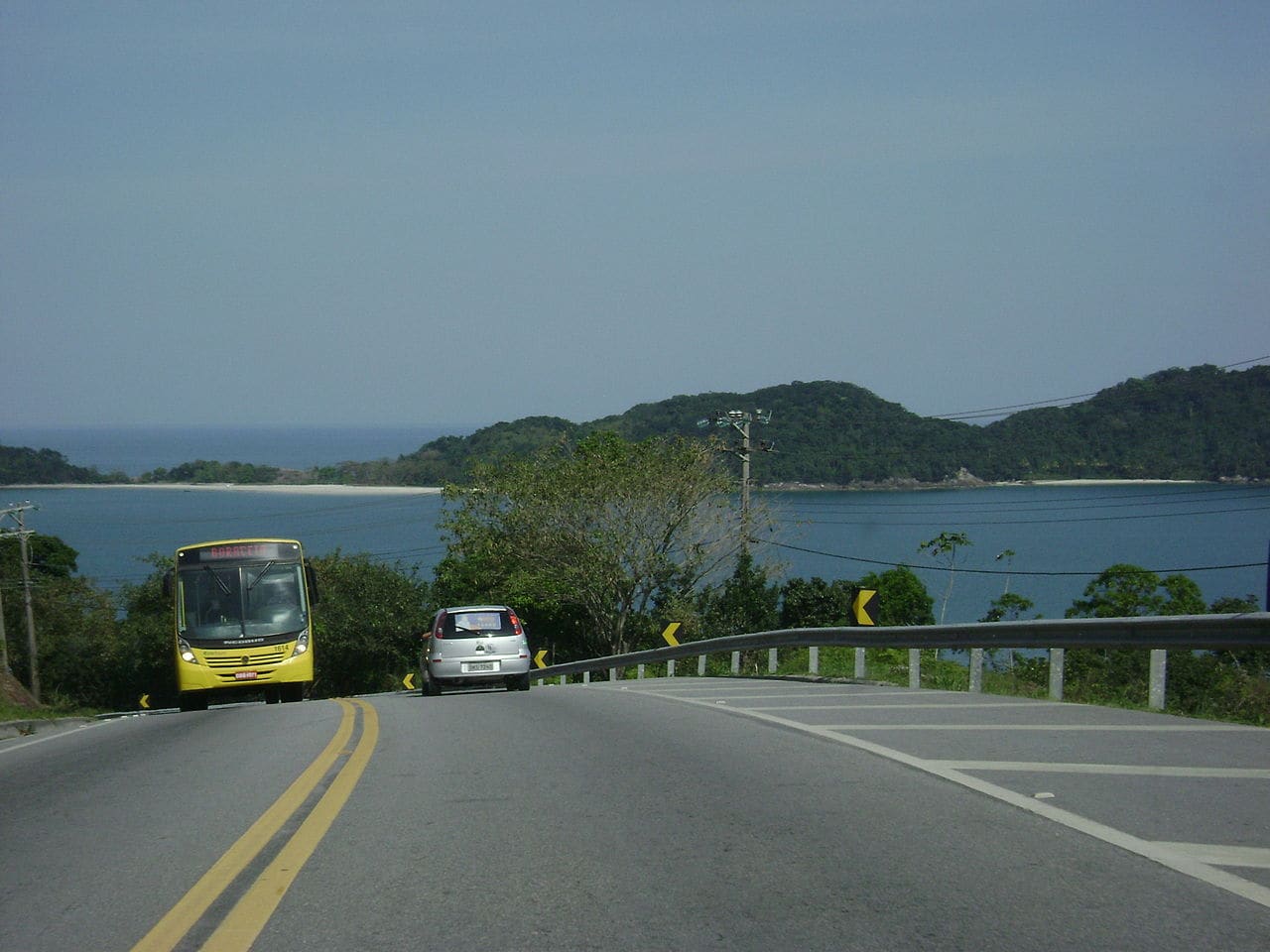
Anyone who needs to get from Rio de Janeiro to São Paulo (or the other way around) almost always thinks of the Dutra highway or a flight. That makes sense: those are the fast options. But there is a third way, one where the Serra do Mar rides pressed against your window and the ocean appears at every curve. On the Rio-Santos, the trip between the two capitals stops being a transfer and becomes the destination itself, running through Angra dos Reis, Paraty, Ubatuba and Ilhabela, the heart of the Costa Verde.
We write from inside that corridor: the people behind this guide live in Ilhabela and use this road all year, to work, to welcome travelers and to get home. Here are the three ways to do the stretch along the coast (car, bus, and a combination of the two), how much time each one asks for, and where it is worth stopping on the way.
The two roads
The classic route between Rio and São Paulo is the Via Dutra (BR-116), which cuts inland through the Paraíba valley. It is divided, fast and dull: the scenery is logistics warehouses and gas stations.
The coastal route uses the Rio-Santos, which is the BR-101 on the Rio side and becomes the SP-055 on the São Paulo coast. It leaves Rio’s west side, drops down the mountains at Itaguaí and starts threading the sea: Mangaratiba, Angra, Paraty, Ubatuba, Caraguatatuba, São Sebastião. It is single lane for almost its entire length, full of curves, with the Serra do Mar on one side and the ocean on the other.
The practical difference is brutal. The Dutra gets done in one easy day. Along the coast, the end points alone take time: Rio to Paraty is about 240 km and around 4 hours, and from Paraty to São Paulo the road continues through Ubatuba and then climbs the mountains on the Tamoios highway. Doing it all in one go, without stopping, is possible and is a waste. The whole point of this route is to stop.
By car on the Rio-Santos
The car is the most flexible way to do the coast, because public transport has one weak link right in the middle of the route (we will get there). The reference times, outside holidays:
- Rio to Angra dos Reis: about 155 km, roughly 2h30
- Rio to Paraty: about 240 km, around 4h
- São Paulo to Ubatuba: about 230 km, roughly 4h
- São Paulo to the São Sebastião ferry: about 200 km, around 4h counting the crossing to Ilhabela
On long holiday weekends, double those numbers without mercy. The Rio-Santos is single lane: one slow car or one accident is enough to build a line of traffic several kilometers long, and we have watched the Angra-Rio stretch sit still for hours on a homebound Sunday. If you can, travel on a weekday and start early.
Since 2026, the Rio state stretch between Itaguaí and Paraty has free flow tolling: there is no booth, cameras read your plate and the charge is settled by app, website or tag. In January 2026 the rate was R$ 4.80 per gantry on weekdays and R$ 7.90 on weekends and holidays. Drive through without paying and a fine arrives later, so it is worth sorting this out before you travel. The details on rentals, parking and the ferry are in our guide to a Costa Verde road trip.
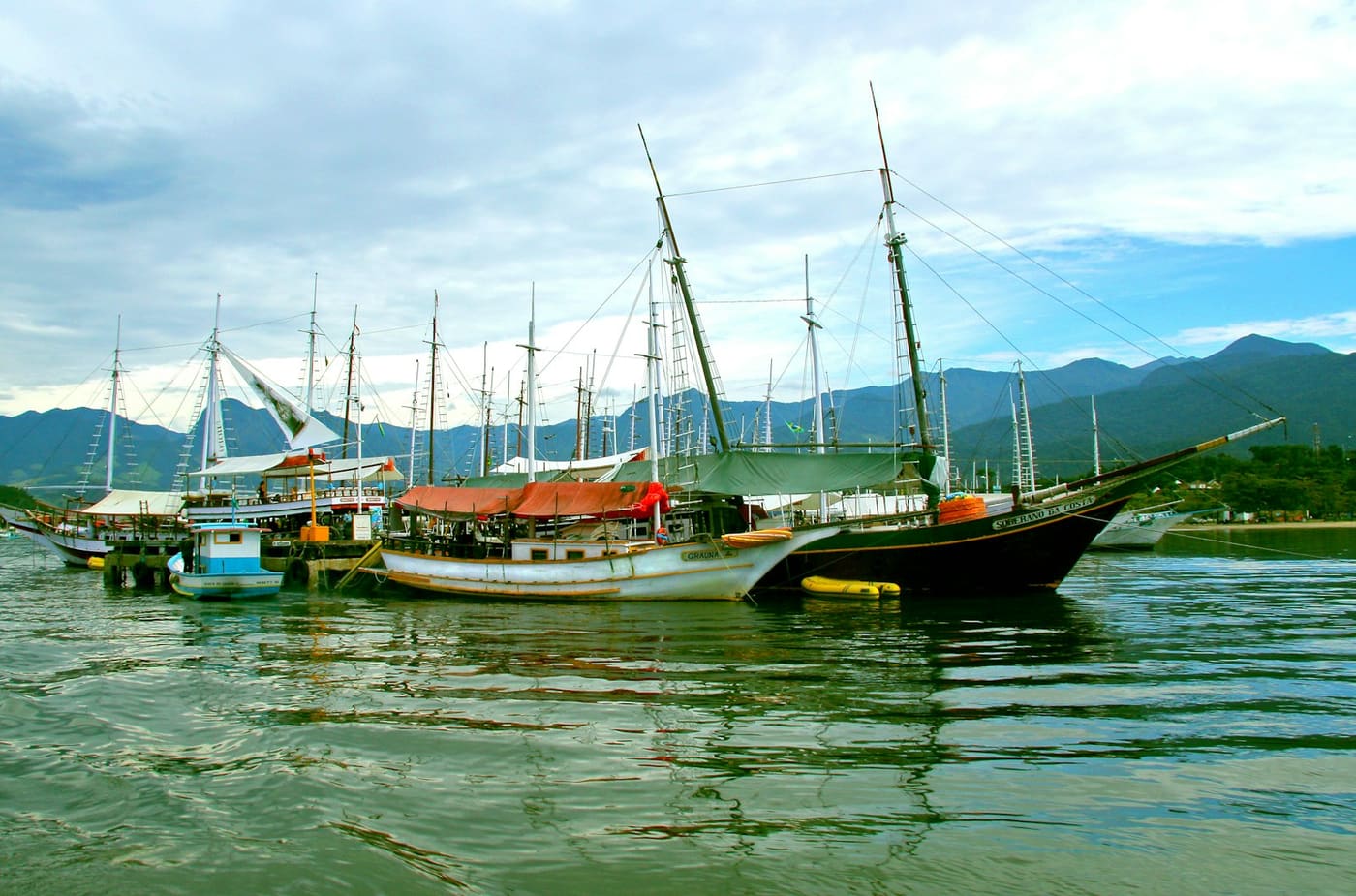 The Paraty pier, halfway between the capitals. Photo: Nareeta Martin, Unsplash
By bus, in segments
You can do the whole route by bus, and it comes out cheap. The secret is understanding that there is no single “Rio to São Paulo along the coast” line: you build the trip leg by leg.
| Leg | Company | Approx. price | Time |
|---|---|---|---|
| Rio → Angra | Costa Verde | R$ 53 to 117 | 3h to 3h30 |
| Rio → Paraty | Costa Verde | from R$ 120 | 4h30 |
| Angra ↔ Paraty | Colitur (L101) | R$ 27.50 | 2h |
| Paraty → Trindade | Colitur local | R$ 5 | 40 min |
| Ubatuba → São Paulo | Pássaro Marron | R$ 126 to 142 | 4h |
| Ilhabela → São Paulo | Pássaro Marron | R$ 101 to 123 | 4h30 + ferry |
The weak link is the jump between states: Paraty to Ubatuba has only a few bus departures per day, and missing the morning one can cost you the day. Confirm the timetable at the bus station as soon as you arrive in Paraty, not when you are about to leave. Within Ubatuba and between Caraguatatuba and São Sebastião there are municipal and intermunicipal lines that get the job done, but they demand patience.
The good news is that the destinations themselves do not need a car: Ilha Grande has no cars by definition, Paraty’s center is closed to vehicles, and Ilhabela works fine with the municipal bus, a bicycle and boats. Anyone who wants to do the entire trip this way will find the step by step, with apps and connections, in our guide to the Costa Verde without a car.
The mixed route, which is the one we recommend most
There is a middle path that solves things for a lot of people: do the long legs by bus and rent a car only where it earns its keep. A common shape is to leave Rio by bus down to Angra or Paraty, do Ilha Grande and Paraty without a car (there it only gets in the way and racks up parking fees) and rent a car in Paraty or Ubatuba for the São Paulo stretch, where the beaches are spread out and buses run less often.
Another variation: leaving from São Paulo, you can go by direct bus to Ubatuba or Ilhabela, do the north coast at your own pace and cross to Paraty by bus, leaving the car out of the equation entirely. The math on what each format costs per day is in our article on Costa Verde travel costs.
Where to stop along the way
The full list would fill a book, so here is the essential of each stop, in order leaving Rio.
Mangaratiba and Conceição de Jacareí are the boarding points for Ilha Grande, the first big reason to take the coastal route. For anyone going independently, the service information: from Conceição, the flex boat crosses in 20 to 25 minutes (R$ 45 to 150 each way, with departures roughly every hour between 8 am and 5 pm); the conventional ferry costs R$ 20.50 from Mangaratiba but runs very few times a day.
Angra dos Reis works as a base for schooner tours around the islands of the bay, between R$ 49 and R$ 109 per person. Paraty asks for at least one night: the historic center at dusk, with the lamps lit and the tide coming in through the stone streets, justifies the trip on its own. And here this guide takes a side: the most beautiful piece of the whole route, between Paraty and Ilha Grande, we recommend doing by sea, not on the single lane road. The Albatroz, our group’s 23 meter schooner, leaves town on two to five night expeditions through spots like Lagoa Azul, on Ilha Grande, and Saco do Mamanguá, with a chef on board; on one of the nights the boat anchors by Praia do Pouso, and Lopes Mendes receives you before the day-trip boats arrive. You have dinner on deck, sleep rocked by the sea and wake up at a beach no car can reach: it is the piece of the trip where giving up the wheel stops being a concession and becomes the reason. And 27 km from Paraty, Trindade keeps the Cachadaço natural pool.
On the São Paulo side, Ubatuba has more than 100 beaches and the Projeto Tamar sea turtle base, open since 1991. Maresias is the stop for surf and nightlife. And Ilhabela, 20 minutes by ferry from São Sebastião, closes the route with more than 40 beaches, dozens of waterfalls and a state park covering most of the island; between May and August, humpback whales pass through the channel. It is where this route ends and where we live: the people writing this run Hostel da Vila, an eco lodge opened in 2016 in the island’s historic center, with 8,000 m² of Atlantic Forest where you sleep in a dome, a treehouse or a VW kombi, and a pool heated to 32°C waiting for whoever arrives off the road. Anyone who wants an honest ranking of where to invest their time can start with the most beautiful destinations between Rio and São Paulo.
 Late afternoon on the São Sebastião channel, the final stretch of the route. Photo: Vitor Camilo, Unsplash
How many days to set aside
It depends on what you want this trip to be.
Two days turn the route into a stretched-out day trip: you can sleep in Paraty and keep moving, no islands. It already beats the Dutra, but it leaves you wanting.
Four or five days let you pick a side: either Ilha Grande and Paraty, or Ubatuba and Ilhabela. It works well as a first taste of the region.
A week is the minimum for the complete corridor, with two nights on Ilha Grande, two in Paraty and the rest on the São Paulo coast. That shape is broken down in our 7 day Costa Verde itinerary. With ten days the trip breathes, there is room for Trindade and Saco do Mamanguá, and the plan becomes the 10 day itinerary.
Warnings from people who use this road all year
First: the Rio-Santos at night is not worth it. No lighting, tight curves, fog at the foot of the mountains and landslide-prone stretches in the rainy season turn scenery into tension. Plan your transfers for daylight.
Second: fill up in the towns. Between Paraty and Ubatuba, for example, gas stations get scarce, and running dry on a single lane road blocks everyone.
Third: pick your season well. Between December and February it rains hard (January in Paraty can top 500 mm) and the road fills up; April, May, September and October bring steady weather, lower prices and open road. The month by month breakdown is in our guide to the best time to visit the Costa Verde.
Finally, a local’s reminder: this route rewards whoever slows down. If your only goal is to arrive, take the Dutra or fly. If the trip can be part of the vacation, the coast delivers one of the most beautiful stretches of road in the country and a collection of places that make plenty of people rethink what exists between São Paulo and Rio beyond the capitals.