
How to plan a Costa Verde road trip
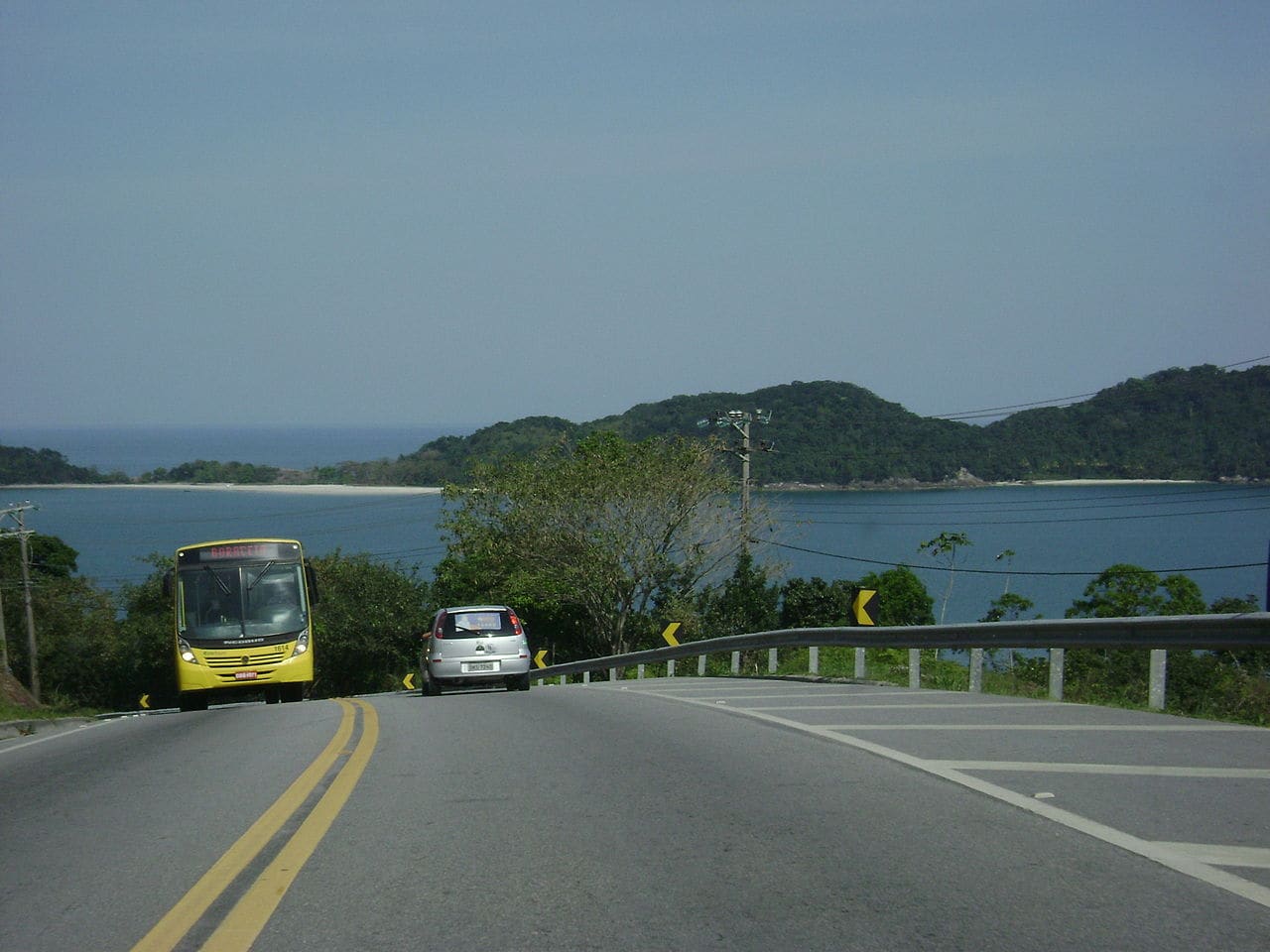
The Rio-Santos shows up on every list of Brazil’s most beautiful roads, and the fame is deserved: hours of curves with the Serra do Mar on one side, the sea cutting into coves on the other, and beaches appearing through the windshield before you have decided whether to stop. What the lists leave out is the practical part. A single-lane road that locks up on holidays, a toll with no booth that fines drivers who never knew it existed, historic towns where the car cannot enter, an entire island where it cannot even board.
We live in Ilhabela and drive this corridor all year, from the ferry to the mountain passes, so this guide is the manual we wish someone had handed us before our first trip. It complements the definitive Costa Verde guide, which introduces the destinations, and the comparison of how to travel between Rio and São Paulo along the coast, which weighs car against bus.
The right car (and whether renting pays off)
First piece of good news: you do not need a 4x4. The Rio-Santos and the Tamoios are paved end to end, and a basic compact makes the whole trip without drama. The exceptions are specific access roads, like the dirt road to Castelhanos in Ilhabela, and in those cases a tour with a local jeep beats taking your own car.
Two warnings for anyone renting. Check the mileage allowance, because the full crossing easily adds up to more than 600 km between pickup, side trips and drop-off. And watch the plan of returning the car in a different city from where you picked it up (collect in Rio, drop off in São Paulo, for example): most rental companies charge a one-way fee for that, and it can change the math of the whole trip. Ask for the amount in writing before you book.
Documents in order and insurance with third-party cover are worth the extra care: a single-lane road has more friction than a divided highway, literally.
The Rio-Santos in practice
The stretch between Rio and Paraty (BR-101) and its São Paulo continuation (SP-055) run single lane for almost their entire length. That defines everything. A slow truck becomes a convoy, an accident becomes a standstill, and there is no alternative route: the mountains sit on one side, the sea on the other.
Reference times with a clear road: Rio to Angra in about 2h30 (155 km), Rio to Paraty in around 4h (240 km), São Paulo to Ubatuba via the Tamoios in about 4h (230 km). On a long holiday weekend, double them. That is not a figure of speech: it is what happens, every holiday, in both directions. The most critical dates are New Year, Carnival and July, which in 2026 also stacks FLIP in Paraty (July 22 to 26) and the Sailing Week in Ilhabela (July 24 to August 1).
The golden rules of the people who live here: drive in daylight, always. The road has no lighting, fog comes down early at the foot of the mountains and, in the rainy season, the landslide warnings are real. Leave early, arrive with light. And fill up in the towns, because gas stations get scarce between Paraty and Ubatuba.
The toll with no booth
Since the Rio de Janeiro stretch went to a private operator, the toll between Itaguaí and Paraty works on a free flow system: gantries with cameras read your plate and there is no booth to stop at. In January 2026, the rate per gantry was R$ 4.80 on weekdays and R$ 7.90 on weekends and holidays.
The detail that catches the unprepared: the charge is not automatic if you do not have a payment tag. Without a tag, you have to pay after driving through, on the operator’s website or app, within the deadline. Anyone who does not pay gets a toll evasion fine on top of the amount. If your car already has a parking and toll tag, nothing changes; if not, set a reminder on your phone for the day of the trip.
Parking: the car sits out the best parts
Here is the irony of a Costa Verde road trip: the three most famous places on the route do not take your car.
Ilha Grande has no cars, period. Anyone spending nights there leaves the car on the mainland, in private lots at the boarding points: in Conceição de Jacareí and Mangaratiba daily rates run around R$ 30, and Angra has covered options in the R$ 40 range. Pick an established lot over street parking, because the car will sit for days.
Paraty’s historic center is closed to vehicles, with irregular stone paving that would wreck your suspension anyway. And it is in Paraty that we give the most openly biased advice in this guide: the best destination for your car is a parking space for a few days, with you out at sea. The Albatroz, our group’s 23 meter schooner, leaves Paraty on expeditions of two to five nights, with a chef on board and sunrises on beaches that have no parking because they have no road. The logistics for anyone staying on land: lots around the center charge in the range of R$ 15 per day, and many guesthouses have their own spots, which in practice matters more than location when choosing where to sleep.
In Trindade the problem is different: the village is small, the little access road is narrow and in high season the district saturates. Arrive before 9 am or take the bus from Paraty (Colitur, about R$ 5) and leave the car in town.
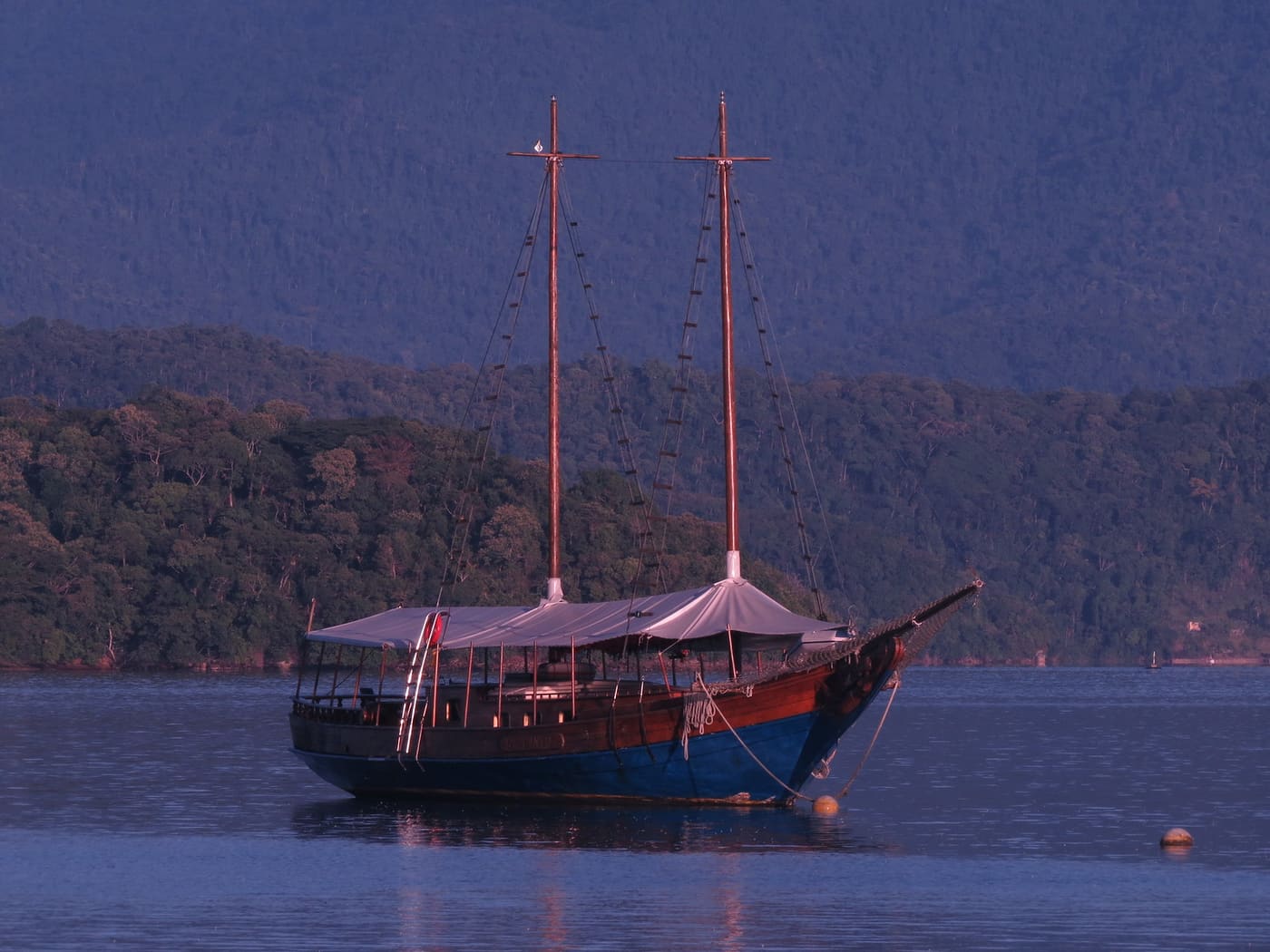 In the bay of Angra, the day continues by sea: the car stays in the lot. Photo: Hudson Sousa, CC BY 2.0, Flickr
The car ferry to Ilhabela
The only crossing on the route where the car boards is São Sebastião to Ilhabela: 20 minutes across the channel, departures every half hour between 5:30 am and 11:30 pm, R$ 19 per car on weekdays and R$ 28.50 on weekends. Pedestrians and cyclists ride free.
Is it worth taking the car to the island? In most cases, yes: Ilhabela’s beaches spread along dozens of kilometers of shoreline and the car earns its keep. The exception is holidays, when the ferry line toward the island can stretch to hours of waiting. There is a paid time-slot booking for anyone who wants to guarantee the crossing; on peak days, also run the honest math of parking in São Sebastião and crossing on foot, then covering the island by municipal bus and taxi. Guests based around the Vila get through most days without a steering wheel; it is there, in the historic center, that you find Hostel da Vila, our group’s eco lodge, open since 2016, with 8,000 m² of forest around it and a pool heated to 32°C that closes out a day on the road nicely.
A reminder about protected forest: inside the island, access to the ocean side is restricted. For Castelhanos, hire the 4x4; for Bonete, it is a 16 km trail or a boat. Your rental car will thank you.
The order of the stops
The corridor is linear, so the road trip draws itself: Mangaratiba or Conceição de Jacareí (base for Ilha Grande), Angra, Paraty, Trindade, Ubatuba, São Sebastião or Maresias, Ilhabela. Leaving from Rio, that is the order; leaving from São Paulo, reverse it. There is no shortcut worth taking in the middle: leaving the Rio-Santos means climbing the mountains and abandoning the route.
Two decisions deserve attention. The first is where to “spend” the nights: our recommended distribution for a week is in the 7 day itinerary and, with more slack, in the 10 day itinerary. The second is direction: travelers who depend on expensive flights usually prefer to arrive and leave through the same city, driving the route as far as Paraty and turning back, which eliminates the rental company’s one-way fee and leaves the second half of the road for a future trip.
What the drive costs
Adding up the pieces, the car budget on the Costa Verde has five lines: rental (if any), fuel, tolls, parking and the ferry. The last three are small and predictable: gantries of R$ 4.80 to 7.90 on the Rio stretch, parking rates between R$ 15 (Paraty) and R$ 40 (covered lots in Angra), ferry up to R$ 28.50. Fuel is the line that fools people, because the low average speed and the constant climbing and descending raise consumption compared with the same distance on a divided highway.
Against intuition, going by car is not always more expensive than the bus: from two people up, splitting the cost already competes with the combined tickets, and with three or four the car wins comfortably. The full comparison, including lodging and tours by traveler profile, is in the article on what a Costa Verde trip costs.
Checklist before you turn the key
Book your lodging in advance for holidays and July, because the region sells out and sleeping in the car is not a plan. Download offline maps: the phone signal disappears along several stretches of the road and on beaches like Trindade’s. Carry cash for informal parking lots and village kiosks. Check the rain forecast for the day you cross the mountains, and always keep half a tank in reserve.
And calibrate your expectations, which is the most important piece of advice: the average speed on the Rio-Santos is low, and that is simply how it is. The good plan is not the one that arrives fast, it is the one that stops often. If you are unsure where, the list of the most beautiful destinations between Rio and São Paulo and the calendar of the best time to visit close out the planning.