
Perfect destinations for nature lovers
There is a type of traveler we recognize at check-in. They do not ask where the party is or which beach is trending: they ask what bird is singing, whether the peak can be climbed and what time the forest wakes up. This guide is for them. We write from inside a property where the Atlantic Forest comes down to the accommodations, in the middle of an island that is 85% park, so the list’s criterion came easily, because it is the house criterion: standing forest, wildlife at ease and genuine silence. The six destinations below are the sanctuaries of the corridor between Rio and São Paulo, the places where nature is not the trip’s backdrop, it is the trip.
Ilhabela State Park: the island that is almost all forest
Start with the fact that changes how you read the place: about 85% of Ilhabela is State Park, continuous Atlantic Forest where no street or subdivision enters. The urbanized part is a thin edge along the channel coast; the rest is forest climbing to peaks above a thousand meters, dozens of waterfalls and an entire ocean side with no asphalt.
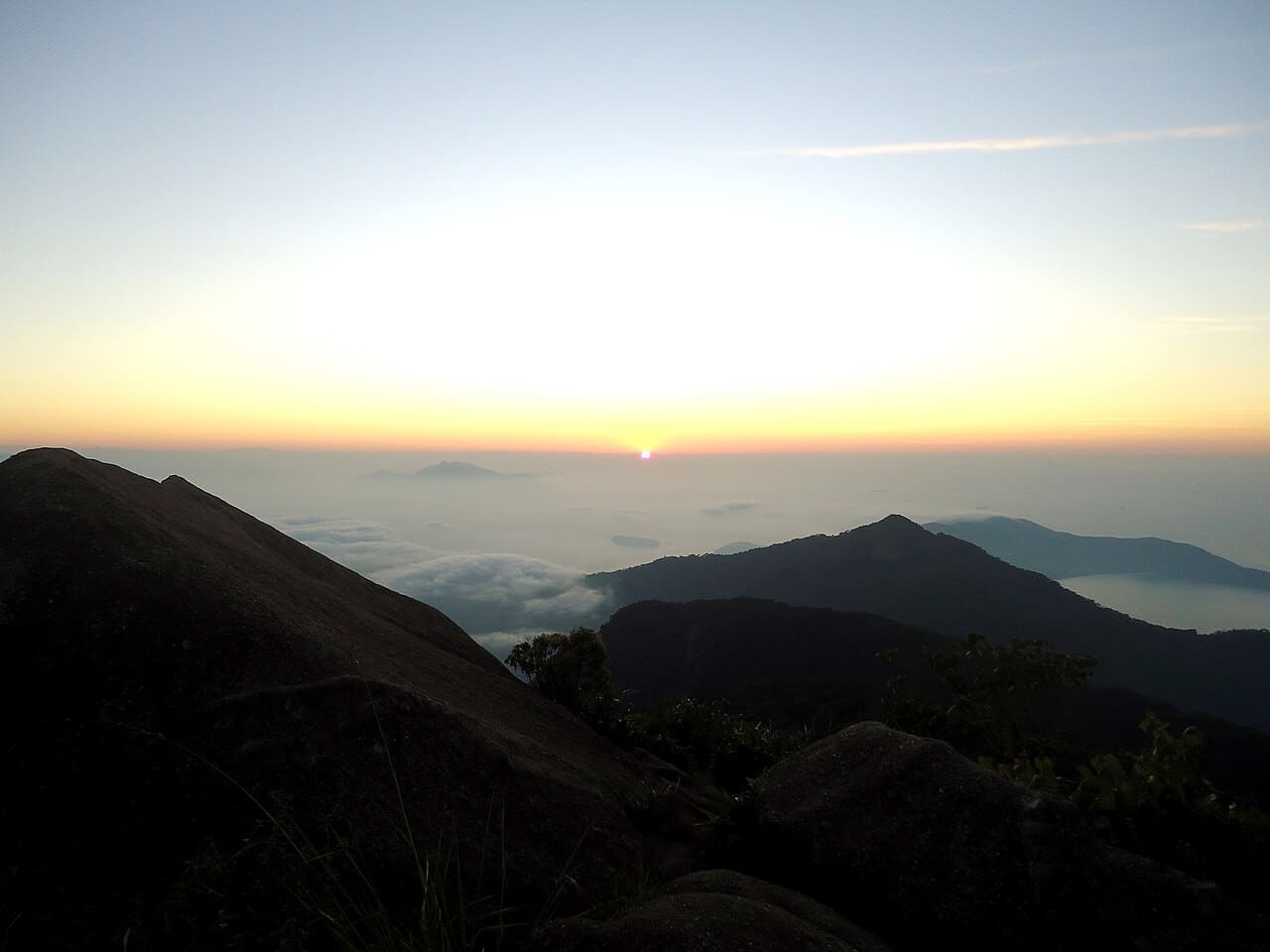
In practice, that yields a run of immersions on consecutive days without repeating a biome: the climb of Baepi peak (1,048 meters, accredited guide mandatory) with the whole channel at your feet, the Água Branca trail with five swimming holes inside the forest, and the 16 km crossing to the caiçara village of Bonete, fording rivers and passing waterfalls to reach a community with no road. The full catalog, with the honest difficulty of each one, is in the guide to the best hikes in Ilhabela, and the freshwater has a chapter of its own in Ilhabela waterfalls.
The seasonal bonus is too big for a footnote: between May and August, humpback whales pass along the island’s coast on their way to Brazil’s Northeast, and winter becomes the liveliest season of the year for anyone who loves wildlife, as we argue in Ilhabela in winter.
And here is the usual declared interest, because the base matters to whoever comes for the forest: Hostel da Vila, our group’s eco lodge in the historic center, on the channel side, keeps 8,000 m² of Atlantic Forest inside its own property. Waking up in a dome or a treehouse hearing the same animals you will meet on the trail, and ending a hiking day in the pool heated to 32°C, is the comfortable version of the immersion this article argues for.
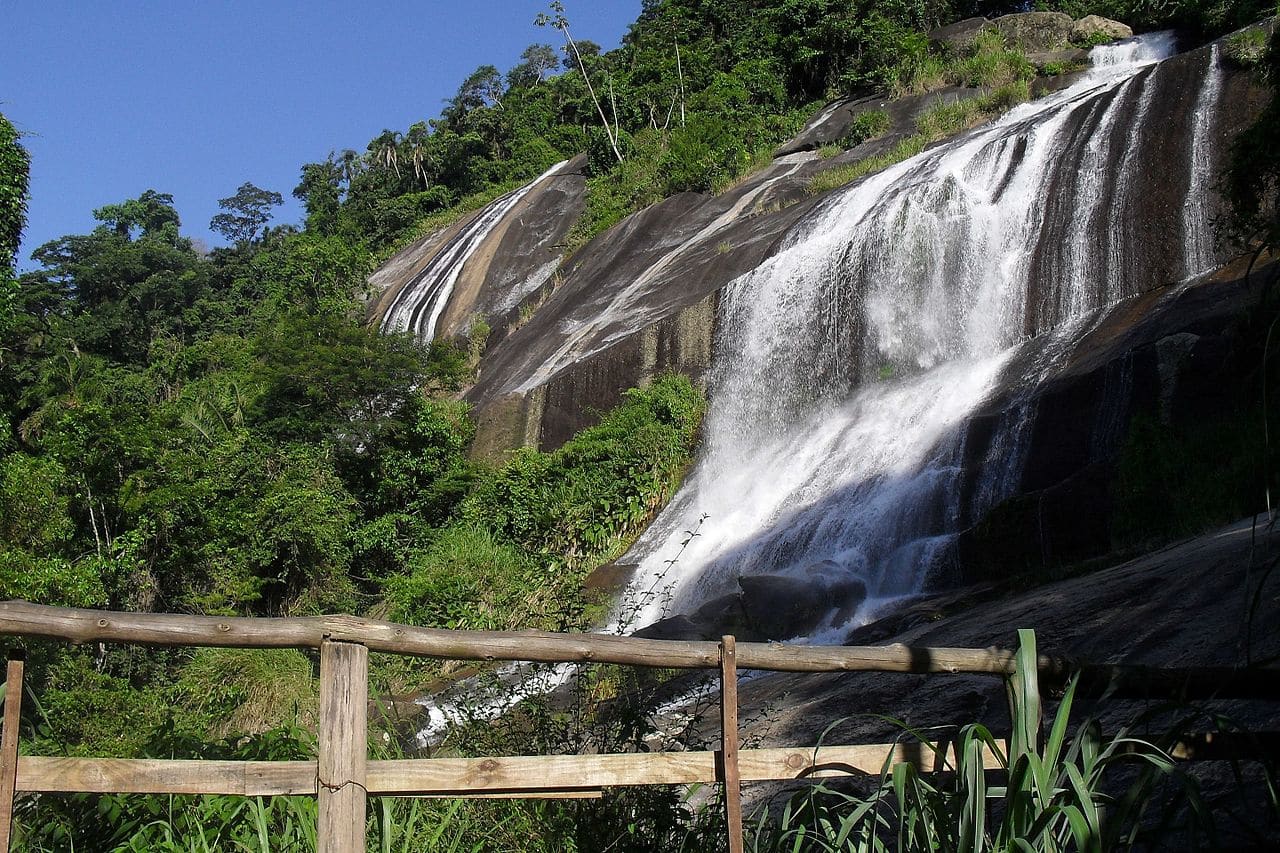 Freshwater in Ilhabela State Park: the mountains manufacture waterfalls all year long. Photo: Iuri Bertolini, CC BY-SA 4.0, Wikimedia Commons
Ilha Grande State Park: the island without cars
On the Rio de Janeiro side, the sanctuary holds a trump card no other destination in the Southeast offers at the same scale: Ilha Grande has no cars. None. The silence there is not an absence of people, it is an absence of engines on land, and your body registers the difference on the first day.
The island is dominated by the State Park and studded with natural superlatives: Pico do Papagaio, at 982 meters, with the tradition of climbing before dawn to watch the sunrise with the whole bay below (guide mandatory for the night hours); Lopes Mendes beach, 2.5 km of sand without a single building; and the trail circuit connecting beaches, ruins and rocky shores, mapped in our guide to Ilha Grande hiking trails. Below the waterline the park continues: turtles, seahorses and dense schools of fish in the protected coves, which makes the island the epicenter of Costa Verde snorkeling.
At the island’s ocean end, the village of Aventureiro takes the concept to its limit: a sustainable development reserve, a cap of 560 visitors, generators that shut down at 10 pm and the Milky Way as street lighting. It is the most radical nature experience on the corridor for anyone who accepts camping and rules.
Ilha Anchieta: the park the sea regenerated
The smallest sanctuary on the list is the most instructive. Ilha Anchieta, in Ubatuba, a state park since 1977, carries an improbable history: it housed a prison until the middle of the last century, and since then the forest has swallowed the ruins and the sea has rebuilt the rocky shores. Today you arrive by schooner from Saco da Ribeira to see the result: brain corals, turtles, rays and groupers along the rocks, monitored trails (the Praia do Sul trail ends at an isolated cove of green water) and the ruins as a reminder of what nature does when given fifty years of peace. It is the best nature day trip on the São Paulo north shore and the only entry on this list that fits comfortably into a single day.
Serra da Bocaina and Trindade: where the mountain falls into the sea
Serra da Bocaina National Park is the region’s silent giant: it descends from 2,000 meters of altitude until it touches the sea at Trindade, the caiçara district of Paraty squeezed between the mountain and a cove of giant boulders. What that geography produces is the rare place where you walk from the beach into hillside forest in minutes: the Cachadaço natural pool, the wild beaches in sequence and, up the mountain, the Caminho do Ouro, the 18th century paved gold trail visited with a guide inside the park. Trindade fills up on summer holidays, and honesty requires saying the village already flirts with its own limit; off season, it is one of the most beautiful meetings of forest and sea in the country. The region’s walks are in the ranking of the best hikes on the Costa Verde.
Saco do Mamanguá: the fjord of silence
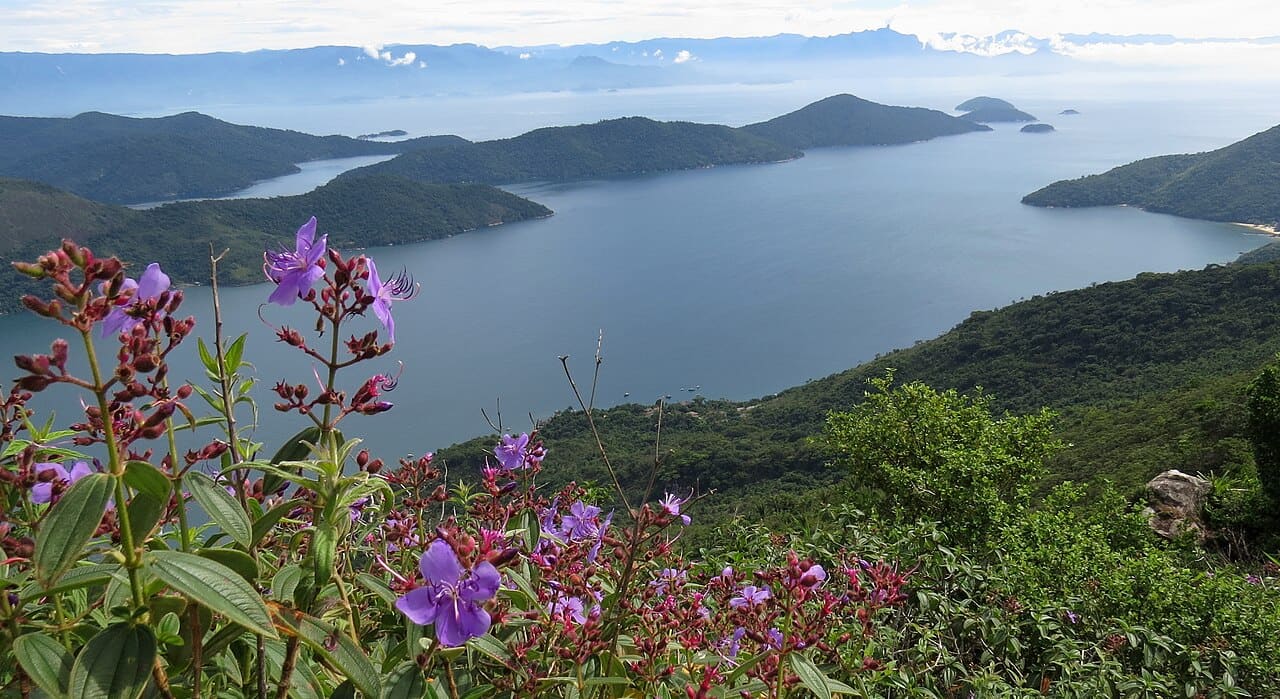 Mamanguá from the top of the Sugarloaf: 8 km of sea running into the mountains. Photo: Pedro Gabriel Maciel, CC BY-SA 3.0, Wikimedia Commons
If the criterion is silence, the corridor’s champion is an 8 km arm of sea that pushes into the mountains south of Paraty and ends in mangrove. Saco do Mamanguá has no road at all: more than thirty pocket beaches, around eight caiçara communities and a steep 1.4 km trail up the Pão de Açúcar, the 425 meter hill from which the whole fjord draws itself. At the far end, the mangrove is visited by canoe, gliding through corridors of roots with herons lifting off ahead of the bow.
Mamanguá is also where we sleep, and this is this guide’s second and last mention of home: the Albatroz expedition, our group’s schooner, leaves Paraty and spends the night anchored inside the fjord, with a bonfire on the beach and the Pão de Açúcar trail starting practically where the boat slept. At night, when the houses’ generators shut down, the stars double: half in the sky, half reflected in the still water. It is the scene we would use to explain to a foreigner why this coast carries the name it does.
How to build the trip around nature
Three pieces of advice from people who host this type of traveler every year:
- Choose the season for the forest, not the beach. From May to August the trails dry out, visibility opens up, the whales pass and the parks empty. It is nature’s high season, even if the tourism calendar says otherwise; the full reasoning is in the best time to visit the Costa Verde.
- Give each sanctuary a night, not a visit. The best of these places happens at the edges of the day, when the day-trippers have not arrived or have already gone. It holds for Mamanguá, for Aventureiro, for Bonete: whoever sleeps there sees a different place.
- Treat the rules as part of the destination. Mandatory guides, visitor caps, trail hours: all of it is the reason the list above still exists. The full manual of that mindset is in the guide to sustainable travel on the Costa Verde.
And if the question is where to begin: for a first trip, Ilha Grande answers with the easiest combination of forest, sea and logistics; for those who already know the obvious, Mamanguá and Aventureiro are the next steps up; and Ilhabela is the only one on the list where the immersion coexists with a town’s full infrastructure. Their profiles, side by side, are in the most beautiful destinations between Rio and São Paulo.
The Costa Verde holds one of the country’s best preserved stretches of Atlantic Forest falling straight into the sea, and it is not hidden: it sits four hours from Brazil’s two biggest cities, waiting behind a trail, a boat crossing or a free permit collected in Angra. Pick one sanctuary from this list and give it more time than seems reasonable. It is in that extra time that the nature here introduces itself.