
Where to go snorkeling on the Costa Verde
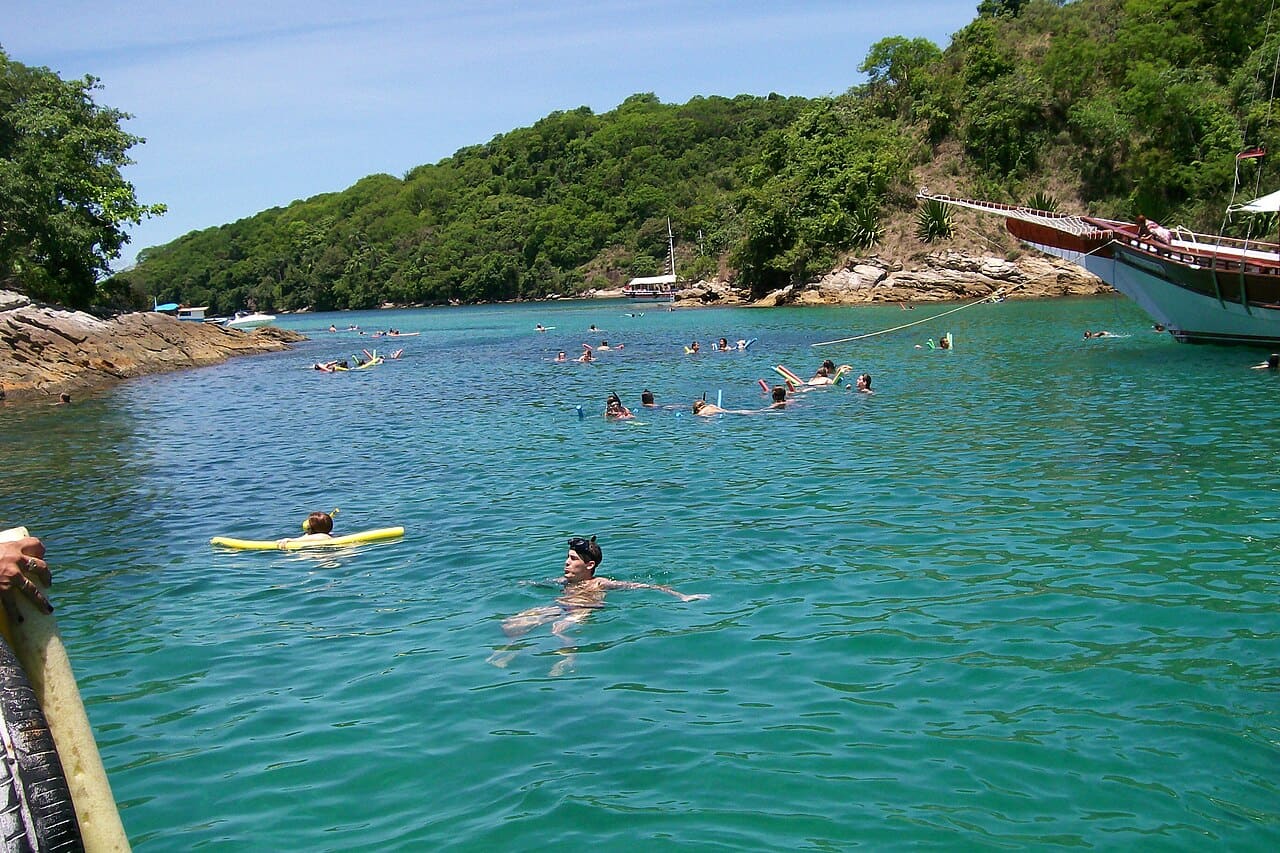
Of all the travel gear that passes through our reception, the one that delivers the most joy per real invested is a R$ 100 snorkel mask. We see the proof every week: our group’s schooner crosses Ilha Grande bay with masks and transparent kayaks on board, and the moment when someone lifts their head out of the water for the first time, pulls out the mouthpiece and tries to describe what they saw has been the same for years. No full sentence comes out.
This guide maps where that moment happens across the whole Costa Verde, from Angra to Ilhabela, region by region. The logic that organizes everything: good snorkeling needs sheltered sea. Where the coast folds into a cove and the waves die, the sand settles and the water clears; where the sea hits open shore, visibility dies with it. That is why the spots below concentrate on the protected side of each destination, and why famous open-sea beaches are left out without apology.
Ilha Grande: the epicenter
Nowhere on the corridor packs in as many good spots as the sheltered coast of Ilha Grande, and two of them need no introduction: Lagoa Azul, a natural pool between islets with cheeky sergeant majors and a bright bottom dotted with sea stars, and Lagoa Verde, smaller and more tucked away, where greenish corals hide seahorses and turtles show up often. Both run on a clock: early morning or late afternoon they are a silent aquarium; at midday they turn into a schooner parking lot. The full duel, with timings, is in the comparison Lagoa Azul or Lagoa Verde.
The island delivers far beyond those two: Praia Preta, 20 minutes on foot from Abraão, the deep pool of Caxadaço, Meros beach with turtles almost guaranteed, the still water of Saco do Céu. Every spot, from the easiest to the most secluded, is broken down in our guide to snorkeling in Ilha Grande.
And here comes our position, stated with the declared interest of people who operate on this sea: the way we recommend snorkeling Ilha Grande is by sleeping on it, on board. The three night Albatroz expedition, our group’s 23 meter schooner, leaves Paraty with snorkel kit and transparent kayak included and was designed around the lagoons’ clock: Lagoa Azul right after breakfast, hours before the schooners from Angra, and Lagoa Verde late in the afternoon, when the excursion boats have already gone. Drifting in a glass-hulled kayak over an empty Lagoa Verde, with fish passing underneath as if you did not exist, is the kind of thing no day trip can schedule. The onboard videos are on the Albatroz Instagram.
Paraty: Ilha dos Meros and the inner sea
Paraty’s bay is shallow and gentle, fine for floating at several of the day-trip schooner stops, but the region’s real snorkeling lies on the way south: Ilha dos Meros, on the route to the Cajaíba cove, with clean rocky shores and dense schools of fish in protected water (do not confuse it with Meros beach on Ilha Grande; both names honor the same giant fish, today endangered and protected). It is the breakfast stop of the two night expedition and also appears on independent speedboat routes; the context of that roadless coast is in the guide to Enseada da Cajaíba.
Trindade: the Cachadaço pool
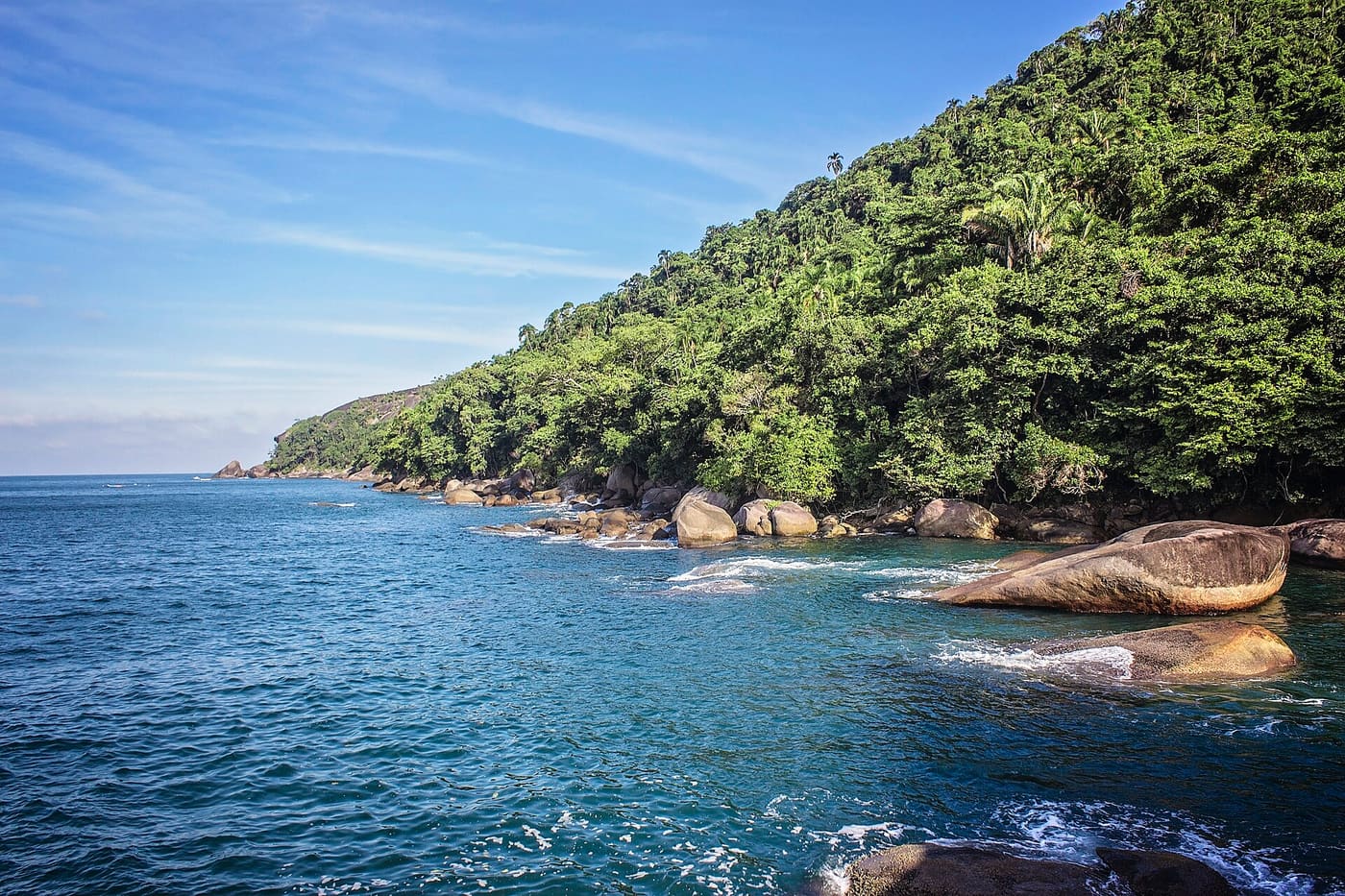 Cachadaço, in Trindade: giant boulders holding the sea outside. Photo: Eduardo Gabão, CC BY-SA 3.0, Wikimedia Commons
27 km from Paraty, the village of Trindade holds the most democratic spot on the list: the Cachadaço natural pool, a pocket of sea protected by giant granite blocks where the water rarely passes your waist and fish swim around your shins. You get there by a 30 minute trail from the end of Cachadaço beach, or by boat on days when they run. Early in the morning, before the excursion boats, it is a different place; the trail makes our ranking of the best hikes on the Costa Verde, and the municipal bus from Paraty, at about R$ 5, makes this the cheapest snorkeling in Rio de Janeiro state.
Ubatuba: Anchieta and the sheltered corners
Ubatuba’s organized spot is Ilha Anchieta, the state park reached by schooner from Saco da Ribeira: green water, brain corals, turtles and rays, with the monitored Praia do Sul trail leading to an isolated cove that is an open invitation to freediving. On the mainland, the sheltered corners of some beaches produce rocky-shore fish life on calm days (the protected end of Félix beach is a classic example), but the rule in Ubatuba is to check the sea that day: the coast is more exposed than Angra’s, and visibility there is a lottery the wind decides.
Ilhabela: the channel side
The largest island on the São Paulo coast keeps its mask spots on the channel sea and the south shore, where the water arrives gentle. Three names settle the trip. Ilha das Cabras, a marine ecological sanctuary off the south shore, is the most famous: ornamental fish, sea stars, seahorses and even a statue of Neptune at 7 meters, visible from the surface on a clear day. Julião beach, just beyond, has rocky bottoms at its corners and marine life within the first few meters, with pool-flat sea on a good day. And Feiticeira beach completes the circuit with urchins, sea stars and small schools between the rocks. The three sit in sequence in the same part of the island, which adds up to a whole morning of floating with minimal moving around; the overview of the beaches is in the ranking of the most beautiful beaches in Ilhabela.
A local’s reminder: the channel sea is sheltered, but it is a boat lane. If you swim away from the sand, tow a signal buoy, always.
The gear that gets it done
- Your own mask. The R$ 100 investment that changes the trip. The loaners on excursion boats fog, leak and have passed through three hundred mouths. Test the seal: press the mask to your face without the strap and inhale through your nose; if it holds on its own, it seals.
- A simple snorkel, no fancy valves. Fewer parts, fewer failures.
- Fins are optional in the shallow coves; at spots with current, like open rocky shores, they help a lot. Some protected places ask you to skip them, to avoid stirring sediment or touching the bottom.
- A UV shirt instead of sunscreen from the waist up: protects more, harms the water less.
- Anti-fog or the caiçara solution: spit and rinse. It has worked for generations.
The ethics of floating
Snorkeling looks harmless and is not, when done badly. The rules we repeat on board, and that apply at every spot on this list:
- Do not stand on the bottom. Coral breaks at a touch and takes decades to grow back; even a sandy bottom holds life that a fin churns up. If you need to rest, float on your back.
- Do not feed fish. Bread changes the behavior of an entire rocky shore, and it is why the sergeant majors at some spots crowd people with the nerve of a city pigeon. The less fed a spot, the more natural the animals behave.
- Sunscreen half an hour before entering the water, never at the water’s edge: the film it sheds on the surface attacks the coral. Better still, a UV shirt and sunscreen only on what stays exposed.
- Nothing leaves the water with you. A sea star is not a souvenir or a photo prop.
The full reasoning on how to use this coast without wearing it out is in the guide to sustainable travel on the Costa Verde.
When the water clears
The snorkeling calendar is the same as for tank diving: winter, from May to August, delivers the clearest water and the calmest sea of the year, charging only some courage at the entry (the water cools without freezing; a thin wetsuit solves it for anyone who feels it). Summer brings water around 25 degrees and crowded spots, with visibility hostage to the rain showers: after a storm, the mountain rivers cloud the coastal sea for a day or two. The month by month detail is in the best time to visit the Costa Verde.
The next step down
If floating becomes a habit, the natural path is to descend: the Costa Verde has shallow wrecks, discovery dives for anyone who has never used a tank and wildlife sites that justify getting certified. The complete map of that other half, from the sunken hulls of Ilhabela to the freighter Pinguino at Ilha Grande, is in our guide to the best diving spots on the Costa Verde.
But start simple. A mask in your backpack, one spot from this list early in the morning, and the Costa Verde doubles in size: half of it has always been below the waterline, waiting for you to look.