
How to travel sustainably on the Costa Verde
This is not an article about saving the planet. It is an article about not ruining your own trip, and the trips of those who come after. The Costa Verde is one of the best preserved stretches of the Brazilian coast for two concrete reasons: parks that impose limits and communities that make their living from the place staying whole. Whoever understands those two mechanisms travels better here, literally: cleaner beaches, friendlier villages and a sea with more life in it. We write from the inside, from an eco lodge surrounded by forest in Ilhabela, and what follows is the practical manual we hand to whoever arrives: what works, what is myth and what nobody tells you.
Transport: public here is not a sacrifice
Your trip’s carbon bill is decided before you arrive, and the Costa Verde has a rare quirk for Brazil: public transport works, and on several legs it is objectively better than a car. Ilha Grande does not allow vehicles, the historic centers of Paraty and Ilhabela have nowhere to park, and the Rio-Santos highway on a holiday turns any driver into a passenger with regrets.
The 2026 numbers help the decision: buses from Rio to Angra from R$ 53, Angra to Paraty for R$ 27.50, Paraty to Trindade for about R$ 5, the ferry to Ilha Grande at R$ 20.50. And the region’s best example is the São Sebastião ferry to Ilhabela: pedestrians and cyclists cross for free, while a car pays and faces a queue that on holidays runs past an hour. Reaching Brazil’s largest sea island on foot, without spending a single real, is the kind of choice where the sustainable option and the smart one are the same thing. The step by step for the whole corridor is in the guide to the Costa Verde without a car.
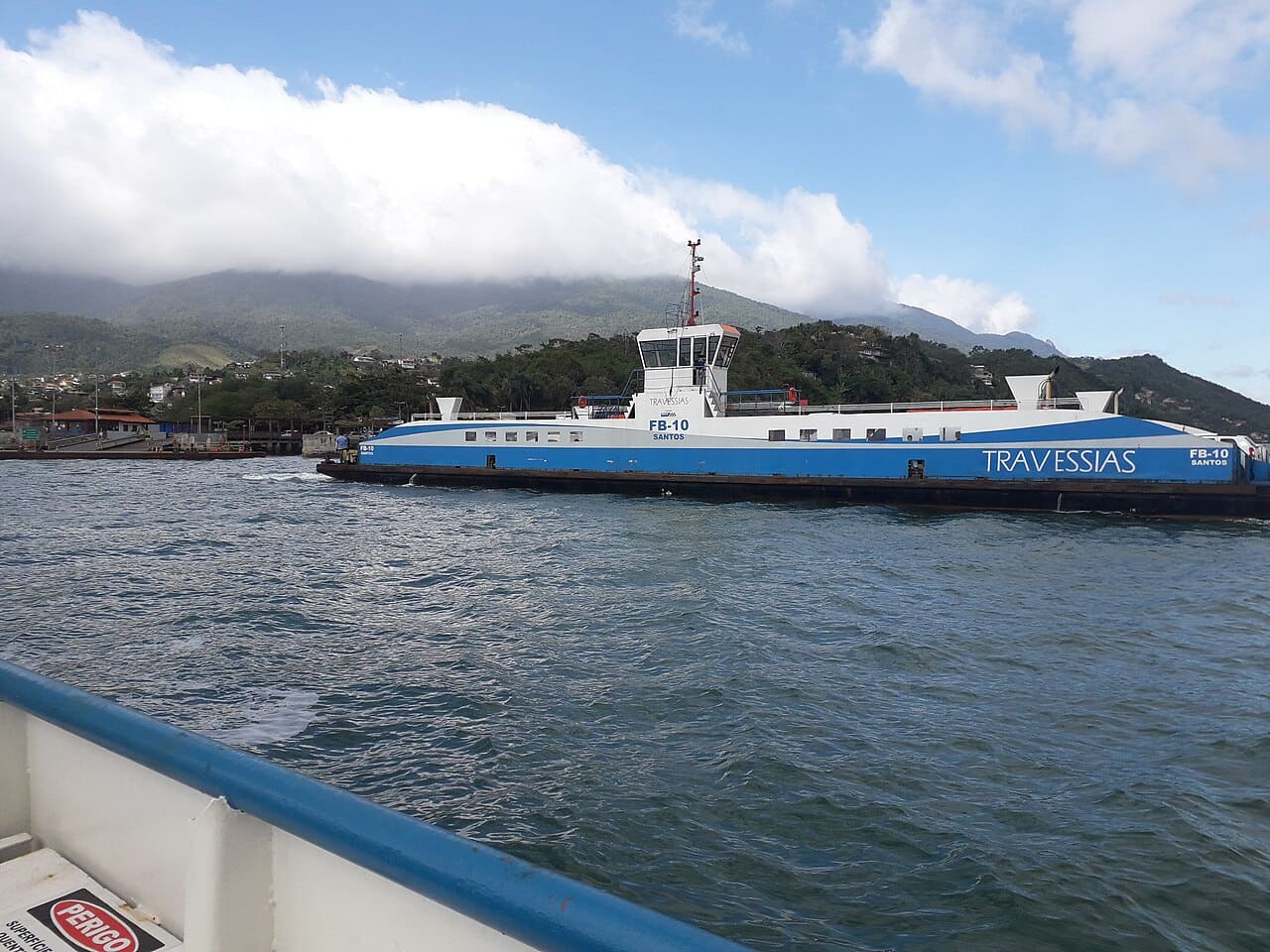 The Ilhabela ferry: free for anyone crossing on foot. Photo: Clonefox19, CC BY-SA 4.0, Wikimedia Commons
Trash: the rule of places with no collection
A good share of the Costa Verde’s best places has no garbage collection, because it has no road. In Saco do Mamanguá, everything that comes in by boat has to leave by boat. On the Bonete crossing, whatever you leave stays. The practical rule, no philosophy attached: a light, sturdy bag in your backpack, and all your trash goes back with you to a town bin, fruit peel included (it takes months to break down and draws animals to the trailside).
The upgrade almost nobody makes and that changes everything: a reusable bottle and a polite refusal of single-use plastic at the beach kiosks. In a region where badly managed trash ends up in the sea you came to see, every bottle avoided is a direct win.
Money: spend in the village, not on the platform
The most efficient way to “support the local community” is not donation: it is direct spending. In the caiçara villages of the corridor, from Aventureiro to Bonete, through the beaches of Mamanguá and Cajaíba, stay at the family campground, have the fish of the day arranged the evening before, buy the manioc flour and the handicrafts from the people who make them. Money that enters through that path keeps artisanal fishing, the small farms and the collective decision not to sell the land to speculation. What we have learned in a decade of hosting travelers: the visitor who buys from residents is received as a guest; the one who arrives with everything booked from outside is tolerated as a tourist. You feel the difference in the first good morning, and the places where it matters most are in the guide to the most authentic places on the Costa Verde.
Park rules: the limit is the product
Here comes the mindset shift that separates the mature traveler from the complainer: on the Costa Verde, environmental bureaucracy is not an obstacle to the experience, it is what manufactures it.
The corridor’s best example is Aventureiro beach, on the ocean face of Ilha Grande: visits are capped at 560 people staying at the village campgrounds, with a free permit collected in person in Angra. Annoying? A little. The result: one of the last beaches in Brazil’s Southeast with a genuinely dark sky, generators switching off at 10 pm and the whole Milky Way over the sand. The limit does not spoil the place, the limit IS the place.
The same reasoning holds along the corridor: the Veloso waterfall in Ilhabela accepts 110 people per day and that is why it stays clean through high season; the Baepi peak requires an accredited guide and that is why nobody gets lost on it anymore; Pico do Papagaio, on Ilha Grande, requires a guide for the pre-dawn climbs. Respecting entry times, staying on the marked trail and paying the local guide is not a toll: it is the maintenance fee of the scenery, and the details of each one are in the guides to the best hikes in Ilhabela and the best waterfalls on the Costa Verde.
In the water: sunscreen, fish and coral
Three water habits solve almost everything:
- Sunscreen half an hour before entering the sea, never at the water’s edge. The film it sheds on the surface goes straight to the rocky shore. On the chemistry: studies link filters such as oxybenzone to coral bleaching, and destinations like Hawaii went as far as banning the substance; Brazil has no rule, so the practical solution is a UV shirt from the waist up and mineral sunscreen on what remains. It protects better than a forgotten reapplication, costs less and ends the argument.
- Do not feed fish. The bread that amuses a child for two minutes changes the behavior of the rocky shore for years. The spots where fish crowd people like square pigeons are exactly the most fed ones. The details of that etiquette, spot by spot, are in the guide to snorkeling on the Costa Verde.
- Coral is not stepped on, not held, not taken. It breaks at a touch and comes back in decades.
And on the big life: between May 16 and August 16 humpback whales pass along this coast, and the responsible way to see them is a boat with regulated conduct, respected distance and the engine in neutral at the encounter. The whale watching departures we operate in Ilhabela follow the Whale Friendly Seal for exactly that reason, and they keep the honesty the seal demands: sightings are not guaranteed, because the show belongs to them, not to us.
The borrachudo: repellent instead of complaint
No honest text about nature on the Costa Verde skips the borrachudo, the tiny fly with the treacherous bite that is Ilhabela’s majority shareholder. The piece of information that changes your relationship with it: the borrachudo only lives where the water is very clean. Its presence is the quality certificate of the island’s rivers; the borrachudo-free places on the Brazilian coast usually solved the problem the wrong way. The mature response is not demanding fumigation, it is repellent reapplied (after every waterfall swim, because the water washes the protection off) and light trousers at dusk. Accept the toll: it is charged in the name of the water you came to see.
Where you sleep counts too
Lodging has a footprint as well, and the yardstick is simple: a structure that treats its own impact, uses its land without clearing forest and employs people from the region. We have run ours by that yardstick for ten years: Hostel da Vila, in Ilhabela’s historic center, sits on an 8,000 m² property where the Atlantic Forest climbs behind the accommodations, a few minutes’ walk from the ferry, which lets guests arrive without a car and move around the Vila area on foot. We do not tell you this as a medal, but as an example of what to ask any lodging on the corridor: what do you do with the sewage, who works here, what happened to the forest on the property. Whoever asks that three times changes the market more than any certification stamp.
The pocket summary
Arrive by bus and ferry, move on foot and by shared boat. Carry your trash out of places with no collection. Spend with the people who live there. Treat park limits as a guarantee, not as a queue. UV shirt, repellent, zero bread for fish. And distrust any experience that promises the place “all to yourself” without explaining how: in this region, real exclusivity is earned with timing and an overnight stay, never with a shortcut over the rules.
The Costa Verde does not need a hero, it needs a polite guest. The route to becoming one, with every destination and connection, starts at the definitive guide to the Costa Verde.