
The best viewpoints on the Costa Verde
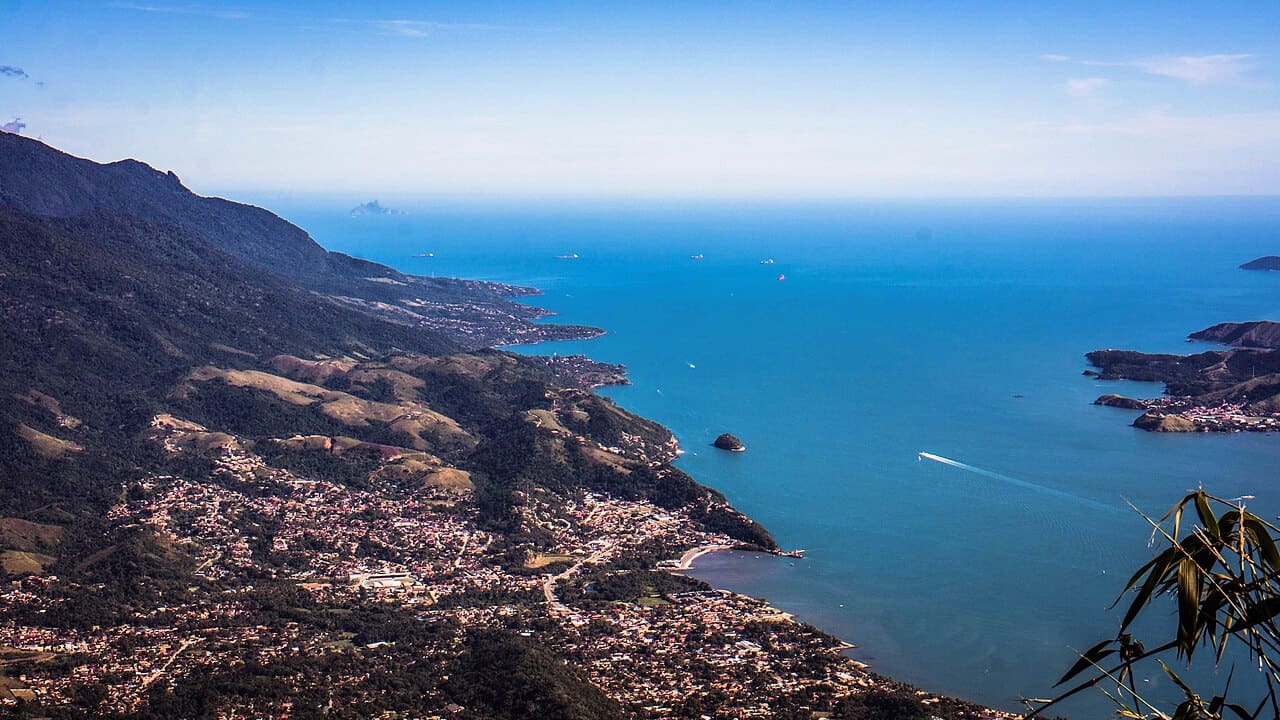
The Costa Verde has a good problem: too much view. The mountains plunge into the water along the whole corridor between Rio and São Paulo, and any high point becomes a window onto a cut of sea, island and forest that looks like a painter got carried away. The result is that “viewpoint” here ranges from a highway shoulder to a summit of nearly a thousand meters, and treating it all as the same thing is the mistake this guide wants to avoid.
We live inside this scenery and send travelers to these spots all year, so the proposal is simple: the viewpoints worth your time, one by one, with the honest effort each one charges. There are views you earn in flip-flops and views you pay for with three hours of climbing. Both are worth it, but for different reasons, and you deserve to know the bill before leaving breakfast.
Pico do Baepi, Ilhabela: the view that sums up the island
We start with the highest on the São Paulo side of the list: 1,048 meters, inside Ilhabela State Park, with the clear rule of climbing only with an accredited guide. It is two to three hours of continuous ascent through forest, and the prize is seeing the channel on one side, the ocean on the other, and understanding at a glance the size of Brazil’s largest sea island. On a clear winter day, the Serra do Mar stands cut out on the mainland and the Alcatrazes archipelago draws itself on the horizon.
Honest effort: heavy. Leave before 8 am, because cloud tends to close over the peak after midday. If you want the budget version, climb only to the viewpoint deck, 20 or 30 minutes from the trailhead, steep but short: it is the best view-per-effort deal on the island. The other climbs are in the guide to Ilhabela viewpoints and the best hikes on the island.
One logistics detail that changes the day: the trail starts behind the central part of the island, a few minutes from the historic center. It is the kind of program we live with guests of Hostel da Vila every week: out early on foot, back mid-afternoon with ground-up legs, and straight into the pool heated to 32°C with the property’s forest all around. Descending the Baepi knowing there is hot water at the end is an argument that converts a lot of undecided people.
Coração viewpoint, Castelhanos: Ilhabela’s most famous photo
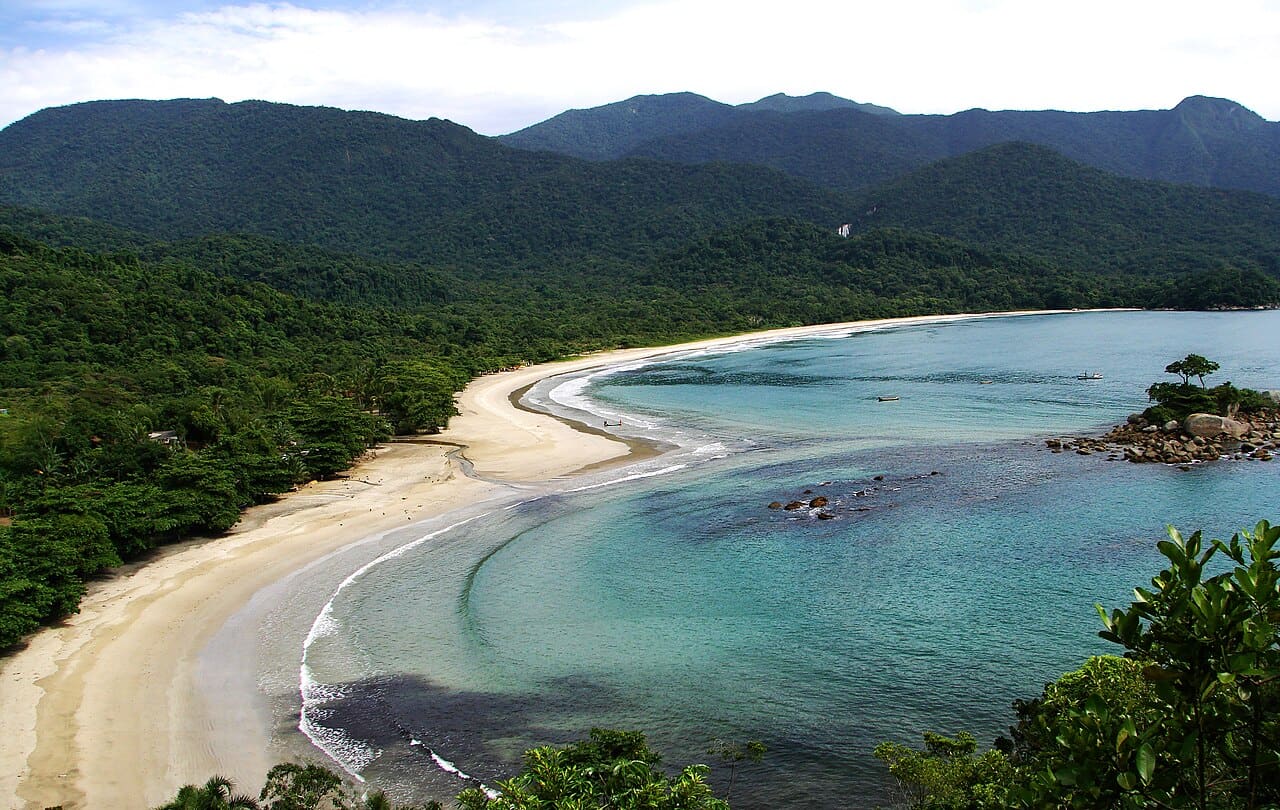 Castelhanos bay seen from the Coração viewpoint. Photo: Diego F. Gonçalves, CC BY-SA 4.0, Wikimedia Commons
On the other side of the island, on the ocean face, a wooden deck at the right-hand end of Castelhanos beach shows the bay in the shape that named the spot: a heart drawn by the sand and framed by the mountains. The walk from the beach takes about 10 minutes, marked by signs. Easy, right? Almost.
Honest effort: the viewpoint is light, getting to Castelhanos is the program. It is 17 km of dirt road cutting through the state park, open only to authorized 4x4s, which in practice means an agency jeep, a boat or an on-foot crossing of more than three hours. Halfway along the same road there is a second spot worth the stop: the Castelhanos road viewpoint, where the bay appears for the first time after an hour of dust, with the forest as the soundtrack. The full logistics, with jeep prices and schedules, are in the guide to Castelhanos beach.
Pico do Papagaio, Ilha Grande: the sunrise you earn
The most dramatic viewpoint on the Rio side of the Costa Verde has no deck and no sign: it is a rock summit at 982 meters, reached by 6 km of continuous climbing through dense forest from Vila do Abraão. The local tradition is to set out in the small hours, between 2 and 3 am, to watch the sunrise from the top, with the whole of Ilha Grande bay waking up below you. At that hour the park requires a guide or accredited leader, and we agree: darkness, roots and fatigue do not mix with improvisation.
Honest effort: the heaviest on this list. Five to seven hours round trip, knees taxed on the descent, sleep taxed for the rest of the day. It is also, in the opinion of many people who pass through our reception, the most memorable experience in the region. The trail’s context is in the guide to the best hikes on the Costa Verde, and the rest of the island in things to do in Ilha Grande.
Mamanguá’s Sugarloaf, Paraty: the fjord from above
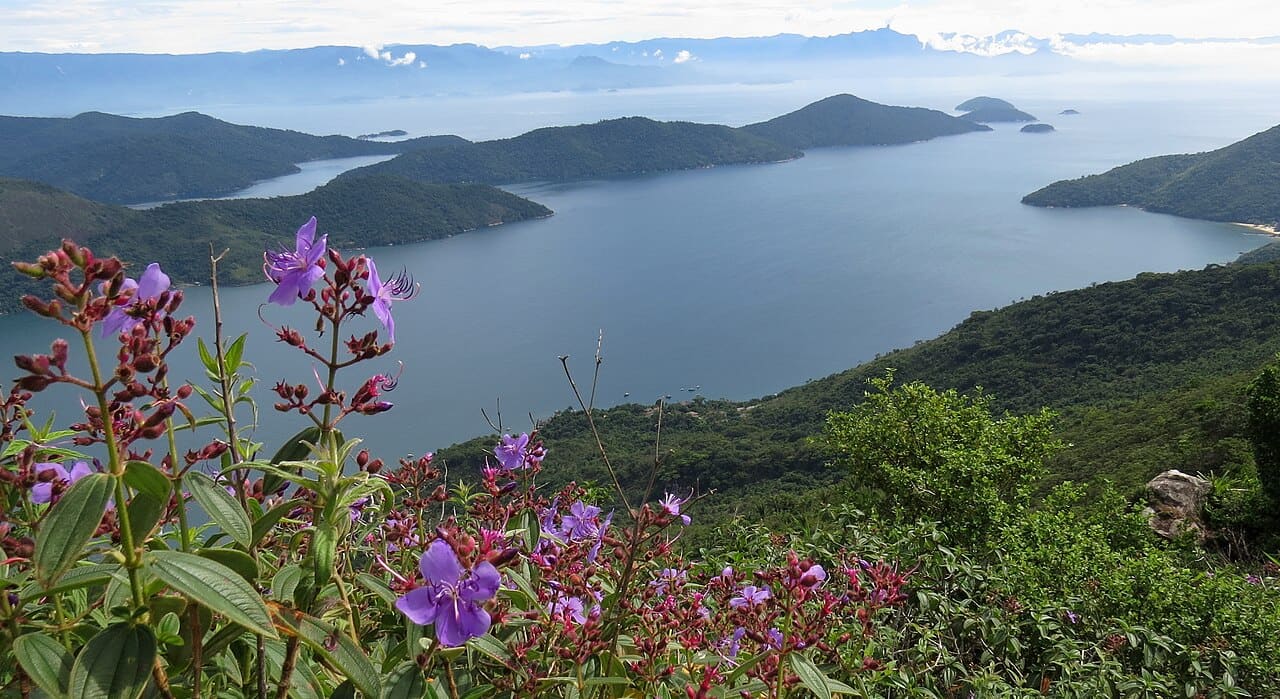 Saco do Mamanguá seen from the Pão de Açúcar trail. Photo: Pedro Gabriel Maciel, CC BY-SA 3.0, Wikimedia Commons
Saco do Mamanguá is an 8 km arm of sea that earned the nickname of tropical fjord, and the hill guarding it delivers Paraty’s most photographed view. The climb is short and sincere: 1.5 km with fixed-rope stretches, done in 1h to 1h30, up to the 425 meter summit, from which the whole fjord appears with Ilha Grande bay in the background.
Honest effort: moderate, with hands on rock. The real toll is the access, because the trail starts at Praia do Cruzeiro, reached only by boat. Our recommendation here is declared, because it is the house route: the Albatroz expedition, our group’s schooner, sleeps at anchor in the Mamanguá after the bonfire night on the beach, and the trail starts the next morning a few meters from where the boat spent the night. Having coffee on deck while looking at the hill you are about to climb solves the logistics and improves the story.
The roadside viewpoints of the Rio-Santos
Not every Costa Verde view charges sweat. The highway itself, on the stretch where it hugs the coast, has become a collector of shoulder viewpoints, and two names are worth writing down. On the Rio side, the Sahy viewpoint in Mangaratiba sits at about 200 meters of altitude and opens the view over Sahy beach, the islands and the open sea of the bay. On the São Paulo side, São Sebastião made it official by decree with Rota 55, a circuit of nine viewpoints along the SP-55, and the most generous of them is the Cascalho viewpoint, which frames the beaches of Toque-Toque Grande and Toque-Toque Pequeno in one shot.
Honest effort: zero legs, some road patience. The Rio-Santos is slow, winding and full of reasons to stop, which suits an unhurried driving trip better than a timed transfer. If you are doing the whole corridor by car, these spots are mapped in our guide to a Costa Verde road trip, and the overall logic of the route in Rio to São Paulo along the coast.
Honest mention: the viewpoints that demand a trip of their own
Two sets stayed off the podium for a single reason: they are not a stop, they are a destination. The viewpoints of the Bonete community, in southern Ilhabela, are earned after 13 km of trail or an hour by boat, and only make sense for whoever is going to sleep in the village, as the guide to Bonete beach explains. And the Jabaquara viewpoint, at the far north of the same island, is a gap between trees at the end of the dirt road, with no structure at all, the beach below in shades of green that look edited. Neither disappoints; both demand commitment.
How to build your circuit of views
The rule of thumb we use with guests works for any itinerary: one big-effort viewpoint per trip, chosen by where you are based, with the roadside ones filling the transfers. If you are in Ilhabela, climb the Baepi; if you are on Ilha Grande, get up before dawn for the Papagaio; if you are sailing around Paraty, climb Mamanguá’s Sugarloaf. Stacking two summits on consecutive days is a recipe for a limping trip.
Three warnings from people who climb these hills often. First: a good view is a morning view, because the mountains manufacture cloud in the afternoon all year round. Second: shoes with real soles, because wet roots are soap. Third: plenty of water and repellent, especially in Ilhabela, where the borrachudo works extended hours. The best period for walking is winter, from May to August, when the trails dry and the air opens, as the guide to the best time to visit the Costa Verde shows.
In the end, that is what a viewpoint is: the whole region explained at once, no caption needed. The Costa Verde seen from sea level already convinces; seen from above, it tells you how everything fits together, the mountains, the islands, the corridor of water in between. Pick one from this list for your first day. The rest of the trip gains context.