
Ilhabela viewpoints: where the island shows itself whole
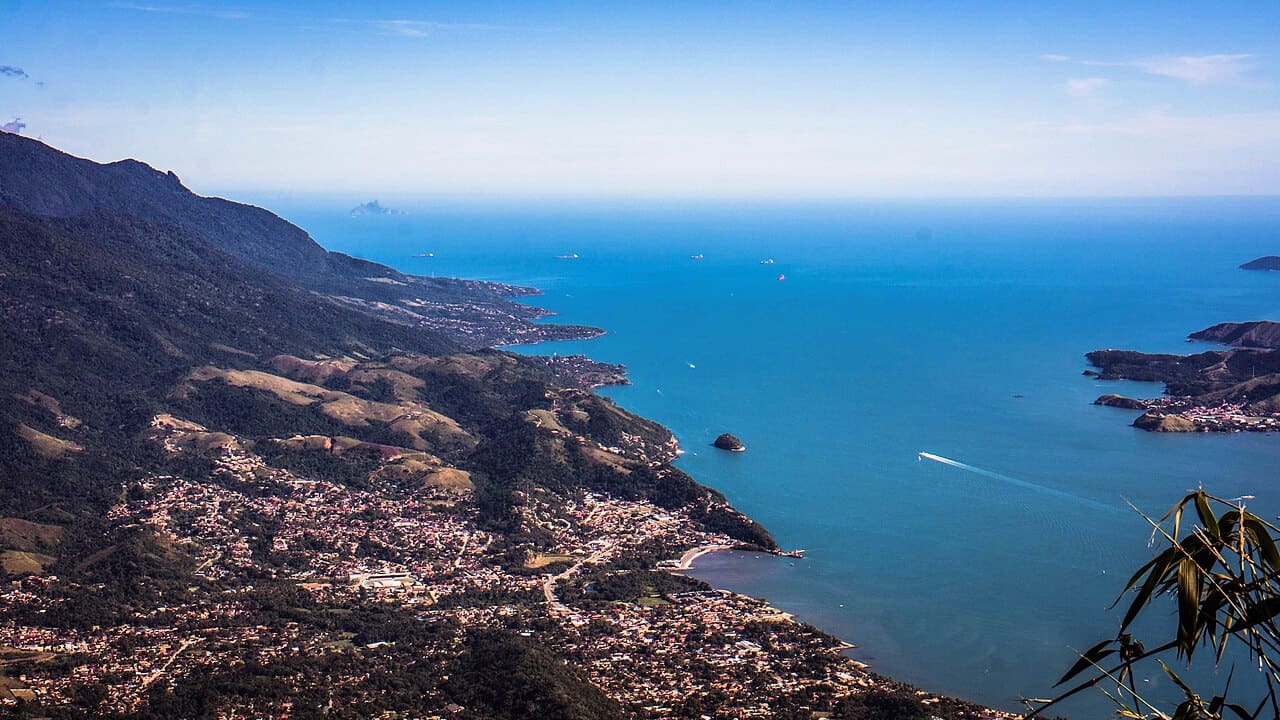
Ilhabela is a place you understand better from above. At sea level, the island presents itself in pieces: a beach, a bend, another beach. Only when you gain height does the design appear, the mountains plunging into the water, the channel separating island and mainland, the forest covering everything the state park protects. We live here and still climb the same spots to remember the size of the place we call home.
This guide lists the viewpoints that deserve your time, from the one you can reach in flip flops to the one that charges three hours of legwork. For each: where it is, how to get there and how much effort it asks. They split into two groups worth understanding first: the viewpoints on the channel side, easy to reach by the paved road, and the ones on the ocean side, which demand a trail or a 4x4. If the trip is still on paper, start with our general guide to things to do in Ilhabela.
Piúva lookout
The most democratic on the island. It sits on Avenida Brasil, at the southern entrance, with parking, a bus stop and the bike path passing at the door. Effort: zero. You step out of the car and the view of the channel is already there, with the São Sebastião coast on the other side and sailboats streaking the water in between.
It is also the viewpoint with the “eu amo Ilhabela” (I love Ilhabela) sign, which means a photo line on holidays. Go at the end of a weekday afternoon: Piúva faces west and is one of the good dusk spots on the island, a subject we broke down in the guide to where to watch the sunset in Ilhabela.
Barreiros beach lookout
At the start of the north region, on Avenida Luiz Massa, the Barreiros lookout has parking and a frame that became a classic of trips for two: a heart-shaped cutout with the channel behind it. Effort: zero as well. Morning light is best there, and the north region that begins at this point holds beaches calmer than the central ones, several of them in our guide to the best beaches for couples in Ilhabela.
Morro da Cruz lookout
In the central region, near Perequê, Morro da Cruz is the viewpoint locals use when they want to see the channel without meeting anyone. Easy access by car, no tourist attraction infrastructure, and that is exactly the charm: a high, quiet spot, with the island lit up below at the end of the day. It is the kind of place for a thermos of coffee and half an hour with no agenda. If your trip is for two, write this one down first: of all the easy-access viewpoints, it is the one that least shares its view with strangers.
The Baepi lookout and the peak
Here begins the sweat category. The Baepi trail starts on Rua Morro da Cruz, behind the central region, and enters Ilhabela State Park. The first prize comes fast: some 20 to 30 minutes of hard climbing lead to a wooden deck with an open view of the channel. It is genuinely steep, so wear sneakers, but it is the best view-for-effort deal on the island.
The second prize is for anyone who wants the whole island at their feet: Pico do Baepi, at 1,048 meters, the postcard of local mountaineering. It takes on average two to three hours of continuous climbing inside the forest, and the park’s rule is clear: only with an accredited guide. We agree with the rule, because the trail deceives and the weather at the top changes fast. From up there, on a clear day, you see the channel on one side, the ocean on the other, and you understand at once why Ilhabela is called Brazil’s largest sea island. The island’s other climbs are in the guide to the best hikes in Ilhabela.
A piece of advice from people who send guests up this trail every week: leave early, preferably before 8 am, because cloud tends to close over the peak after midday. And here is the most convincing argument we know for taking on the climb: the pool heated to 32°C at Hostel da Vila waiting on your return. Coming down from Baepi with your legs ground up and sinking into warm water with the property’s forest around you is an ending that makes the trail pay off twice. The base in the historic center leaves the trailhead a few minutes away.
Coração lookout
On the other side of the island, at Castelhanos beach, sits Ilhabela’s most famous viewpoint. From the top of a wooden deck at the right corner of the beach, the bay shows itself in the shape that named the spot: a heart drawn by the sand and framed by the mountains. The walk from the sand takes about 10 minutes, marked by signs.
The real effort is getting to Castelhanos: about 17 km of rough dirt road cutting through the state park, allowed only for 4x4 vehicles with authorization, which in practice means an agency jeep, a boat or a hike for almost everyone. The complete logistics, with prices and times, are in our guide to Castelhanos beach.
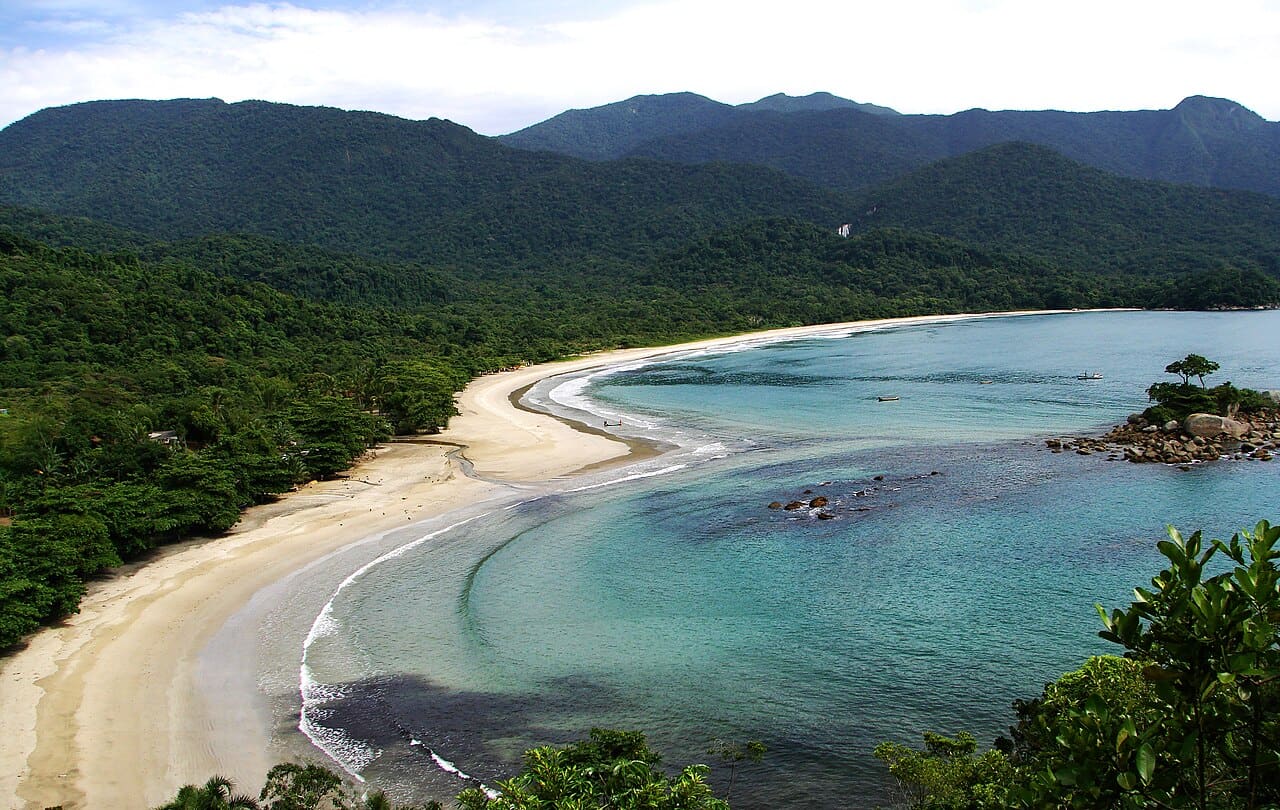 Castelhanos bay seen from the Coração lookout. Photo: Diego F. Gonçalves, CC BY-SA 4.0, Wikimedia Commons
The Castelhanos road lookout
In the middle of the same road, inside the park, there is a high-altitude lookout that frames the bay below with the forest in the foreground. Jeep tours stop there by default; anyone on foot faces three hours or more of uphill walking. It is the stop that turns the journey into part of the experience: the engine switches off, the forest provides the ambient sound and the bay appears for the first time after an hour of dust. Worth stepping out of the car even in a hurry.
Jabaquara lookout
At the far north, where road SP-131 ends, the Jabaquara lookout is the least obvious on the list: no infrastructure at all, a gap between two trees on the shoulder of the dirt road, with Jabaquara beach below in shades of green that look edited. The access asks for caution with low cars on rainy days, but asks nothing of your legs. It is the view that tends to come up when someone asks about the secret beaches of Ilhabela, and the silence there is part of the scenery.
The Bonete lookouts
To close the list with the most remote ones: the Bonete community, in the south of the island, has three lookouts of its own. Barra, on the left side of the beach, about 30 minutes on foot from the village; Saquinho, on the right side, about 40 minutes along the trail that continues from Borrifos; and Praia das Enchovas, at the end of a 3.6 km route. None of them is an “attraction”; they are rewards for those who have already made the long journey there, by boat or along the 13 km trail. The complete route is in the guide to Bonete beach.
How to build your viewpoint circuit
A simple logic solves it: group by region and by effort. On a day with a car, you can string together Piúva, Morro da Cruz and Barreiros in one afternoon, ending at whichever is closest to your dinner. Baepi asks for a full morning and rested legs. Coração and the road lookout belong to the Castelhanos day, and the Bonete ones only make sense if you sleep there. Without a car, you reach Piúva and the Baepi trailhead by municipal bus without drama; the guide to Ilhabela without a car explains the lines.
On what to bring, the list is short and non-negotiable at the trail viewpoints: real water (the Baepi climb drains a small bottle in the first hour), sneakers with soles that grip wet roots, a warm layer for the altitude and a charged phone, because the signal comes and goes up there and an offline map saves the day. At the roadside lookouts, just show up, but show up with time: a good view swallowed in a rush never becomes a memory.
Two practical warnings from a resident. First: Ilhabela’s viewpoints have borrachudo, the biting fly of clean waters, and it works extended business hours. Repellent before contemplating, always. Second: the mountains manufacture cloud in the afternoon all year round, so a good view is a morning view. In winter the sky stays clear for days at a stretch, and that is when photos of the channel come out with the mainland sharp; one more point for the case for Ilhabela in winter.
If your trip has room for a single big effort, we vote for Baepi: it is the view that sums up the island. The others slot in as punctuation on beach and waterfall days, and with five days you can collect almost all of them. Climb one on your first day. The island seen from above changes how you live the rest of it.