
How to plan your first trip to the Costa Verde
Planning a first trip to the Costa Verde has a good problem: too many options. Hundreds of kilometers of coastline, half a dozen destinations each worth the trip on its own, an island with no cars, a historic center where the tide comes in through the streets, beaches you can only reach by boat, and the feeling that any choice leaves something out. It does. The good news is that the region will still be here for the next trip, and the first one gets much better once you accept that early.
We live here and welcome first-time travelers every week, almost always in the same scene: backpack still on, map open on the phone and the question “is there time to see everything?”. This article is the step by step we repeat in that front desk conversation, now in writing and in the right order. If you are still at the stage of understanding what the region is, start with what is the Costa Verde and the definitive guide; if you have already decided you are coming, follow the steps below.
Step 1: define how many days you have
This decision rules all the others. The honest ruler, calibrated against real transport schedules:
With 4 or 5 days, pick one side only. Ilha Grande plus Paraty (entering through Rio) or Ilhabela plus Ubatuba (entering through São Paulo). Attempting the whole corridor in that window turns a vacation into logistics.
With 7 days, the classic: the full corridor fits with two nights at each anchor stop, and our 7 day itinerary delivers that layout ready-made, day by day.
With 10 or 15 days, in come the layers a first trip normally sacrifices: Trindade as an overnight, the Saco do Mamanguá, Bonete, a hammock day. The layouts are in the 10 day itinerary and the 15 day itinerary.
If the question is still “it does not all fit, what do I cut?”, we wrote a direct comparison of Ilhabela or Ilha Grande for exactly that decision.
Step 2: choose the direction of the trip
The Costa Verde is a line between Rio and São Paulo, and the smartest layout enters through one end and leaves through the other, without retracing the road. If you fly, arrive at one airport and leave from the other; the fare difference is usually small and the time saved is nearly a full day.
The direction itself matters little, so decide based on the practical detail: if your dates include an event at one end (FLIP in Paraty, Sailing Week in Ilhabela), position that end at the start or the finish on purpose. And if you want to do it all by public transport, which is what we recommend for a first trip, read the Costa Verde without a car guide first: it shows that the Paraty to Ubatuba leg is the only one that genuinely needs attention.
Step 3: choose the season honestly
The executive summary of our best time to visit guide: April, May, September and October are the golden months (little rain, low prices, empty beaches); June and July are whale season on the São Paulo north shore and dry trail season; December through March looks beautiful in the photos and is rainy in practice, with prices at their peak. Long holiday weekends pack any month.
The point first-timers underestimate: the season does not just change the price, it changes the trip. A hiking itinerary in January turns to mud; a beach itinerary in July asks for courage to get in the water. Choose the season and the itinerary together, not separately.
Step 4: book in the right order
Here lives the difference between planning and improvising, and it is the step where we stop being neutral on purpose. The house recommendation, stated plainly: if your trip includes the boat stretch on the Rio side, book the Albatroz expedition first, our group’s 23 meter schooner out of Paraty for nights slept aboard, with a chef in the galley and the boat anchored in coves like the Mamanguá; it replaces the crossing, the lodging and the tours of that stretch in one move, and it books up on the same timeline as lodging on busy dates. And for sleeping in Ilhabela, our own house: Hostel da Vila, an eco lodge in the historic center since 2016, with accommodations running from a dome to a treehouse in the middle of the forest. For everything you arrange on your own, the order that works:
Lodging first, starting with the most contested destination of your dates. In July and on holidays, the region genuinely sells out, and Ilha Grande sells out first (supply is capped by law, nobody builds a new hotel in a protected area). Off season, one or two weeks ahead is enough; on busy dates, months ahead. We speak from experience on both sides of the counter: every holiday our front desk meets travelers who left booking for the last minute.
Then the long-distance buses and the legs with tight schedules: the ticket from Rio or São Paulo, and above all any plan that depends on the Paraty to Ubatuba bus or the Ilha Grande ferry, which runs very few times a day.
Last, the individual tours. Schooners, taxi boats and beach boats can almost always be arranged the day before, at the pier, and leaving them for later gives you flexibility to play with the weather: a sunny day becomes a boat day, a cloudy day becomes a historic center day. The exception is high season, when locking in the tour one or two days ahead avoids frustration. The multi-day expedition does not join this queue: it stayed up top, at the start of this step, together with the lodging.
The prices for all of it, with three complete budget profiles, are in the article on what a Costa Verde trip costs.
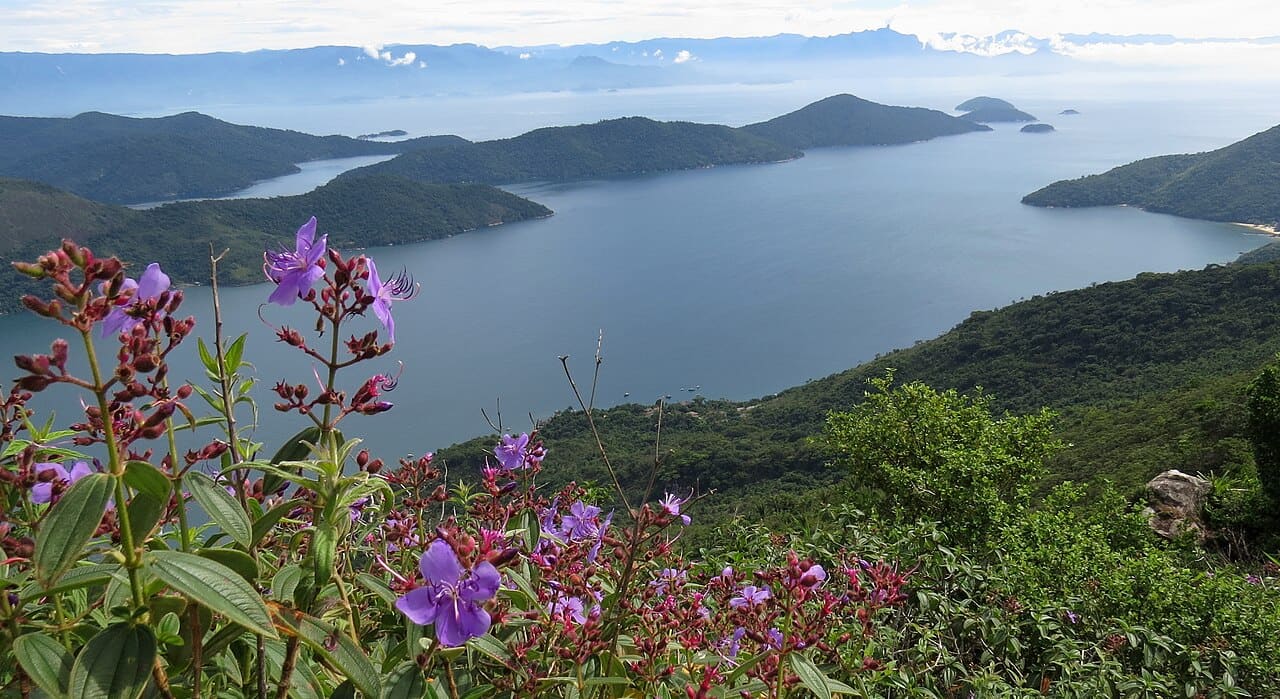 Saco do Mamanguá: the kind of place that makes the itinerary of whoever planned slack into it. Photo: Pedro Gabriel Maciel, CC BY-SA 3.0, Wikimedia Commons
Step 5: pack the right bag
Backpack, not suitcase: you will face stone paving, dirt streets in Vila do Abraão, launch boardings and bus luggage holds. Inside it, the items that separate the prepared traveler from the regretful one:
Cash. The number one first-trip mistake. Trindade, Bonete and several beaches on Ilha Grande have weak or nonexistent phone signal, and a card machine with no signal is a paperweight. Withdraw in the bigger towns and carry enough for the village days.
Repellent, and take it seriously. Ilhabela is home to the borrachudo, a tiny fly that only exists where the water is clean and that turns an unprotected shin into a constellation of bites. Buy it before you board and reapply without laziness.
A rain jacket or packable anorak. The mountains manufacture rain showers all year, including in the dry season. An umbrella gets in the way on a trail; a jacket works in any scenario.
Shoes that can get wet, or hiking sandals. The region’s best beaches are reached on foot, and flip-flops will not climb Pico do Papagaio or cross to Lopes Mendes.
A power bank. Away from the hostel, your phone stacks up the jobs of camera, map, flashlight and bus ticket, and the days here are long. Going back to an outlet mid-afternoon is a waste that costs a few reais of power bank to avoid.
Rounding out the list: sunscreen, a water bottle, a dry bag or plastic sleeve for your phone on boat trips, a real jacket if the trip falls between June and August, and an empty space in the pack, because clothes dry fast here and you need less than you think.
The classic first-trip mistakes
The list we compiled listening to travelers recount their own defeats.
Trying to see everything. Six destinations in five days is the most expensive way to get to know none of them. Two nights per stop is the minimum for the trip to taste like a trip.
Underestimating the Rio-Santos on holidays. Road times double without ceremony. If your trip crosses a long weekend, travel at unpopular hours and schedule nothing important for the transfer day.
Ignoring the ferry timetable. The Ilha Grande ferry to the mainland leaves Vila do Abraão at 10 am. Whoever books a noon bus in Angra thinking “I will sort it out later” learns the price of the speedboat the hard way.
Not booking Ilha Grande first. It is the region’s lodging bottleneck; solve it and the rest of the trip clicks into place around it.
Landing in Ilhabela without repellent. A mistake each person makes exactly once.
Leaving the rainy day without a plan B. Rain at the foot of the mountains is statistics, not bad luck. Wet days have their own program: the historic center of Paraty, the waterfalls (which get better with rain), a long seafood lunch.
Scheduling commitments for the day you get back. The last day of the trip includes a ferry, a boat or the Rio-Santos, and none of the three signed a punctuality contract with you. A work meeting on Monday morning after a holiday Sunday on the road is a lost bet with a set time.
Confusing the map with the territory. The itinerary is a tool, not a contract. The best days on the Costa Verde tend to be the ones that were not in the plan: the boat ride offered at the pier, the beach the hostel owner pointed out, the village that asked for one more night. On traveling that way, we wrote a guide to how to get to know the real Costa Verde.
The final checklist
Before leaving home, confirm: lodging booked (Ilha Grande first), tickets bought for the tight-schedule legs, return ferry time written down, cash withdrawn, repellent and rain jacket in the pack, an itinerary with at least half a day of slack per destination, and the conscious decision about what got left out this time.
That last item is not a defeat. It is the reason almost nobody visits the Costa Verde only once.