
How to explore the Costa Verde without driving
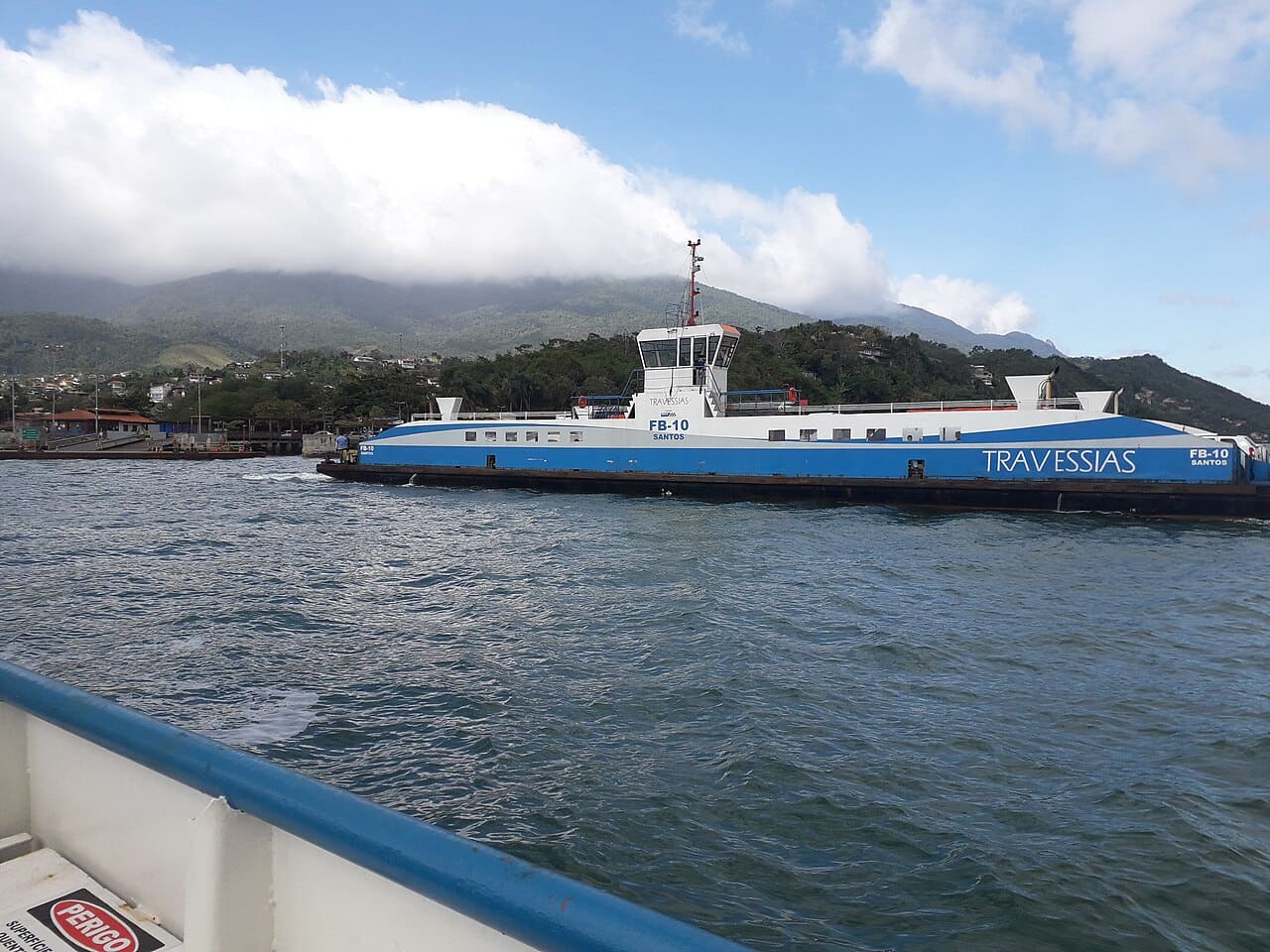
There is a scene that repeats every late afternoon at the ferry dock on the São Sebastião side: the line of cars wrapping around the block, engines running, everyone calculating how many crossings until their turn. Next to it, the line of people on foot simply walks. Up the ramp, lean on the rail, feel the channel wind. Twenty minutes later, those people are dropping their backpacks in Ilhabela without having paid a single real for the crossing. A good share of the cars is still on the other side.
We live at the far end of that line and watch this scene from the window, so this text takes a position that still sounds strange to anyone who grew up hearing that a coastline is something you see by car: on the Costa Verde, not driving is an upgrade. It is not the plan B of someone without a license, nor thrift dressed up as virtue. It is the way of traveling that best matches what the region does best, for a reason that fits in one line: the best of the Costa Verde has no parking lot.
This article is the argument. The technical manual, with times, prices leg by leg and the complete connections table, already exists and lives in our guide to the Costa Verde without a car. Read the two in whichever order you like: one convinces, the other executes.
The best of the region has no parking lot
Run the test on your own trip wish list.
Ilha Grande, probably the most repeated item on those lists, takes no cars: there is not a single street for them on the entire island. Whoever drives there pays daily parking at a mainland port while walking through Vila do Abraão like everyone else. Paraty’s historic center is closed to vehicles, and the stone paving the tide floods on full moons was designed two centuries before the automobile existed. Lopes Mendes can only be reached by boat plus a stretch of trail. The Saco do Mamanguá is a fjord with no road: you either paddle or sail. And in Ilhabela, most of the territory is a closed state park of Atlantic Forest, where the places that justify the trip begin exactly where the asphalt ends.
The pattern repeats along the whole coast. The car takes you to the edge of these experiences and stays there, parked and costing money, waiting for you to come back. In this region it is not the key to the trip: it is the weight of it.
The shape of a trip without a steering wheel
The whole logic fits in one sentence: the bus does the repetitive part, the boat does the beautiful part, and your bed is in a village or on board.
Buses solve the highway, which is precisely the stretch where driving adds the least. From São Paulo, Pássaro Marron reaches Ilhabela for R$ 101 to 123, in 4h30 plus the ferry. From Rio, the Costa Verde bus company runs down to Paraty from around R$ 120. In between, regional lines stitch the towns together for R$ 5 to R$ 27.50. The Rio-Santos remains a beautiful, slow road, single lane almost the whole way, that doubles everyone’s times on holidays. The difference is the role you occupy in it: on the bus, the traffic jam becomes scenery through the window; at the wheel, it becomes work.
The ferry: the border where pedestrians go first
The crossing from São Sebastião to Ilhabela takes 20 minutes, leaves every 30 minutes from 5:30 am to 11:30 pm and charges nothing for pedestrians and cyclists. Cars pay R$ 19 on weekdays and R$ 28.50 on weekends, and on holidays face a queue that has swallowed entire afternoons. It is hard to think of another destination arrival in Brazil where the person without a car gets the premium treatment: you step off the bus, walk to the dock, board right away and cross the channel watching the anchored sailboats and the island’s mountains growing ahead.
The disembarkation tells the same story. Ilhabela’s historic center is a walk from the ferry, so the car-free trip ends where the island’s life happens, with no hunting for a parking spot.
A living base, no garage required
Choosing to sleep in the historic center changes the math of the whole island. From there leave the municipal buses that run the channel coast, the bars and restaurants sit within a ten minute walk, the bakery opens before the day’s first swim. The lines, prices and tricks of getting around this way are in our guide to Ilhabela without a car.
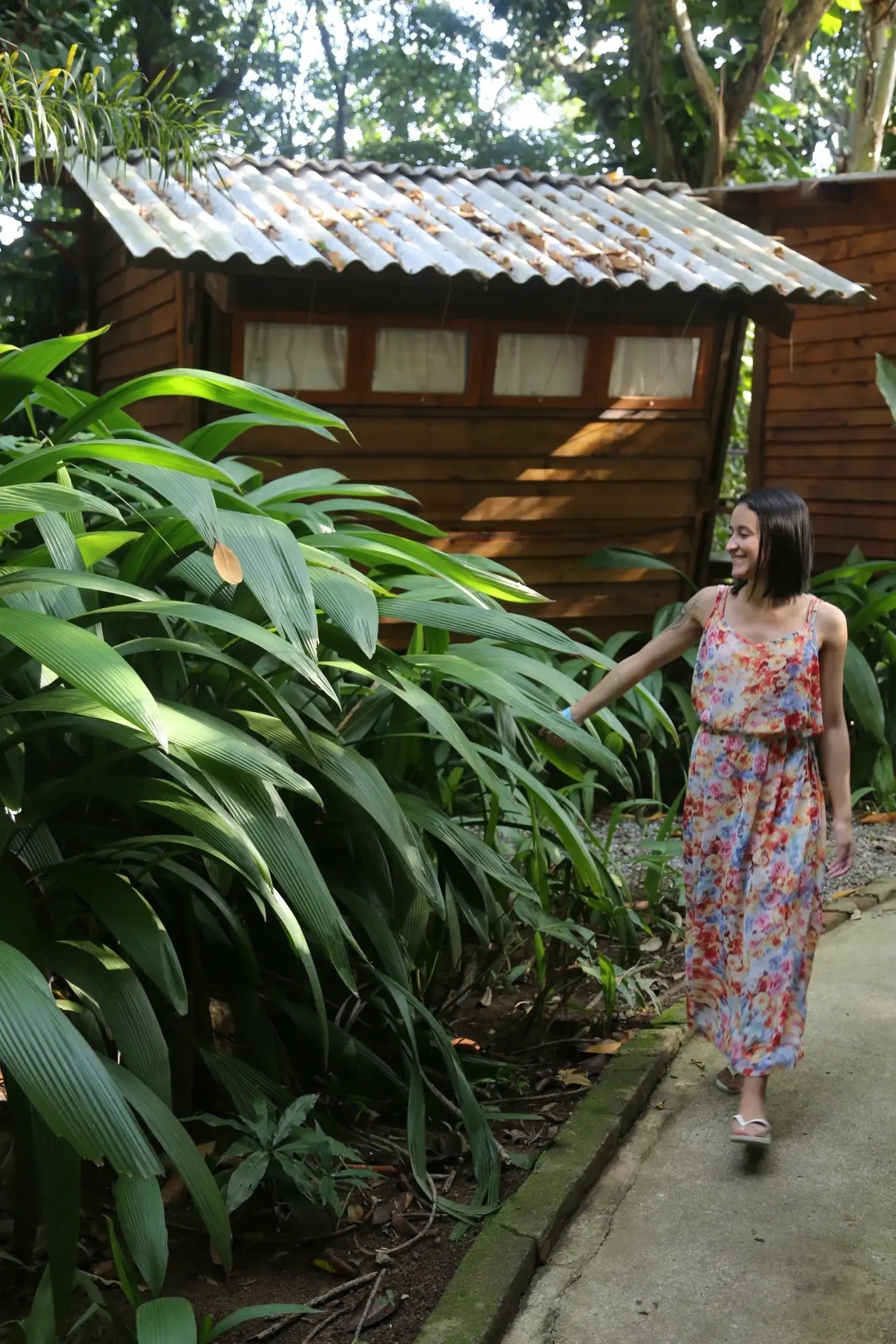 The paths through the forest at Hostel da Vila, in Ilhabela’s historic center. Photo: Hostel da Vila Group archive
That is the life we built at our house. Hostel da Vila is the group’s eco lodge in the historic center, on the channel side, since 2016, and the ritual of anyone arriving on foot from the ferry tends to be the same: drop the backpack, get into the pool heated to 32°C and only then decide the rest of the day, with the property’s 8,000 m² of forest closing the view above. At night, nobody has to draw straws for a designated driver: the Floresta Bar lights up inside the property itself, with live music and people from several countries comparing itineraries at the next table. The week’s lineup goes out on our Instagram.
To build your island days, between beaches by municipal bus, waterfalls and viewpoints, our complete guide to Ilhabela covers the options one by one.
The whole Rio stretch, sleeping on a boat
On the Rio side, the classic route pairs Paraty and Ilha Grande, and this is where traveling without a car stops being a clever alternative and becomes an open advantage. The coast’s oldest solution is still its most elegant: a boat. The one we recommend is our own, said with declared interest and the conviction of people who board it: the Albatroz, our group’s 23 meter schooner, leaves the Paraty marina on expeditions of two to five nights in which transport, lodging and food become the same thing.
It works like this: boarding opens at 6 pm and the first night is spent docked at the marina, with Paraty’s historic center on foot for dinner. On the three night expedition (around R$ 1,491 in 2026, outside holidays, in up to 10 interest-free installments), the boat wakes up sailing toward the bay of Ilha Grande, spends the day between snorkeling and Vila do Abraão and, the next morning, drops you at Praia do Pouso early, with the 20 minute trail to Lopes Mendes still empty, hours before the day-trip schooners arrive. The cabin has air conditioning and blackout curtains, the chef cooks on board from day two and the late afternoon has no closing time, because nobody there checks a ferry timetable: the bed travels with you.
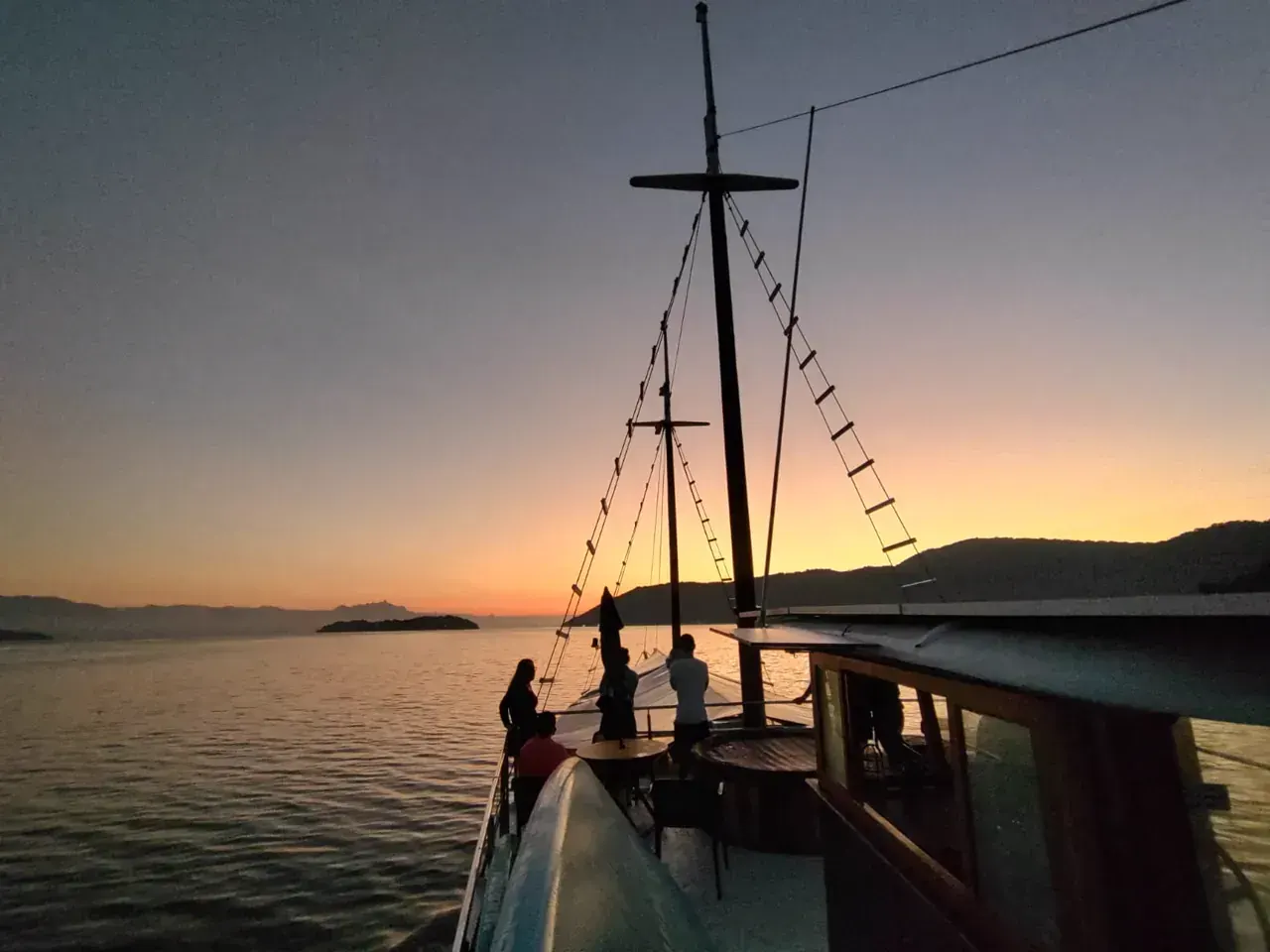 End of day on the Albatroz deck, between Paraty and Ilha Grande. Photo: Hostel da Vila Group archive
The contrast with the motorized version is concrete. Whoever does this stretch by car leaves the vehicle in a paid lot at the port, crosses by speedboat or ferry against the clock and spends the stay watching for the 10 am return. Whoever sleeps aboard wakes up where the day begins.
What you lose (because you do lose something)
Honesty from people who have traveled this coast both ways. Without a car, the remote beaches of Ubatuba and of Paraty’s south do sit genuinely far: buses do not reach them well, and it is in that specific scenario that driving wins. If that is the center of your trip, rent a car for a few days and follow our Costa Verde road trip guide, written for exactly that plan.
There is also the rigidity: the hop between Paraty and Ubatuba has few buses per day and calls for confirming at the bus station the day before, and a hiccup can cost an extra night. The answer to that is not improvisation, it is design: our 7 day Costa Verde itinerary is built on public transport connections from the start, with slack in the right places.
All told, what you lose fits in two itinerary adjustments. What you gain shows up every day: the crossings become part of the trip instead of dead time, and the money for the rental, the fuel and the parking fees is left over for what stays in the memory.
The window, returned
Driving the Rio-Santos is beautiful, but it is beautiful mostly for whoever rides shotgun. The driver sees the curve, the mirror and the speed bump sign. On the bus, on the ferry and on the deck, the whole coast becomes a window: the mountains falling into the sea, the coves appearing one by one, the channel changing color with the afternoon. The trip starts at boarding, not at check-in.
And if this argument convinced you of the sea as the way, the next step is seeing it as a complete route: our guide to island hopping through the Costa Verde turns this thesis into a plan, leg by leg.