
What to expect from the Hostel da Vila experience
You arrive to sleep, but you end up staying to live. The sentence is on our wall and in our manual, and it took us ten years to work up the courage to say it out loud, because promises in hospitality tend to age badly. This one aged well: since 2016, more than 65,000 people have passed through this property in Ilhabela’s historic center, and a considerable share of them booked their return before handing back the key.
This article is the guide to the house written by the house. No disguise: the blog is ours and the hostel is ours. The advantage for you is that nobody knows this place better than the people who sweep the deck in the morning, and we are going to tell you what exists here, who it works for and, with the same frankness, who it does not.
An 8,000 m² property between the forest and the sea
Hostel da Vila sits in Ilhabela’s historic center, on the São Sebastião channel side of the island, a few minutes’ walk from the Igreja Matriz and the small bars of the Vila. Anyone arriving by ferry is ten minutes by car from our door. So far, that is just an address.
What the address does not tell you is what happens when you cross the reception: the property covers 8,000 m² and climbs up the hillside, with the Atlantic Forest closing over the paths. The accommodations are not lined up along a corridor; they are scattered through the forest, connected by internal paths of stone and wood. You fall asleep to the wind in the canopy and wake to the great kiskadee before any alarm. In the late afternoon, you walk down to the sea in a short stroll: the nearest beach is a few hundred meters away, and the sunset over the channel is the hour when half the hostel stops what it is doing.
That combination is why we describe ourselves as an eco lodge, and not a hostel in the classic sense. Is there a cheap dorm bed? There is. But the heart of the place is something else.
The out-of-the-ordinary accommodations
The question we hear most at reception is not “what time does the pool close”, it is “can I see the other rooms?”. The answer is yes, and the list explains the curiosity:
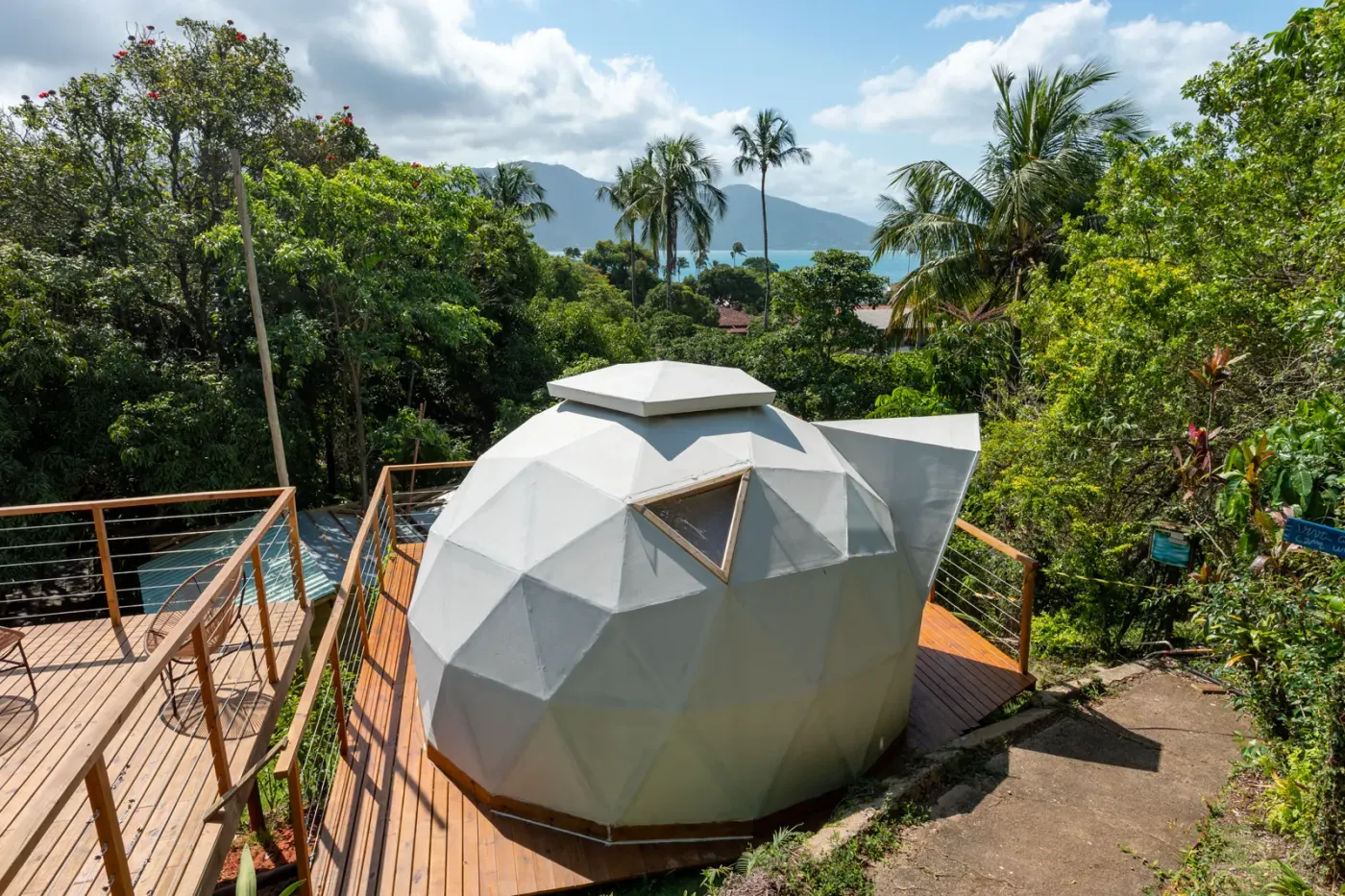
- Geodesic domes, with triangular windows, air conditioning and a private deck. The house’s sea view lives here: from the top of the property, the Dome frames the channel and the mountains of the mainland.
- Treehouses, wooden, suspended on the hillside, with walkways between the trunks. Childhood demanding a rematch, now with a double bed.
- A hippie kombi, hand painted, with a bed where the seat used to be and fairy lights on the door. The most reposted photo on our Instagram.
- A sailboat, on dry land, for sleeping in a boat cabin without leaving the garden.
- A bus and a trailer, refitted inside, parked forever in the middle of the forest.
- Yurts and tipis, the tents that came from the steppe and the plains and adapted surprisingly well to island weather.
- A caiçara cottage and a cabin, for anyone who wants wood, a porch and simplicity.
- A lighthouse, white and red, with a 360 degree lookout on top.
- Private suites and shared rooms, because not every night calls for an architectural adventure, and a dorm bed is still the cheapest way to live on the island for a few days.
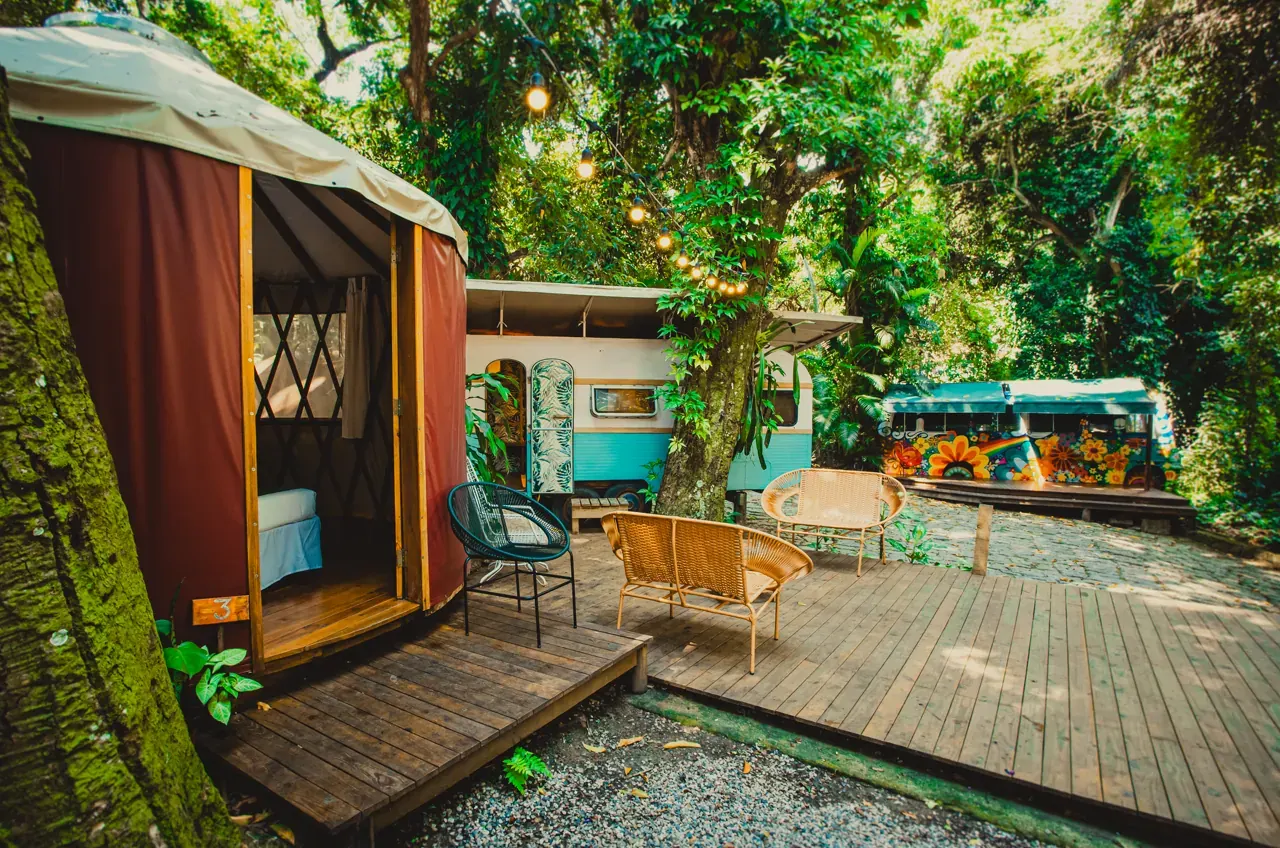 The village of accommodations inside the forest. Photo: Hostel da Vila Group archive
None of these structures came out of a catalog. They were built over a decade, one at a time, and that is why each has its own quirks: the dome’s wooden ceiling warms up in the late afternoon, the treehouse sways slightly in strong wind, the kombi asks that you enjoy drinking coffee sitting in its doorway. People looking for hotel-chain standardization find it odd. People looking for a room with a story usually pick their next one before leaving.
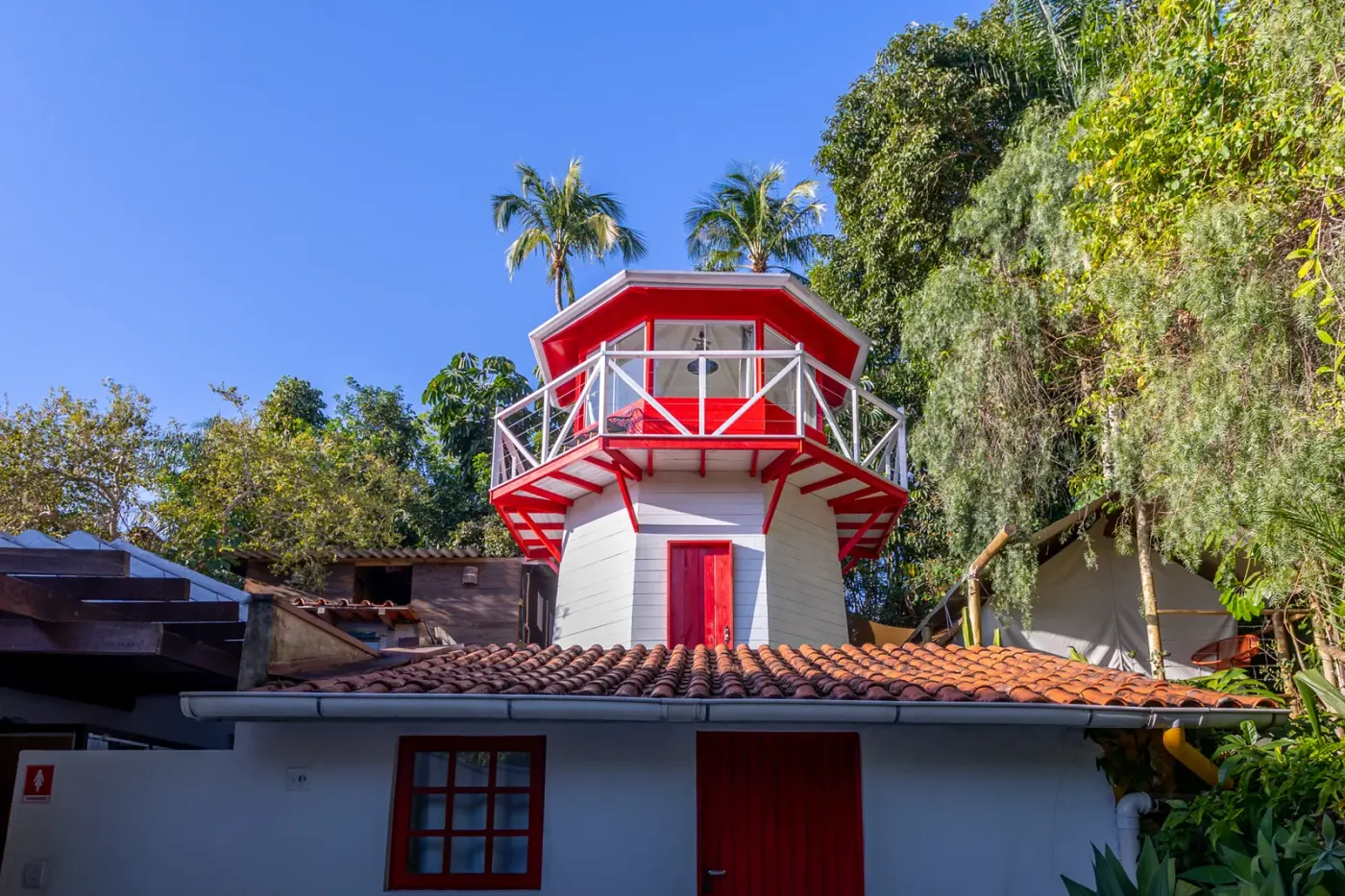 The Lighthouse, with its 360 degree lookout. Photo: Hostel da Vila Group archive
The 32°C pool and the 20 meter waterslide
In the middle of the property there is a pool heated to 32°C all year round. This is not brochure filler: in Ilhabela it rains, the wind blows and winter exists, and a warm pool changes the math of the trip. July here means slipping into steaming water with the forest all around and staying until your fingertips wrinkle. After a day on the trails, it is the best physical therapist on the island.
And there is the waterslide: 20 meters of descent that we built knowing adults deserve one too. The scene repeats every week: someone in their forties climbs up “just to see what it’s like” and goes down five more times.
Floresta Bar and Na Moita: the night starts at home
The Floresta Bar is the house’s center of gravity. Signature drinks, a real kitchen and a stage that hosts live music, DJs and the parties that made a name on the island. When someone on the team says “the Floresta is lighting up”, it is literal: the lights rise into the forest and the deck becomes the meeting point for guests and for islanders who come just for the night. Na Moita is the more hidden sibling, as the name gives away in Portuguese: the bar for the quieter conversation, the slower sip, the start or the end of the night.
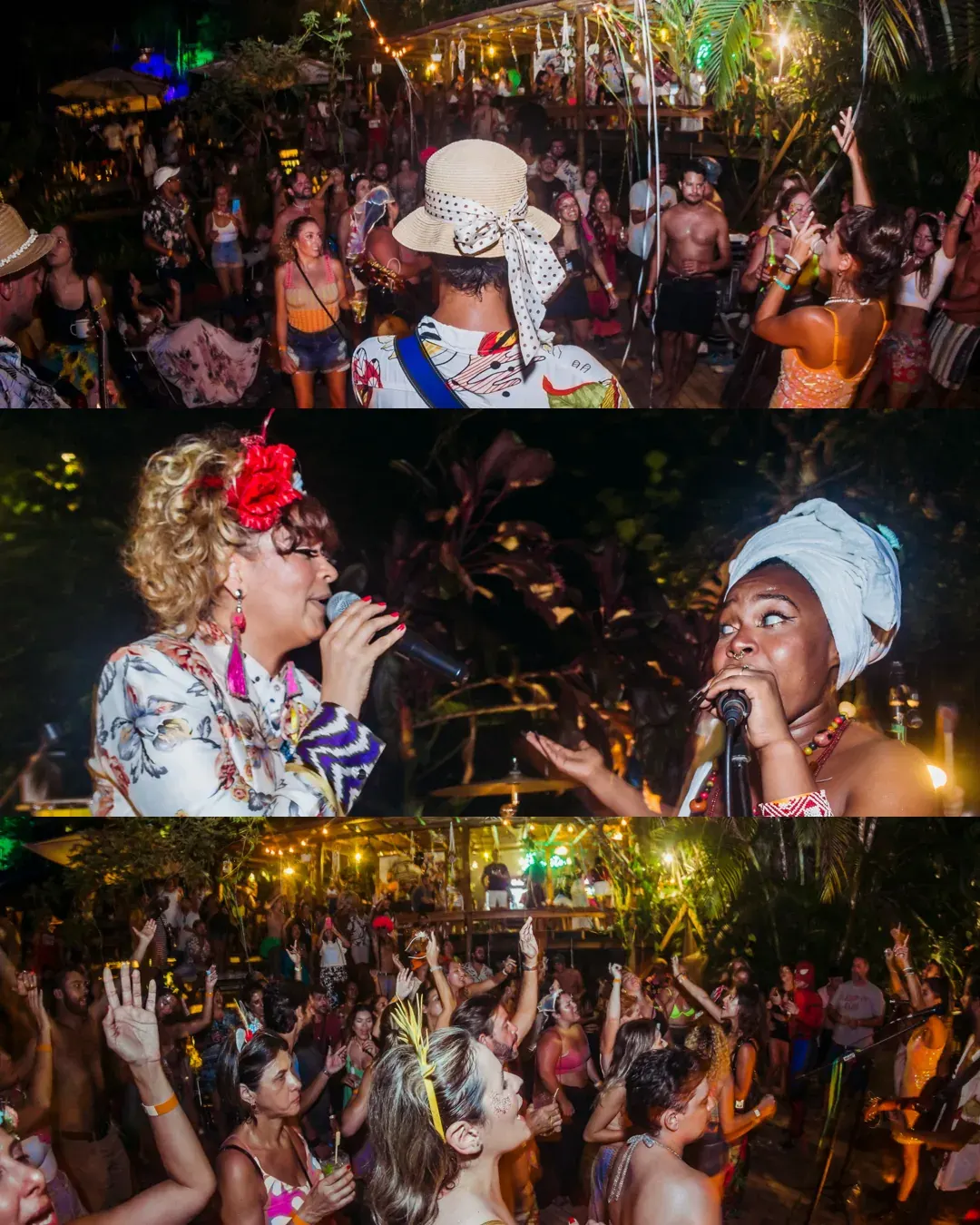 Party night at the Floresta Bar. Photo: Hostel da Vila Group archive
This means there is nightlife inside the hostel, and it is worth spelling out: on party nights, there is music until late. The accommodations further up the hillside sit well away from the stage, and the team knows how to point you to the quietest ones. But if your travel project is absolute silence every night, read the honesty section just below.
The living schedule
The house’s week has morning yoga in the courtyard, climbing at the QG da Escalada, tattooing at Estúdio Caranguejo, live music, parties and whatever the season brings. The lineup shifts with the island’s rhythm, which is why it earned its own article: how the Hostel da Vila weekly schedule works. The honest summary: you can join everything or nothing, and both choices are respected.
For exploring the island from here, the material is ready: our guide to things to do in Ilhabela covers beaches, trails and waterfalls, and the one on how to get to Ilhabela sorts out the ferry logistics. Anyone sketching a longer trip through the region can start with the definitive guide to the Costa Verde or go straight to the itinerary that combines our favorite places in one week.
Who Hostel da Vila is for
Ten years of hosting people gave us an answer that has nothing to do with age. The house is for the traveler at heart: the person who wants to live the place instead of ticking a checklist. That person shows up at 22 with a backpack and at 45 with kids, and the two versions meet at the waterslide. We host honeymooning couples in the Dome (there is a whole article on hostels for couples), families in the caiçara cottage, groups of friends in the kombi, solo travelers who arrive quiet on Monday and leave on Friday with a whole table of new contacts.
What these people have in common is the willingness to be somewhere alive: crossing paths with strangers at breakfast, hearing music drift up from the deck, accepting that the way to your room passes through a forest.
Who it is not for
Here comes the part few hotels write. Hostel da Vila is not for anyone looking for a resort of absolute silence, with room service and total predictability. On party nights, the Floresta plays until late. The internal paths climb and descend the hillside, with stairs and trails: anyone with reduced mobility needs to talk to us before booking, so we can choose the right accommodation together. The forest is real, so Ilhabela’s borrachudo, the tiny biting fly, is real too: repellent is not a suggestion. And the house does not take pets.
If what you want is our structure in guesthouse format, the answer exists and is ours as well: the Vilarejo, our set of standard, superior and family suites three minutes from the hostel, with access to everything we described here. It is the way to sleep in a guesthouse room and live the day at the hostel.
How to get here and when to come
The logistics are simple: the ferry from São Sebastião, a twenty minute crossing (free for pedestrians and cyclists), then about ten more minutes to the historic center. Coming from São Paulo, the trip takes around four hours; the step by step with prices is in the guide to how to get to Ilhabela.
As for timing, the house has two high seasons with opposite personalities. Summer is the island at full volume: warm sea, long days, the Floresta packed. Winter is our favorite season for converting skeptics: dry trails, the 32°C pool steaming in the cold air and, between May and August, humpback whales crossing the channel, when our whale watching departures come into operation. On long weekends and holidays, the house becomes a package with parties every night; the dates are at feriados.hosteldavila.com.br. The month-by-month picture is in the guide to the best time to visit Ilhabela.
What we actually promise
We promise a property where the forest swallows the street noise. A warm pool in the middle of July. A room that will earn its own story at your family’s Sunday lunch. A night that starts on the Floresta deck with no taxi required. And people: the raw material behind 65,000 guests in ten years, many of them coming back with friends who had heard too much about that kombi.
If that sounded like your trip, the most direct path is to build your stay on our site and choose which of the out-of-the-ordinary houses you will wake up in. The island does the rest.