
Costa Verde Experience: a new way to travel the Brazilian coast
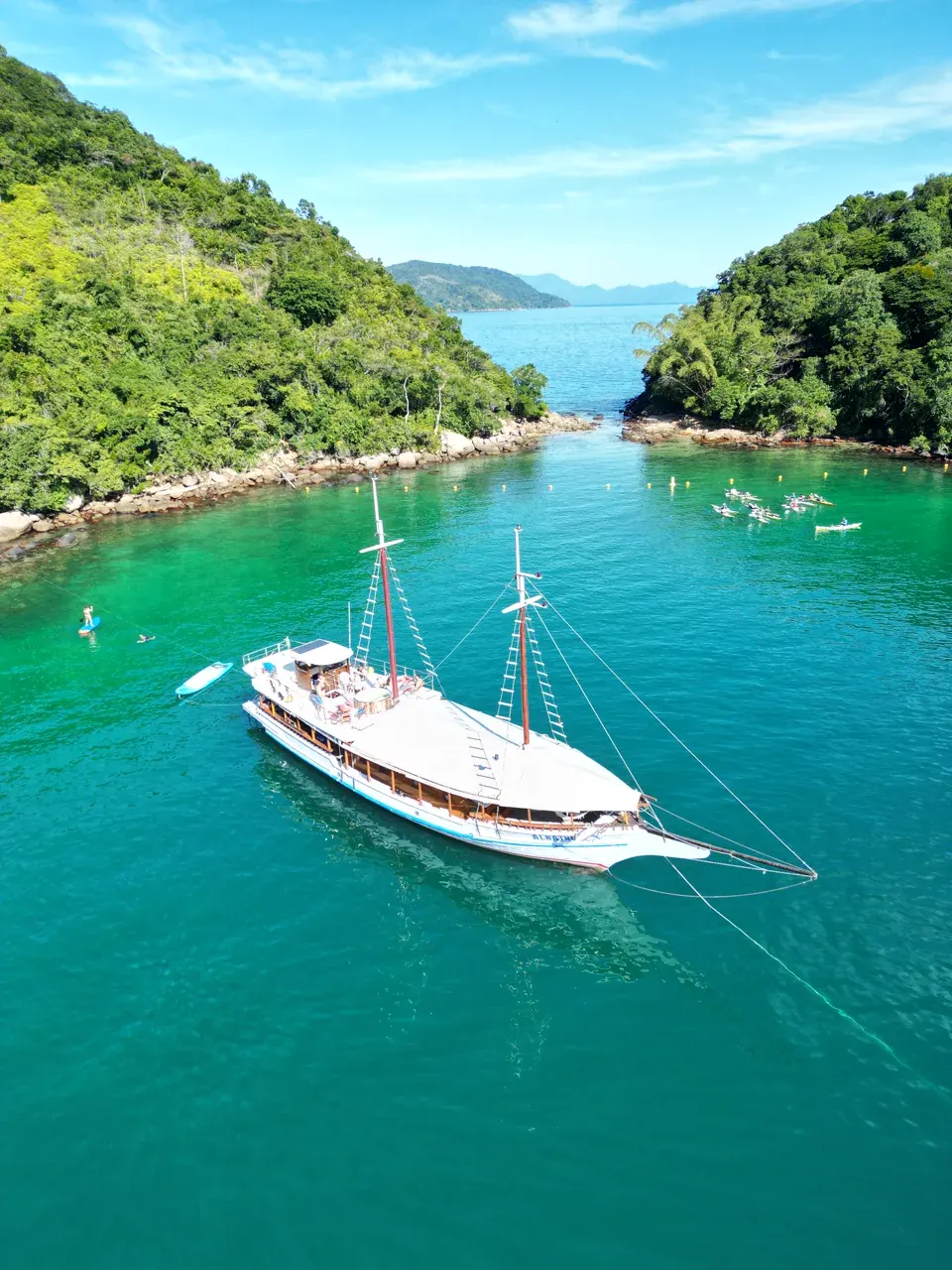
Every famous region ends up reduced to a list. The Costa Verde has suffered from this for decades: Paraty becomes “historic center”, Ilha Grande becomes “Lopes Mendes”, Ilhabela becomes “beaches”. The list is true and, at the same time, it betrays the place, because it treats as scattered points what is in practice a single organism: the same Serra do Mar falling into the same water, the same caiçara culture of canoes and fishing nets, the same forest that does not know where Rio de Janeiro ends and São Paulo begins.
After ten years of hosting travelers here, we gave a name to the way of traveling this geography asks for. This article exists to define that name clearly, because we believe in it enough to have built an entire group around it.
What the Costa Verde Experience is
Costa Verde Experience is the name the Hostel da Vila Group gives to a way of traveling the coast between Rio de Janeiro and São Paulo: treating the 294 km corridor between Mangaratiba and São Sebastião not as a sequence of destinations to tick off, but as one continuous experience, lived in five layers that repeat along the whole coast: forest, sea, village, night and crossing. Instead of asking “how many places do I visit?”, the question becomes “how many layers do I live in each place?”.
The geography backs the concept with facts. This is the most continuous and best preserved stretch of Atlantic Forest on the Brazilian coast, with a territory recognized by UNESCO since 2019 (Paraty and Ilha Grande, the country’s first site listed for culture and nature at once). Since 2025, the city governments of Angra, Paraty, Ubatuba and Ilhabela have promoted the region as a single destination, with around 2,200 beaches added to the historic centers, waterfalls and trails of the same corridor. The complete picture, destination by destination, is in our definitive guide to the Costa Verde.
The five layers
Forest. The forest is not the trip’s scenery, it is half of the trip. Most of Ilhabela is a closed state park; the Serra da Bocaina descends to the beaches of Paraty; Ilha Grande is crossed by numbered trails that leave the village and end at deserted beaches. Anyone who only sees the forest through a window has missed an entire layer.
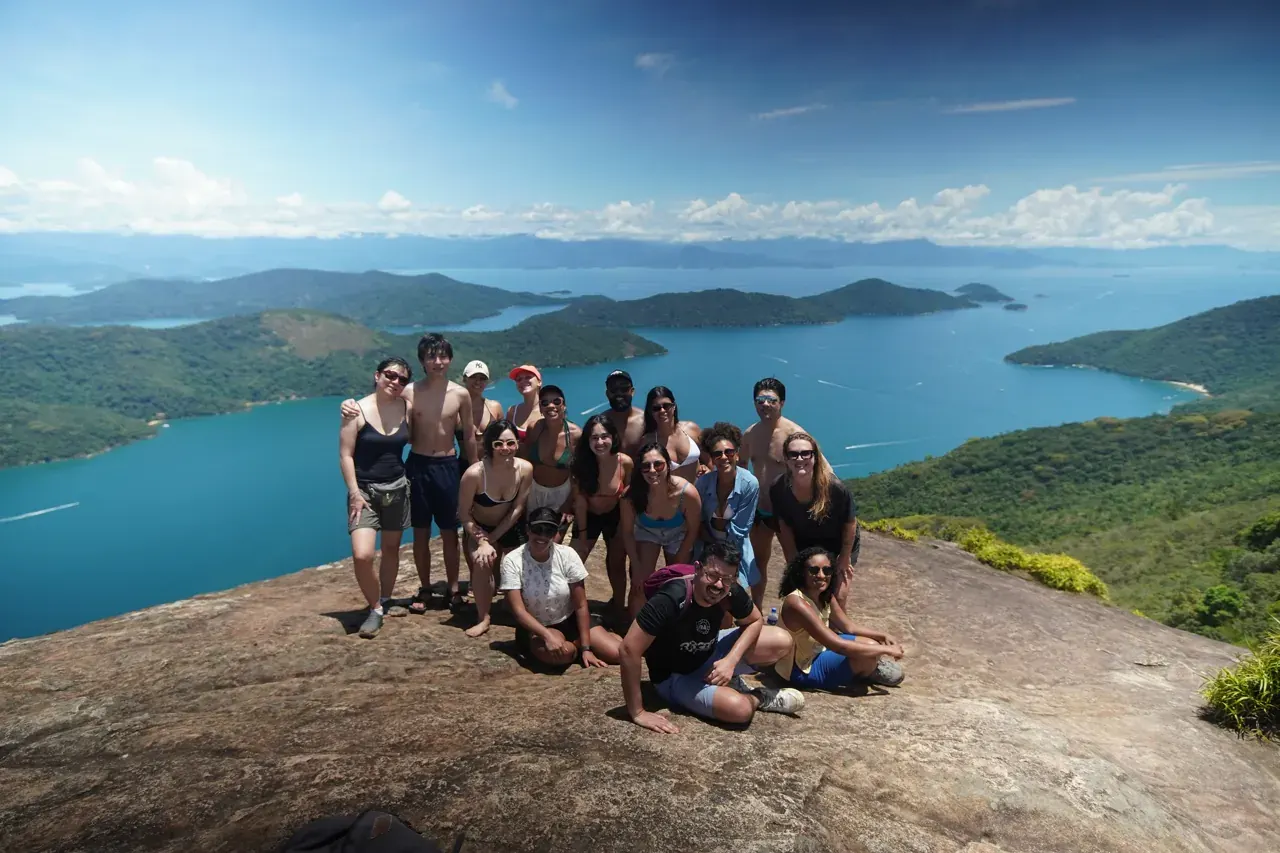 A trail stop on an Albatroz expedition: the forest layer seen from above. Photo: Hostel da Vila Group archive
Sea. Not the sea you look at, the sea you use: snorkeling in a shallow lagoon, kayaking in a fjord, diving along a rocky shore. From May to August, the layer gains the humpback whales migrating along the coast, with sightings peaking in June and July.
Village. Caiçara culture is what separates this coast from any pretty beach in the world: the historic centers of Paraty and Ilhabela, the canoes carved from a single trunk, the ray pastel, the tide that enters the streets and leaves again. Traveling in layers means giving the village the same time you give the beach.
Night. The layer day-trippers never reach, because they leave before it: the starry sky of whoever sleeps at anchor far from any streetlight, the music that starts when the kitchen closes, Ilhabela’s nightlife between bars and festivals. The night is the proof that you are traveling, not visiting.
Crossing. The layer that stitches the others together: ferry, boat, trail. On the Costa Verde, getting there is not the price of the trip, it is part of the product, and there are crossings worth more than many destinations. We wrote an entire article defending this: how to explore the Costa Verde without driving.
The pieces we built to live all of it
Transparency before anything: the people writing this blog run the businesses that follow. We did not arrive at this concept through market research; we arrived by living here and building, one by one, the pieces that were missing for the experience to be complete.
The base between the forest and the sea. Hostel da Vila is an eco lodge in Ilhabela’s historic center, on the channel side, open since 2016: an 8,000 m² property with the Atlantic Forest climbing behind it, 65,000 guests hosted in ten years and accommodations that are already part of the trip, from geodesic domes to treehouses, a kombi, a beached sailboat and yurts. The pool is heated to 32°C all year, and the night happens inside the property itself, at the Floresta Bar and Na Moita. For anyone who prefers a suite with the same life around it, the Vilarejo, 3 minutes from the hostel, gives access to the whole structure.
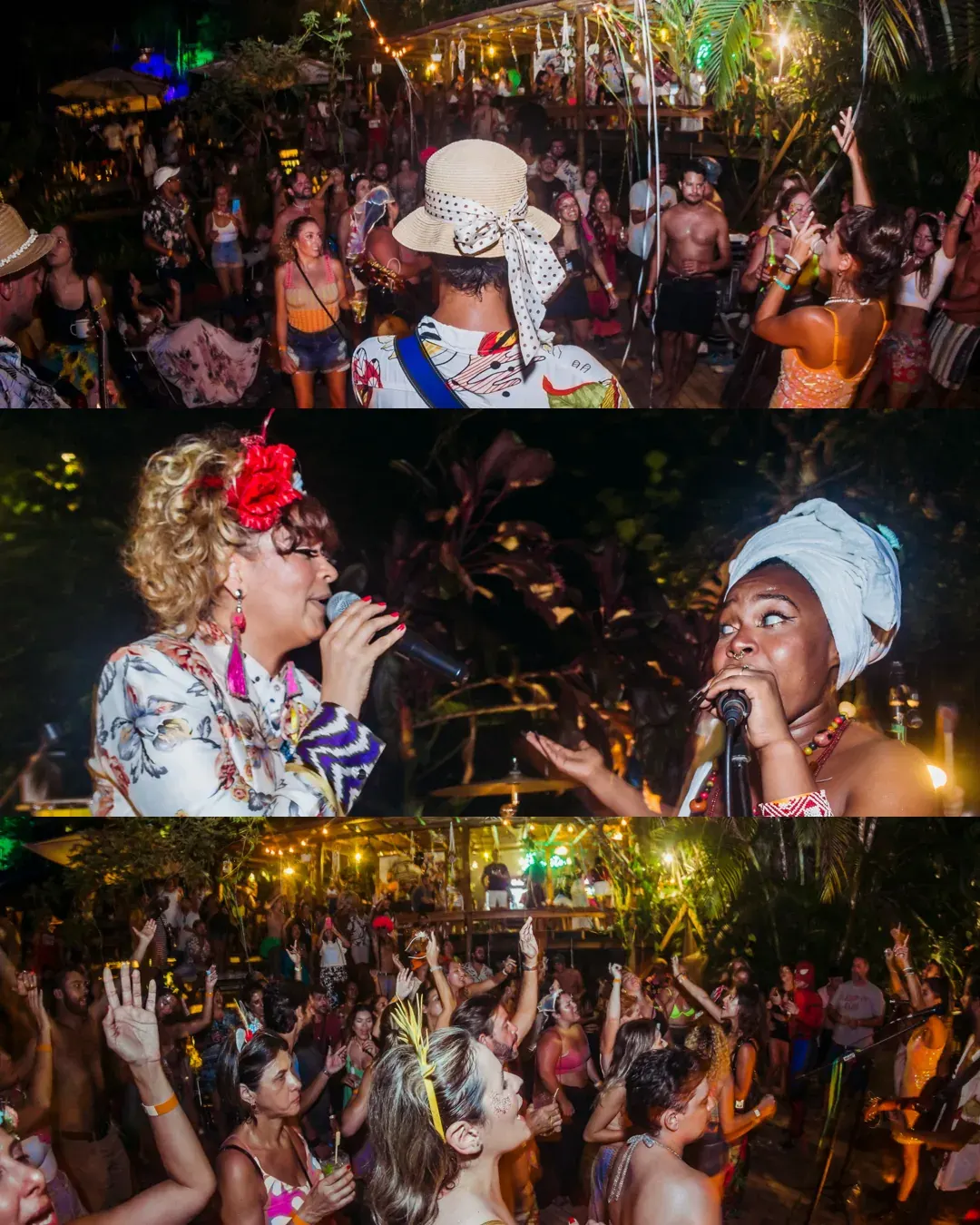 The night layer at home: a party among the trees on the Hostel da Vila property. Photo: Hostel da Vila Group archive
The boat that turns the journey into the destination. The Albatroz is a 23 meter schooner based at the Paraty marina, with 10 cabins, a chef on board and expeditions of two to five nights through the bay of Ilha Grande, the Cajaíba and the Saco do Mamanguá, from R$ 990 in 2026. It is the crossing layer taken seriously: the bed sails, dinner comes out of the onboard galley, and the night can end at a bonfire on a beach with no road. No piece of the group explains the concept better: on the Albatroz, the way between two destinations is the best destination of the two.
The whale departures. In season, from May 16 to August 16, we operate whale watching departures from the Pier da Vila in Ilhabela: R$ 320 per person, 3h30 at sea, operating under the Whale Friendly Seal. The humpback is the star, and honesty rides along on the ticket: a sighting is not guaranteed, because whales do not sign contracts.
The holidays. For long weekends, the hostel’s holiday packages bundle lodging and parties every night, with DJs and bands, in up to 10 interest-free installments and flexible cancellation. On New Year’s Eve, the fireworks burst over the sea 200 meters away.
What the Costa Verde Experience is not
The name has “experience” in it, so it is worth disarming the wrong expectation. It is not an all-inclusive beach resort: the region still has mountain rain that changes plans, the borrachudo fly in Ilhabela (a sign of clean water, but still a biting fly), tides that decide schedules and whales that appear when they feel like it. The idea is not to eliminate the unforeseen; it is to include it in the trip with enough structure that it never becomes a problem.
It is also not a closed package, and it does not depend on our group. The five layers are available to any traveler, independently, and the guides on this blog teach the way for free: that is how we think trust is built. The group’s pieces exist for whoever wants the layers with less friction and more depth, not for whoever needs them.
Where to start
The concept becomes a plan in four reads, in whatever order fits your trip: the definitive guide gives the general map of the region; the argument for traveling without driving explains why the crossing is a layer and not a cost; the island hopping route turns everything into an executable plan; and the best time to visit says when each layer peaks. To choose what to do inside each destination, the guides to Ilhabela and Ilha Grande go down to the detail.
Why we insist on this
Because we have seen the opposite up close, thousands of times. The traveler who did the Costa Verde in checklist mode comes back with photos and a vague feeling of having raced. The one who lived it in layers comes back telling of the conversation with the canoe maker, the waterfall swim after the trail, the night when the party ended and the silence of the forest took over the shift. The difference between the two was never money or time: it was the way of traveling.
We built the hostel, the boat, the whale departures and the packages because we believe in a simple idea: a trip grows when the lodging stops being a pause and enters the plot. If this way of traveling speaks to you, the rest of this blog is its manual: start with the Costa Verde section and build your own version.