
Solo travel on the Costa Verde
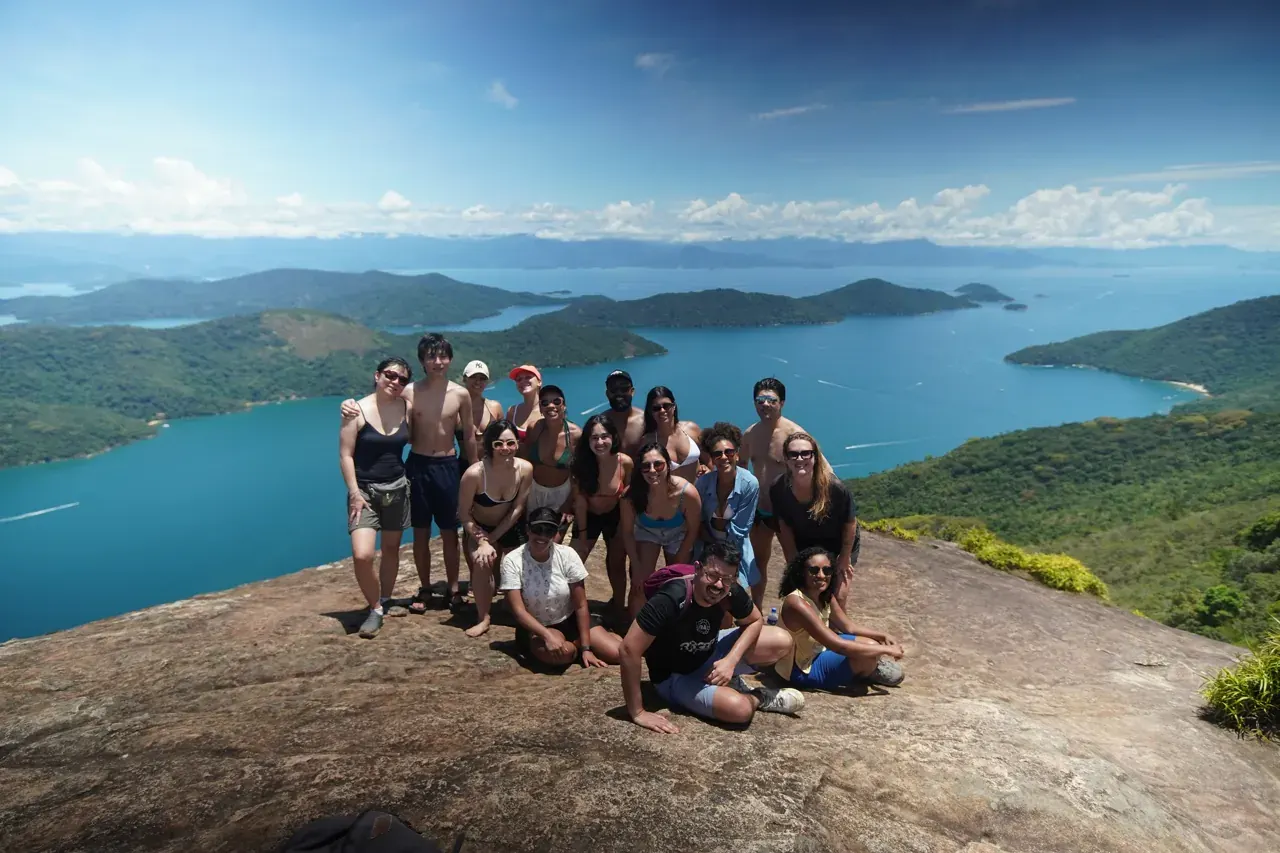
There is a kind of check-in we recognize from a distance, after ten years behind a front desk in Ilhabela: the person arrives alone, slightly formal, asks twice whether the room is quiet, and lets out, almost apologizing, “it’s my first solo trip”. Three days later that same person is returning the key with a group waiting for them at the gate. The transformation is so predictable it became a house thesis: the Costa Verde is one of the best places in Brazil to travel alone, and this article explains why and hands over the itinerary.
Why this coast plays in favor of solo travelers
First, the scale. The destinations along the corridor between Rio and São Paulo are villages and centers you cross on foot: the dirt streets of Abraão, Paraty’s historic quadrilateral, the waterfront of the Vila in Ilhabela. A place you can walk is a place where nobody depends on rides or gets held hostage by taxis, and where faces start repeating by the second day. By the third, you greet the kiosk owner by name.
Second, public transport works. Buses between all the towns, ferry and flex boat to Ilha Grande, a free pedestrian ferry to Ilhabela: the whole stretch can be done without a steering wheel, as the guide to the Costa Verde without a car shows. For solo travelers that is more than savings, it is autonomy: no plan depends on assembling a group to split anything.
Third, and most important: paths cross here all the time. Everyone is stitching together the same destinations in different orders, so the person you met in the Abraão dorm reappears on the Paraty pier. The Costa Verde works like a social corridor, and the solo traveler is the one who harvests the most from it.
The right base is half the trip
The difference between a lonely solo trip and an accompanied one rarely lies in the destination: it lies in the lodging. A closed-door guesthouse is great for couples; solo travelers need a big table, a shared kitchen and an activity schedule, the kit that turns strangers into trail company. All the tactics are in how to meet people traveling solo, but the rule of thumb is: choose the bed by the size of the table.
Here comes our part, said with transparency: Hostel da Vila, the house of the people writing this, was designed for exactly that. We sit in Ilhabela’s historic center, on the channel side, with 8,000 m² of forest climbing behind the property, and the classic route of the solo guest is to arrive from the ferry, drop the backpack and be mid-conversation in the heated pool before their first sunset. Nobody leaves here without someone to have dinner with.
The trail is where daytime company appears
If the hostel table is the evening meeting point, the trail is the daytime one. Ilha Grande has 16 numbered trails where it is rare to walk ten minutes without crossing another traveler, and the 20 minute path between Praia do Pouso and Lopes Mendes is practically a social queue. Walking together breaks the ice without effort: the conversation happens looking at the path, at the pace of the steps.
Two rules from people who live here, because solo hiking demands judgment: tell someone at the hostel where you are going and when you plan to be back, and start early so you never finish in the dark. The Atlantic Forest gets dark fast and without warning.
The expedition where everyone arrives alone and leaves with friends
There is a phenomenon we watch every week at the Paraty pier: solo travelers are the majority aboard the Albatroz, our group’s 23 meter schooner. It was not planned that way, but it makes complete sense. A two to five night expedition with 24 people on a boat solves the three pains of solo travel at once: company (it is impossible not to talk on a deck), logistics (bed, onboard chef and stops in a single package) and that mild fear of “what if I feel out of place” (everyone there is in the same situation, and the group forms on the first night, still docked at the marina).
The cycle repeats with every departure: strangers at Friday’s boarding, snorkeling and kayaking together on Saturday, a bonfire luau on the Mamanguá beach at night, and on arrival the phone numbers exchanged and the group chat christened. If you want to see how that actually happens, the onboard videos are on the Albatroz Instagram.
Safety: the honest answer
The question we get most from people planning their first solo trip, especially from women: is it safe? On safety inside the lodging, from lockers to female-only dorms, we answered in full in are hostels safe. On the region, the honest answer has two parts.
The reassuring part: the Costa Verde is made of small villages and tourist centers where you walk at night with people on the street, and the feeling of safety is visibly higher than in the big cities that flank it. Abraão has no cars, Paraty has constant policing in the center, Ilhabela’s waterfront stays busy until late. We welcome women traveling alone every week of the year, and the reports are consistently good.
The serious part: tourism attracts opportunistic theft, and the universal precautions still apply. Do not leave your phone alone on the beach sarong, use the dorm locker (bring your padlock), prefer cash split between two places and, in a bigger city like Angra, pay extra attention at the bus station and at night. At sea and in the forest, the real risks here are different: currents on open-sea beaches, trail timing and Ilhabela’s borrachudo, the tiny biting fly, which is not a danger, just a nuisance with a well-earned reputation. Repellent solves it.
A 7 day solo itinerary, condensed
The full design, with times and prices, is in the 7 day Costa Verde itinerary; here is the solo traveler’s version, in the Rio to São Paulo direction.
Days 1 and 2, Ilha Grande. Ferry crossing (R$ 20.50, and the guide on how to get there explains the schedules) or flex boat, a dorm bed in Abraão, an afternoon at Praia do Abraãozinho to unlock the trip. On the second day, Lopes Mendes with the company breakfast provided.
Days 3 and 4, Paraty. Bus from Angra (R$ 27.50), late afternoon in the historic center as the lanterns come on, and the R$ 60 schooner the next day, which is a naturally collective program: nobody is “the alone one” on a 40 seat boat.
Day 5, Trindade and the state line. The R$ 5 municipal bus, a morning at the Cachadaço natural pool, an afternoon on the road to Ubatuba.
Days 6 and 7, Ilhabela. Free ferry on foot, a social base in the historic center, a waterfall or a channel beach on the last full day and the sunset over the channel closing the trip. If you have a day to spare, it earns its keep: the island runs on its own time, and it is the best place on the route to slow down before heading home.
If you would rather trade days 1 to 3 for the sea version, board the expedition in Paraty and pick the itinerary back up on day 4, already carrying half a trip’s worth of friends.
What going solo costs
Traveling alone has a single tax: a double bed does not split. In a dorm that tax disappears, and the budget lands in the same range as the accompanied backpacker, R$ 150 to 250 a day, everything in. The open math is in Costa Verde travel costs, and the tricks to shave every line of it are in how to travel the Costa Verde on a budget.
In the end, the secret ten years of front desk taught us is that “alone” only describes the first day. The Costa Verde fills the rest of the week, with an insistence that borders on comic: a full table, a busy trail, a crowded deck. Pick the date, book the first bed and let the corridor do what it does. The step by step is in the 7 day itinerary.