
Are hostels safe?
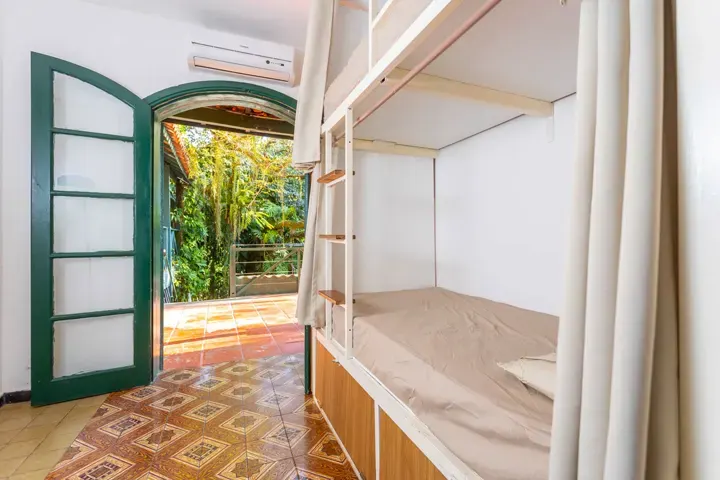
Of all the questions people who have never slept in a hostel ask, this is the first one. Before price, before the bathroom, before anything else: “but is it safe to leave my things in a room with strangers?”.
The people answering here have run a hostel for 10 years. 65,000 guests have come through Hostel da Vila, our home in Ilhabela’s historic center, over that period, and that volume of people gives us something rare in this discussion: a real base of evidence, not guesswork. So here comes the honest answer, with everything reassuring about it and the parts that demand attention too.
The short answer, and what holds it up
Yes, hostels are a safe way to travel, and the reason is less obvious than it seems: a hostel is a community environment, and communities self-regulate. In a shared room, people introduce themselves, know each other’s names, notice who comes in and who does not belong there. Anonymity, which is the soil where problems grow, barely exists.
In 10 years hosting travelers, what we see most are not stories of theft: they are stories of things coming back. The charger forgotten in the socket that waits days at reception for its owner to send a message. The wallet found on the sofa and handed in untouched. The sunglasses that make the rounds of the whole house until they find the guest who was already on the ferry. Lost objects are a weekly routine in any lodging; in hostels, their return rate surprises anyone who arrives suspicious.
That does not mean nothing ever goes wrong. It means problems are rare, almost always avoidable, and that the format has developed layers of protection over decades. Here they are.
Lockers: the industry standard
Practically every hostel in the world offers some kind of lockable storage, the lockers, either inside the room or in a dedicated area. It is the industry standard for a simple reason: shared dorms only work if each guest has a space that is theirs alone.
Two practical tips from people who know the format:
Bring your own padlock. Many hostels lend or sell them, but the experienced traveler carries their own: a medium combination lock, nothing that depends on a key that gets lost. It is the cheapest item in your backpack and the one that buys the most peace of mind.
Check the locker size in the room description. Some fit the whole backpack; others, only electronics and documents. Knowing in advance avoids the only genuinely annoying situation: arriving and discovering that the big pack stays outside.
It is worth saying the obvious thing nobody says: most of what you carry interests no one. Clothes, sunscreen and flip flops spend the whole trip on top of the bed at zero risk. The locker exists for the items that would truly hurt: electronics, documents and your cash reserve. Lock those three groups away and the rest is scenery.
The role of the staff
The second layer is human. A hostel has staff moving through the common areas all the time, and many houses keep a 24 hour reception, which makes a double difference: someone controls who comes in (a hostel is not an open door for people who are not guests) and there is always a human awake for any situation, from a guest feeling ill to a key locked inside the room.
In everyday practice, hostel staff know guests by name in a way a big hotel cannot. That changes what security looks like: it is not cameras and badges, it is people who know who you are, which bed you sleep in and when you plan to be back from the trail. When researching, notice whether the reviews mention the staff often and warmly: it is the most reliable sign of a well cared for house.
Reviews: the filter that never fails
Before booking, the reviews on booking sites are your x-ray, and there is a right way to read them:
Ignore the overall score and read the recent texts. A house can have a 9.0 average with new problems, or an 8.2 with a management that just fixed everything.
Look for patterns, not episodes. One isolated complaint about something going missing can be backpack confusion (it happens more often than actual theft). Three similar complaints in different months are a pattern: walk away.
Notice what guests praise. When reviews talk about “feeling at home”, about a staff member mentioned by name, about “would come back a thousand times”, you are looking at the kind of place where a security problem is a statistical rarity.
The same reading works for discovering the atmosphere of the house, as we show in our article on hostels after 30.
What can go wrong, and how to avoid it
Complete honesty: in a decade, we have seen enough to know that the rare incidents almost always follow the same script, and that the script is avoidable.
Electronics left out in common areas. The phone charging alone on the sofa while its owner went to the beach is the number one risk situation in any shared lodging in the world. Charge it near you or inside the locker.
Mix-ups between similar belongings. Black towel, black charger, black flip flops, black power bank: half of hostel “disappearances” are another guest who took the item identical to theirs in good faith. Mark your things.
Money and documents outside the locker. Passport and cash reserve stay locked up, always. Carry a copy or a photo of your ID and enough money for the day.
A room that does not match you. If sharing a mixed room makes you uncomfortable, a good share of hostels offer female-only dorms: use the filter when booking, no ceremony needed. And if the idea of a dorm itself still weighs on you, the hostel private room exists exactly for that, as we show in our article on dorm rooms.
Arriving in the middle of the night unannounced. Tell the house your arrival time. Showing up at 3am with nobody expecting you is uncomfortable in any city in the world.
And one layer that does not depend on the hostel: at the beach and on the trail, the precautions are the same as on any trip. Our guide to planning your first Costa Verde trip covers that part, from cash in villages without signal to the weather that turns fast at the foot of the mountains.
 The path between the rooms and the forest: the whole house knows each other by name. Photo: Hostel da Vila Group archive
The safety nobody measures
There is also a kind of safety that does not fit in a locker: not being alone. Solo travelers who sleep in hostels have company for the trail, people who notice if you did not come back on time and a group forming to share tomorrow’s boat. It is one of the reasons the hostel is the base we recommend in our guide to solo travel on the Costa Verde: your lodging becomes your support network in a town where you know no one. At Hostel da Vila, after 65,000 guests, we have lost count of how many travelers arrived telling us it was their first trip alone, with that knot in the stomach, and left with the trail group chat still active on their phones. That improvised network of mutual care is, in our experience, the most underrated safety argument of the format. If you are choosing where to start, our comparison of backpacker destinations points to the friendliest bases in the region.
Before your first check-in
To recap the essentials: your own padlock, a locker for everything that would hurt to lose, reviews read with an eye for patterns, a room chosen for your comfort and an arrival announced in advance. Do that, and the statistics play heavily in your favor, and what is left of the trip is the good part.
Fear of the unknown shrinks fast when the unknown has a name, a face and a travel story to tell at the breakfast table. If safety was what held you back, the next step is getting to know the rest of the format: our manual on how hostels work answers every other beginner question, one by one.