
How does a hostel work?
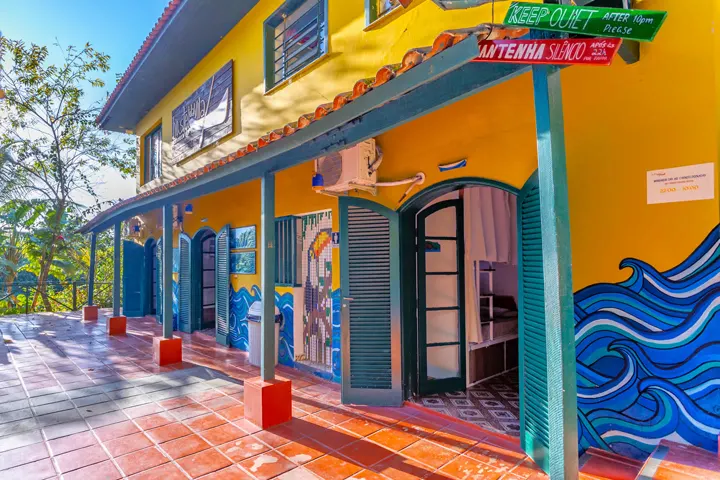
Everyone who works in a hostel recognizes the first-timer the second they walk through the door: the new backpack, the eyes searching for a hotel front desk that does not exist in that shape, the question rehearsed on the way over. We have been welcoming that guest for 10 years at Hostel da Vila, in Ilhabela, and there have been 65,000 check-ins in that period. This article is the conversation our team has with every beginner, now in writing: the complete manual of how a hostel works from the inside, valid for any hostel in the world.
The general logic: you book a bed, you get a house
That is the fundamental difference from a hotel. At a hotel, you rent a room and the rest of the building is hallway. At a hostel, the unit can be a bed in a shared room, and everything that is not a room is yours too: kitchen, living room, garden, bar, deck. The hostel inverts the hotel’s proportions: the room is the smallest piece of the experience, and the common areas are the reason the format exists.
Once you get the logic, the pieces make sense one by one.
Dorm and private: the two room types
The dormitory (or “dorm”) is the shared room, with bunk beds, usually 4 to 12 of them. You book your bed and share the space with other travelers. Dorms can be mixed or female-only, and the booking description always says which. In hostels that take themselves seriously, every bed has a curtain, a reading light and its own socket: cabin privacy, not just a mattress on a bunk. It is the cheapest form of lodging there is, and the complete math is in our article on dorm rooms.
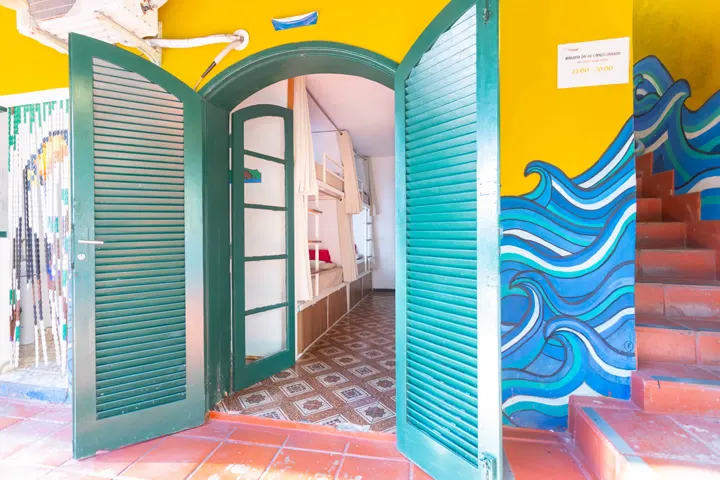 A dorm seen from the doorway: bunks with individual curtains. Photo: Hostel da Vila Group archive
The private room is a room of your own inside the hostel, for a couple or a family. You close the door as you would at a guesthouse and use the common areas like everyone else. It is the fastest growing format, and the one we recommend for testing the style without giving up your sleep, as we explain in our comparison of hostel, guesthouse or hotel.
Some hostels stretch the definition of “room” as far as creativity reaches. At our house, for example, the private rooms include a geodesic dome with the sea in the window, a treehouse, a kombi van and a lighthouse, scattered through the forest on the property. The format accepts anything, as long as the logic of the shared house stays standing.
 A private room can also be a dome with the channel in the window. Photo: Hostel da Vila Group archive
The bathroom: the question every beginner asks quietly
In most dorms, the bathroom is shared, in the room or down the hall. It works better than beginners imagine, for two reasons: shower times spread out naturally (the early riser heading for the trail, the person who showers before dinner) and cleaning in a well-run hostel happens several times a day, because the house knows the bathroom is the first item in every review. Private rooms usually have their own bathroom, and the booking description always says. Practical tip: rubber flip flops are the official uniform of hostel bathrooms worldwide.
The shared kitchen: the heart of the house
A hostel kitchen is equipped for guests to use: fridge, stove, pots and pans, basic seasonings. The rules are universal and simple: label your food with your name and a date, wash what you used right away, and whatever sits unlabeled on the “free” shelf belongs to everyone. It is where the savings happen (cooking instead of eating out every day changes the trip’s budget, as we show in the numbers of Costa Verde travel costs) and where friendships begin: nobody can resist asking what smells so good in the neighbor’s pan.
Common areas: the reason for everything
A living room with sofas, a long table, hammocks, a garden, a pool when the house has one, a bar when the house has one. It is where the trip actually happens: fresh trail intel, a partner to split tomorrow’s boat, the guitar that appears out of nowhere. If you travel alone and the idea of starting a conversation freezes you, know that the common areas do half the work for you, and the other half we taught in our article on how to meet people traveling solo. Many hostels run their own programming (yoga, live music, game nights), and it is usually on the house’s social media before you arrive. Here in Ilhabela, ours lives on the Hostel da Vila Instagram: in a single week you can catch morning yoga and the Floresta Bar lit up at night, with the pool heated to 32°C waiting for whoever comes back from the trail in between.
What is included (and what is not)
The industry standard, with variations the booking description always clears up:
- Bed linen: included, practically always. A sleeping bag is unnecessary and many hostels do not even allow one, for hygiene.
- Towel: varies. Some houses include it, others rent it. Bring yours when in doubt (the quick-dry kind takes up no space).
- Breakfast: varies from house to house; when it is not included, the shared kitchen solves it.
- Locker: the lockable storage for your belongings, standard in the format. Bring your own padlock. We cover it in detail in our article on hostel safety.
- Wi-fi: included in any hostel of this century.
Etiquette: the rules nobody prints but everybody enforces
The social contract of the dorm fits in five lines:
- Quiet after 10pm (the hour varies, the rule does not). Conversation belongs in the common area, which exists for exactly that.
- Room light off if someone is sleeping. Use your reading light or your phone flashlight pointed at the floor.
- Pack your bag at night if your boat leaves early. The 5:30am zipper ritual is the biggest source of dirty looks in the hostel world.
- Short alarm, close to you. Nobody wants to get to know your ringtone on snooze mode.
- Clean the kitchen now, not “later”. It is rule number one of living together.
None of this is hard: it is the common sense of people sharing space, and whoever arrives respecting it gets received the same way.
Check-in and check-out: simpler than a hotel
Hostel check-in usually opens in the afternoon (2pm is common) and asks only for an ID; many places store your backpack for free if you arrive before the room is ready, and the same goes after check-out, which is generally by 10am or 11am. Let the house know if you are arriving late at night. And a tip from people who have seen plenty of sweaty arrivals: check in advance how to reach the hostel’s town, because the transport to the door is half the mood of the first day. For the region where we live, the step by step is in where Ilhabela is and how to get there and in the guide to the Costa Verde without a car.
The summary for your first check-in
Book the bed or the room that matches your sleep, bring a padlock, flip flops and a towel, label your food, respect the 10pm rule and arrive willing to ask “where are you from?” at least once. That is the whole manual. The format teaches the rest by itself, usually on the first night, almost always at a long table.
Ten years of welcoming beginners taught us that nobody forgets their first hostel: it is the day lodging stops being where the trip pauses and becomes part of it. If your next question is where to make your debut, the comparison of backpacker destinations on the Costa Verde is the natural next step.