
Are hostels still worth it after 30?
This question reaches us in several ways. Sometimes it is direct, in a comment or a message. Sometimes it comes disguised, at the check-in desk: “you must only get young people here, right?”. The person asking is almost always someone who backpacked in their early twenties, loved it, and at some point concluded that the door closed along with their age.
We can answer with data from our own house. We have run Hostel da Vila, in Ilhabela’s historic center, for 10 years, and in those 10 years 65,000 guests have come through. The core of our audience is between 25 and 42 years old. It is not a range we chase with marketing campaigns: it is who shows up, year after year, when a hostel offers real comfort alongside the social life. Most of our guests are past 30, and a good share of them discovered hostels precisely after 30.
So the short answer is yes, it is worth it. The complete answer is: it is worth it with the right choices, and those choices are the reason this article exists.
Where the myth came from
The hostel stereotype has honest origins. In the 1990s and 2000s, the hostel in the Brazilian imagination was the backpacker flophouse: creaking bunks, a contested shower, parties running late and a crowd that really was almost entirely college students. A horror movie set in a hostel and a friend’s story about a bad night’s sleep in 2004 did the rest.
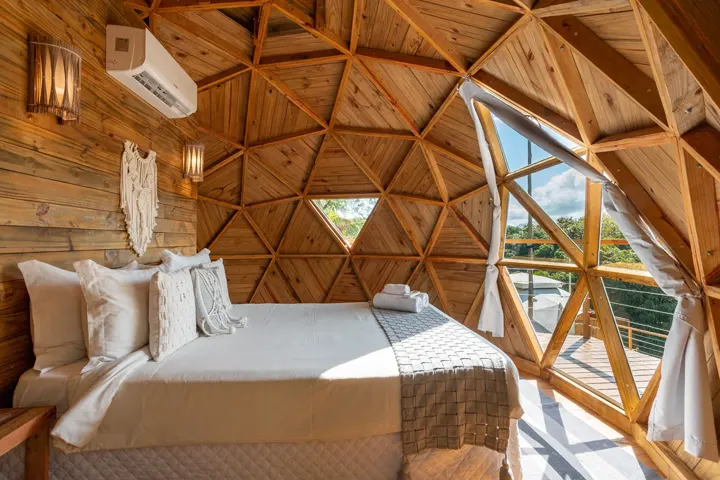
The problem is that the photo aged and the caption stayed. The format has changed enormously over the last two decades: a generation of hostels appeared, designed by people who traveled the world and came back wanting to offer what they had missed. Good mattresses, a curtain and an individual light on every dorm bed, a kitchen you actually want to use, beautiful common areas, cultural programming, private rooms that concede nothing to a guesthouse. The name stayed the same, the product did not.
What the years taught us about age
Welcoming people every day for a decade taught us something worth more than any statistic: the age on the ID predicts nothing. We have had 22 year old guests who only wanted quiet and wi-fi, and 45 year old guests who closed out the night dancing and organized the next day’s hike with the group they met over coffee. The most common scene at our long tables is a conversation between someone who is 26, someone who is 38 and someone who came with a teenage kid, all of them talking about the sea.
What exists after 30 is not a loss of desire, it is a change in standards. You still want to meet people, but you no longer accept sleeping badly. You are still up for improvising the day, but you want a guaranteed hot shower at night. The good news: the modern hostel was built exactly for this guest.
The right measure: the house’s vibe, not the age on your ID
Instead of asking “am I too old for hostels?”, ask “does this hostel have the atmosphere I want?”. They are different questions, and the second one has a researchable answer:
Look at the photos of the common areas, not just the rooms. The long table, the deck, the bar, the garden: that is where the life of the house happens, and the style of those spaces says a lot about who uses them.
Read the reviews looking for people like you. Hostel reviews reveal the profile of the house between the lines: who writes them, what they complain about, what they praise. We teach how to read those signals in our article on hostel safety, and the same technique works for atmosphere.
Check the activity schedule. A hostel with morning yoga and live music at night attracts a different crowd than one whose only programming is partying. Neither is wrong: the mistake is staying at the one that does not match you.
See whether private rooms exist. It is the most practical sign that the house expects guests at other moments of life, not just the dorm backpacker.
A quick test we suggest for anyone torn between two houses: send a message asking something trivial, like whether you can store your backpack before check-in. The tone of the reply tells you more about the place than ten photos. A well-run hostel answers like someone welcoming you into their home, and that care tends to repeat in everything you cannot see through a screen.
The right choices after 30
If you want the social life of a hostel without giving up your sleep, the path has three decisions:
1. A private room instead of a dorm, if the budget allows. You join everything and close your own door at the end of the night. It is the hybrid format we describe in our comparison of hostel, guesthouse or hotel, and for many people it is the discovery that reopens the door to the format. If it turns out to be a dorm after all, that is fine too: our article on dorm rooms shows who they work for at any age.
2. A hostel with a mature profile. Houses with real comfort (a pool, a bar with proper food, well-designed rooms) naturally balance the crowd. A dorm priced far below the city average usually signals the opposite.
3. Season and destination on your side. Carnival weekend at a beach destination has a different energy than a week in June. Nature destinations, like the ones we cover in our Costa Verde adventure pillar, attract travelers who want a trail by day and good conversation at night, at any age.
And if the trip is solo, even better: after 30 the hostel solves a problem the hotel does not even try to solve, which is having dinner with company in a town where you know no one. We wrote about it in detail in our guide to solo travel on the Costa Verde and in the tactics of how to meet people traveling solo, which work the same at 25 and at 45.
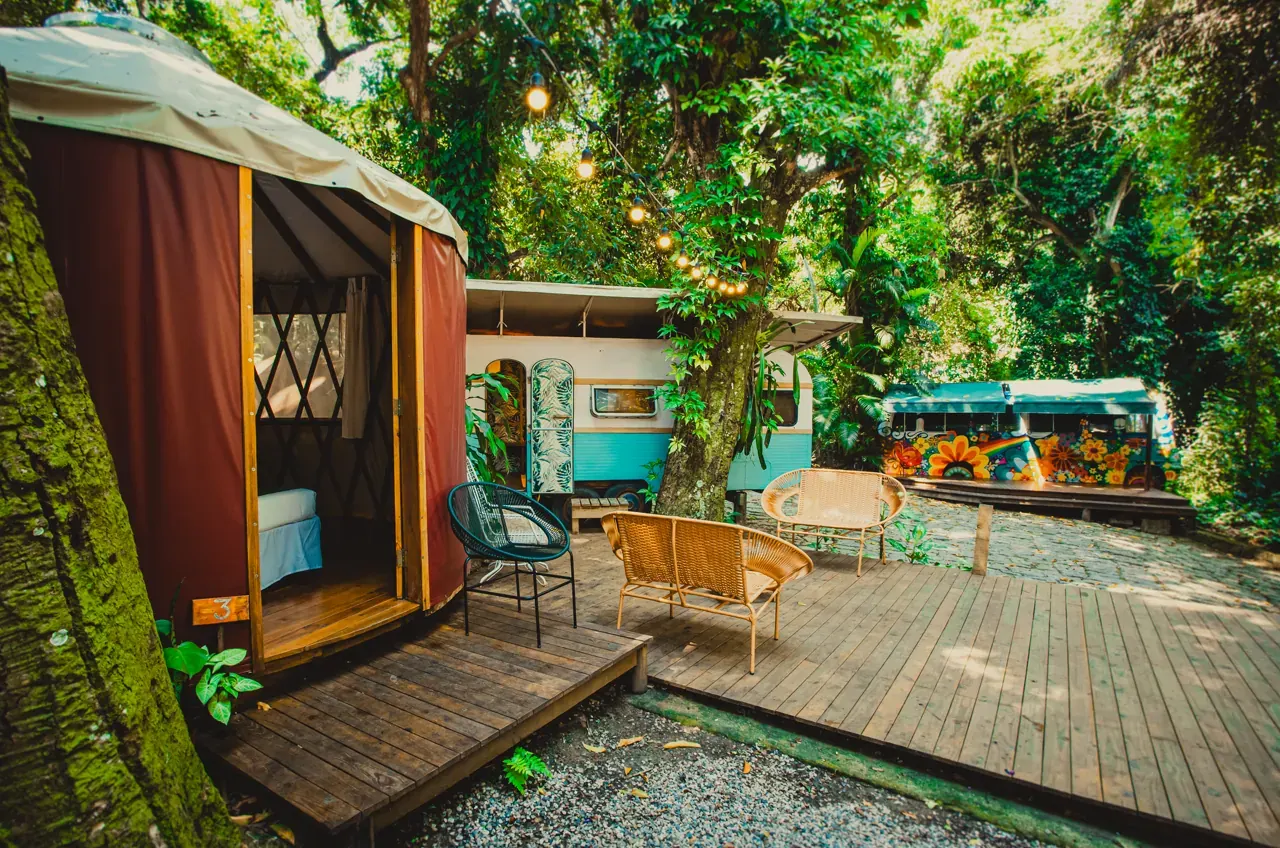 A yurt, a trailer and a bus sharing the same patch of forest. Photo: Hostel da Vila Group archive
When a hostel is not worth it (at any age)
Honesty from people who make a living from this: some trips do not match the hostel format, and forcing it only produces unfair reviews on both sides. A honeymoon calls for a different kind of bubble. A work trip with video calls at fixed hours works badly in a busy common area. If you know you need absolute silence to sleep and do not want to pay for a private room, you will suffer in the dorm, as we tell without hedging in our article on dorm rooms. None of this is about age: it is about the moment of the trip.
Living proof
If the doubt persists, it is worth seeing a concrete example of what the format has become. At our house in Ilhabela, you can sleep in a wooden dome with the sea in the window, in a treehouse or in a kombi van, swim in a pool heated to 32°C after a hike and end the day at the Floresta Bar, when the music lights up under the trees. The behind the scenes of that routine is on our Instagram, and we regularly get messages there from someone who is 35 or 40 asking, a little sheepishly, whether “there is still time”. There is. The program is for whoever shows up, not for whoever was born after a certain year.
What remains
Hostels were never a phase of life: they are a way of traveling. What changes with the years is your criteria, and the format matured along with you. Choose the house for its atmosphere, choose the room for your sleep, and the rest keeps working the way it did at 25: someone asks where you are from, and the trip doubles in size.
If this text knocked down the myth, the next step is practical: read our guide to how hostels work and arrive at your first check-in knowing everything the veterans know.