
How to get to Paraty: from Rio, São Paulo and Angra
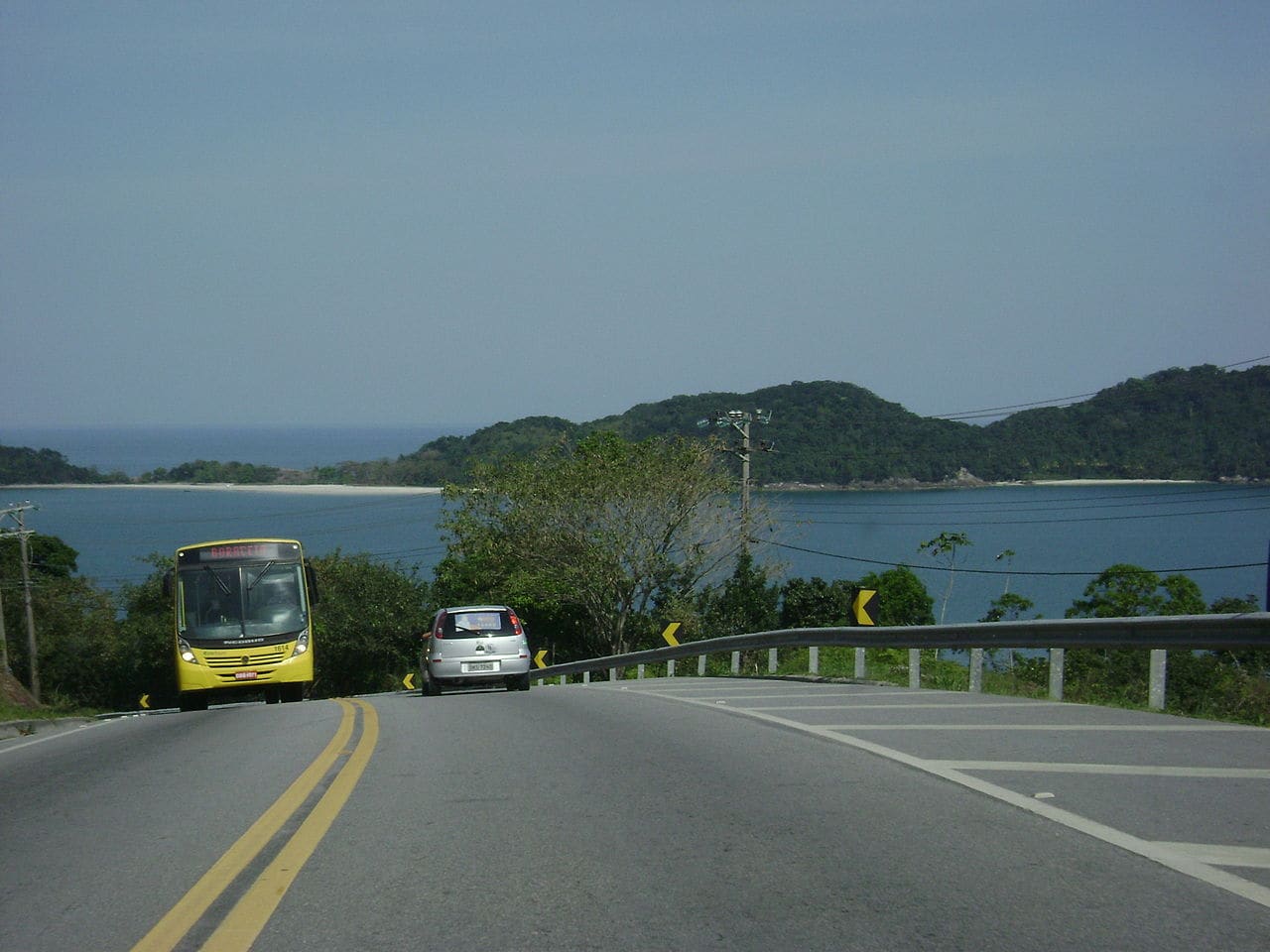
Paraty sits at the back of a bay between the Serra do Mar and the ocean, 240 km from Rio de Janeiro and about 300 km from São Paulo, with no commercial airport and no railroad. Everyone arrives by road, and every road here either crosses mountains or hugs the sea. We know these routes from sheer use: the Albatroz, our group’s schooner, is based at Marina Píer 46, and every week we welcome travelers at the pier who arrived from every direction, some delighted with the drive, others swearing they will “never take the mountain road at night again”.
This guide exists to land you in the first group. Real routes, 2026 prices and the traps the maps do not show.
From Rio de Janeiro: the classic route
By car it is 240 km and about 4 hours: Avenida Brasil, the BR-101 and then the Rio-Santos stitching the coast together through Itaguaí, Mangaratiba and Angra dos Reis. From Angra on, the road becomes what it promises: single lane, curves over the sea, forest closing overhead. It is a genuinely beautiful drive, and slow by nature; on holidays those times double without warning, with the line starting in Angra.
By bus, Costa Verde runs Rio to Paraty from about R$ 120, in around 4h30, with several departures a day from the Novo Rio terminal. It works well, fills up on holidays (buy the round trip in advance) and drops you at the Paraty bus station, about 10 minutes on foot from the historic center.
The toll is now free flow: read this before you travel
Since the modernization of the Rio de Janeiro stretch of the Rio-Santos, the toll plazas with barriers gave way to free flow gantries: electronic structures that register your passage in motion, without stopping. There are three on the way from Rio to Paraty, at Itaguaí (km 414), Mangaratiba (km 447) and Paraty (km 538), charging R$ 4.80 per gantry on weekdays and R$ 7.90 on weekends and holidays, for a passenger car.
If you have a toll tag, you do nothing. If you do not, you have to pay after the trip, through the concessionaire’s website or app or at the highway kiosks, within 15 days. No bill arrives at your door: the initiative is yours, and forgetting becomes a toll evasion fine. Write it into the trip checklist, next to the full tank.
From São Paulo: pick your mountain road
From São Paulo there is no straight path: about 300 km and 5 hours or more, always crossing the Serra do Mar at some point. Three routes compete for your patience:
Via Tamoios (the most used). The Tamoios highway to Caraguatatuba, around the edge to the Rio-Santos and up the coast through Ubatuba to Paraty. It is the route with the best road on the descent and the most predictable, but the final Ubatuba to Paraty stretch is single lane squeezed between the sea and the park, beautiful and slow.
Via Oswaldo Cruz. The Dutra to Taubaté and the SP-125 snaking down to Ubatuba. It shortens the distance on the map and stretches it on the clock: the Oswaldo Cruz is narrow and full of tight curves. It pays off for anyone already in the Paraíba valley.
Via Cunha. The Dutra to Guaratinguetá, the SP-171 to Cunha and the descent on the Paraty-Cunha road, now paved. It is the most scenic of the three, dropping off the mountains straight into the sea with lookouts along the way, and also the one that demands the most from the driver: narrow lanes, hairpin curves and frequent fog at the top. By day and in good weather, it is a spectacle. At night or in heavy rain, choose another.
By bus, there is a direct line from the Tietê terminal, from about R$ 110, but the trip takes 6 to 7 hours going around the coast. The alternative many travelers prefer: a bus to Ubatuba (about 4 hours) and from there a second leg to Paraty. The honest bottleneck is that jump between the states, which has few departures a day and depends on a transfer at the state line on the municipal lines. Anyone building the trip without a steering wheel will find the detailed connections in our guide to the Costa Verde without a car.
From Angra dos Reis: the short leg
Colitur’s L101 line links Angra to Paraty for R$ 27.50, in about 2 hours of Rio-Santos with the sea in the window, with departures throughout the day. It is the leg that stitches Paraty to the rest of the Costa Verde: whoever steps off the ferry or flex boat from Vila do Abraão takes this bus and joins the two destinations. The reverse path, toward the island, is explained in how to get to Ilha Grande.
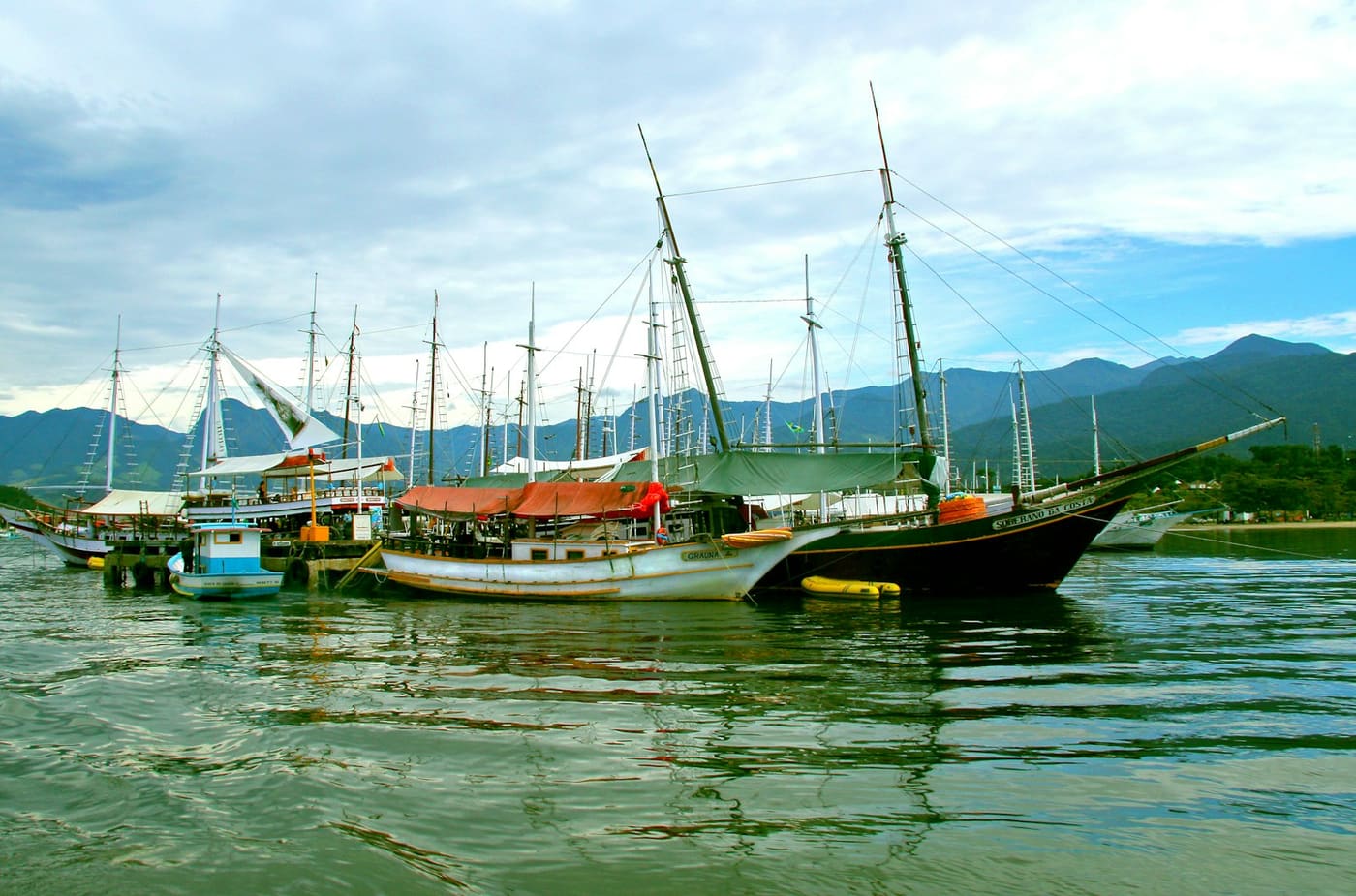 End of the line: the Paraty pier, ten minutes on foot from the bus station. Photo: Nareeta Martin, Unsplash
By plane: the airports that serve
Paraty only has an airfield for executive aviation. The nearest commercial airports are Rio de Janeiro’s (Galeão and Santos Dumont), about 4 hours away by road, and São Paulo’s (Guarulhos and Congonhas), 5 or more. For anyone coming from outside Brazil’s Southeast, the most efficient shape is usually to fly to Rio, sleep one night and take the bus down the next morning, with the whole Rio-Santos in daylight. Many people turn the transfer into the trip itself: the Rio to Paraty corridor is part of the most beautiful stretch of the Brazilian coast, mapped in our definitive Costa Verde guide.
You have arrived: now forget the car
The piece of information that saves a headache: Paraty’s historic center is closed to vehicles. The pé de moleque stone streets are for feet, bicycles and cargo carts, and that is what preserves the ensemble UNESCO recognized in 2019. In practice:
- If your lodging is inside the historic quadrilateral, you will park outside and take your luggage on foot or by cart. Ask the guesthouse where to park before arriving.
- The paid parking lots cluster on the edge of the center and fill up by mid-morning on holidays.
- Inside town, the car sits still: the historic center is walked in minutes, Trindade has a municipal bus for about R$ 5 and the rest of the municipality is sea.
That last point deserves to be spelled out: of Paraty’s roughly 60 beaches and 65 islands, most have no road. The car brings you to the pier, and at the pier the trip changes vehicles.
And from the pier on, the road is the sea
Here comes the part of the journey we know better than any other. For a few hours out, the day-trip schooners leave the pier every day for around R$ 60, and the formats are compared in the best tours in Paraty. But for anyone who wants to go genuinely far, to the Mamanguá fjord or Ilha Grande bay, the house recommendation is to make the boat the trip itself: the Albatroz expedition boards at 6 pm at Marina Píer 46, with the first night docked and free for the historic center, and wakes up sailing. Transport, bed, chef and route in the same hull, which, for anyone who arrived without a car, solves the entire logistics of the stretch in one move.
The summary by origin
| Coming from | Best option | Cost per person | Time |
|---|---|---|---|
| Rio (car) | Rio-Santos | Fuel + 3 gantries (R$ 14.40 to 23.70) | ~4h |
| Rio (bus) | Costa Verde, Novo Rio | From ~R$ 120 | 4h30 |
| SP (car) | Tamoios + Rio-Santos | Fuel + tolls | 5h or more |
| SP (bus) | Direct from Tietê | From ~R$ 110 | 6 to 7h |
| Angra | Colitur L101 | R$ 27.50 | ~2h |
Two decisions made before the road are worth more than any shortcut: the date (a holiday changes everything, as our month by month Paraty guide shows) and the length of the stay (the honest math is in how many days in Paraty). The trip’s full budget, from the bus to dinner, we opened up in Paraty travel costs.
Whatever the route, there is a moment when the mountains open and the sea appears below, full of islands to the horizon. That is when everyone in the car goes quiet. Keep that instant: it is the border between the trip that ends and the one that begins. On this side of it, we wait at the pier.