
What living aboard between Paraty and Ilha Grande is like
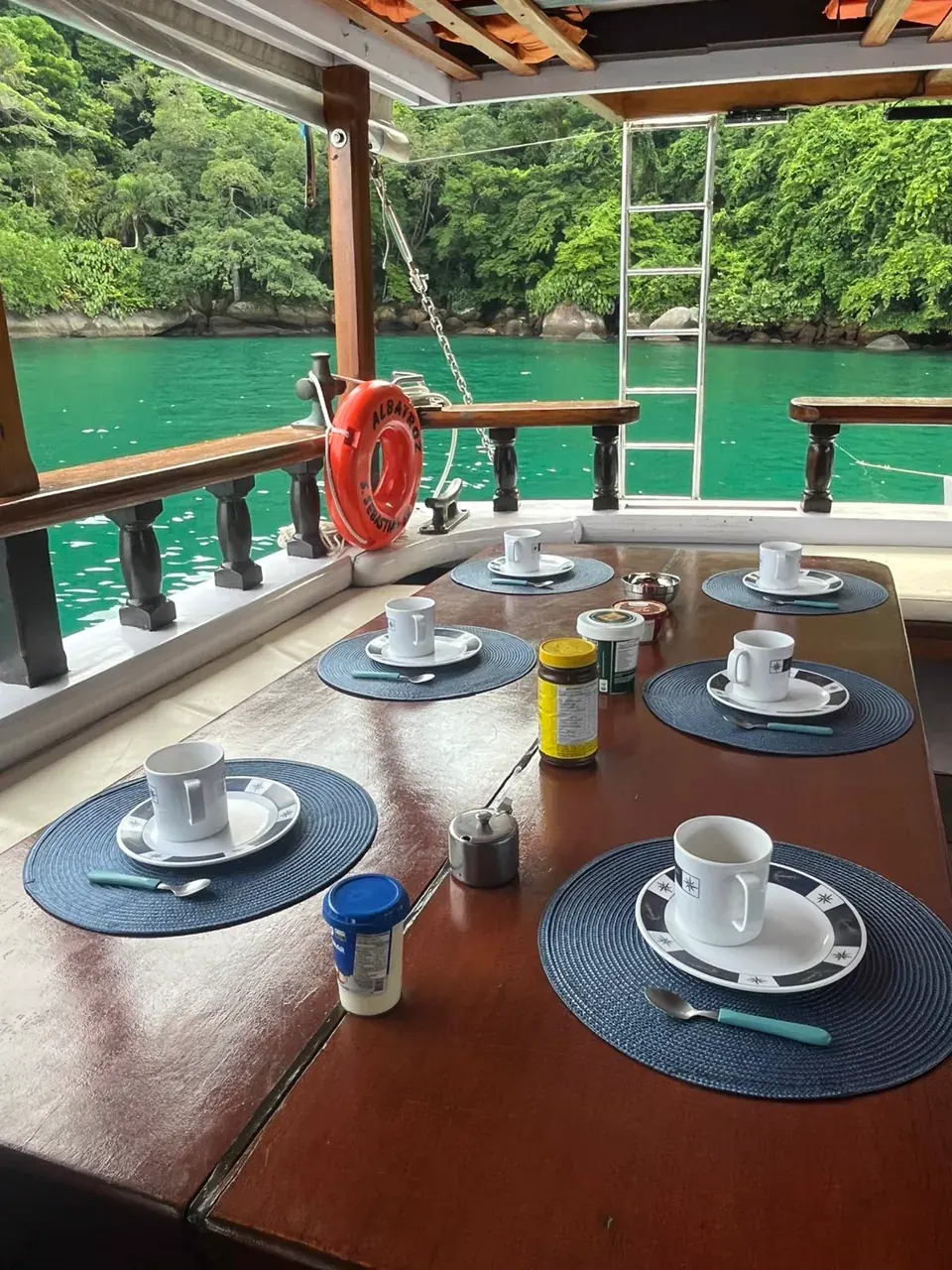
There is a way of knowing the sea between Paraty and Ilha Grande that no drone photo shows: it is the way of the person who wakes up in it. We run the Albatroz, the boat hostel of the Hostel da Vila group, and we have lost count of how many times a guest at disembarkation has said some version of the same sentence: “I thought it was a long boat tour, but it’s something else”. This article tries to explain the something else. It is not an itinerary or a price table (that lives in our guide to how the Albatroz works). It is one full day on board, told in the order it happens.
The night before, for context
The day this article describes is the second of the expedition. The first is the eve: check-in opens at 6 pm at Marina Píer 46, everyone arrives on their own schedule, finds their bed, stows the backpack and heads out for dinner on the stone streets of Paraty’s historic center, a few minutes’ walk from the marina. The boat spends the night docked, quiet, with the string of lights on between the masts. And it is there, sleeping aboard for the first time with the boat still still, that your body signs the contract: tomorrow the scenery starts to move.
Before seven
The first sound of the day is not an alarm. It is the hull. A small slap of water on wood, irregular, that crosses your sleep well before it becomes a thought. In the cabin, the blackout curtain holds back the light and the air conditioning hums low; whoever slept in a deck hammock had no such protection and woke with the sky, which is what the hammock crowd wanted from the start.
Then comes the second sound: the anchor chain coming up, or the engine catching deep in the hull, a low tremor that climbs through the mattress. The boat sails early because morning is the best sea. You have two options, and both are correct: roll over and sleep another rocked hour, or climb the companionway with a creased face and watch the bay of Ilha Grande open up in the new light.
Breakfast on a moving sea
The breakfast table is set on the covered deck while the boat is underway. Cups on placemats, filter coffee, fruit, bread, all of it swaying gently, in a rhythm that by day two you no longer register. Eating while watching the water go by is the kind of luxury that has nothing to do with price: it is geometry. The table sits two meters from the sea, and no waterfront restaurant gets that close.
At this hour the Starlink is on and there is always someone sending a photo to the family with one hand while holding bread with the other. There is also always someone who switched their phone off at the marina and never switched it back on. The boat accommodates both without judgment.
The anchor drops in the Lagoa Azul
Mid-morning the engine softens, the boat curves into the cove and here comes the sound that organizes the whole day: the chain running through the hawse, the anchor going down, the silence that settles when the engine cuts. The exact anchorage is the captain’s call; he read the morning wind the way other people read headlines and picked the cove that woke up like glass. The Lagoa Azul lives up to its name in an almost embarrassing way: the water is a pale turquoise that looks retouched, and is not.
From then on the morning is yours. The transparent kayak goes into the water and becomes a floating aquarium; the SUP boards follow; the snorkel kit reveals the school of sergeant majors that surrounds anyone who enters the water holding a biscuit (do not give them the biscuit: they surround you anyway). Anyone who wants none of it stays on deck, in the hammock or in the jacuzzi, with the book they brought and forgot to open for the first two days. We listed the region’s best spots in our guide to snorkeling around Ilha Grande.
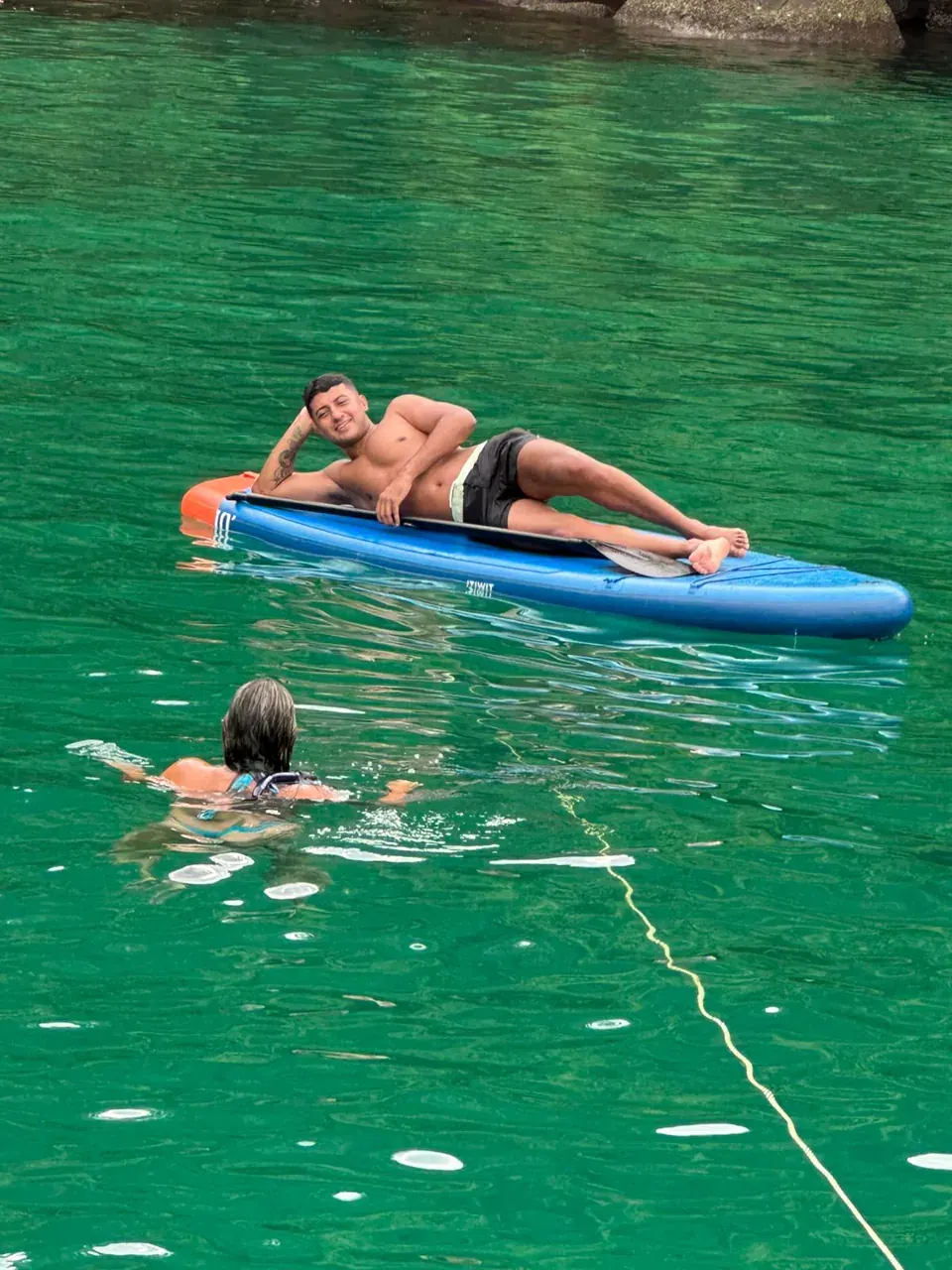 Morning in the cove: SUP, green water and zero hurry. Photo: Hostel da Vila Group archive
Lunch comes out of the galley still at anchor: caiçara food, fish, rice, salad, made by the chef who spent the morning working while everyone floated. At the hostel on land we call this home; here it is the same thing, except the view changes address three times a day.
The afternoon in Abraão
In the afternoon the Albatroz crosses to Vila do Abraão, the only real settlement on Ilha Grande, and the dinghy starts its shuttle. The village is dirt streets, not one car, a little white church, an ice cream shop, barefoot people and a dog asleep in the shade of an upturned boat. Everyone spends the free hours their own way: some walk out to the 19th century aqueduct at the forest’s edge, some hunt down a crepe and a beer, some just walk to the end of the pier and back.
The best moment of the afternoon, in our crew opinion, is the return: the dinghy crossing the cove in the last light, and the Albatroz at anchor against it, masts against the hillside, waiting. Seeing your own bed from the sea is a strangely affectionate experience. It is the hour when the boat stops being transport and becomes home.
The chef’s dinner on deck
Dinner is the social event of the day. The long table on the covered deck seats all 24 people at once, and the food arrives on platters, to serve and pass along: there have been octopus rice nights with the tentacles arranged on top, the kind of dish that gets applause before anyone eats. Cross-table conversation, travel stories, the bar open for anyone who wants wine or a caipirinha. All around, the dark of the bay and the small lights of the other anchored boats.
The table, by the way, is a curious census: a couple from Curitiba, an engineer who boarded alone, two Argentinians with backpacks, a family whose teenagers dropped their phones on day two without being asked. On land, these people might never have crossed paths. By the second dinner, they are trading travel plans and mock-fighting over the last ladle of rice.
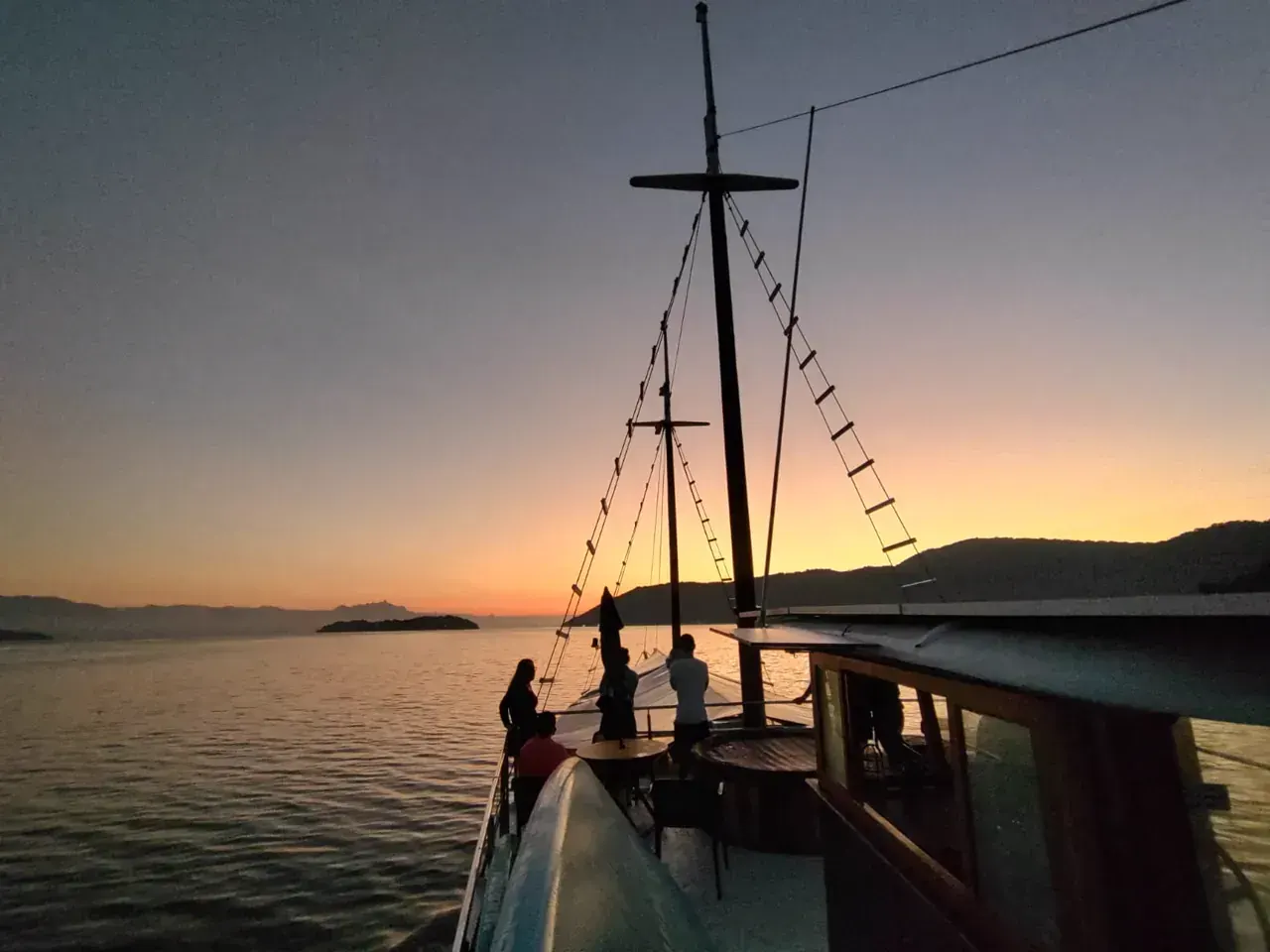 The last of the light seen from the deck, before dinner. Photo: Hostel da Vila Group archive
The silence after
After dessert the night splits. Part of the group stays at the table, stretching the conversation. Another goes to the bow with the crew to try squid fishing, which is less about the squid and more about patience by flashlight. And on moonless nights, when the water is truly dark, someone stirs a hand across the surface and the bioluminescent plankton lights up in green sparks, the kind of thing you knew from documentaries and suddenly it is at your fingertips.
On the departures that go to Cajaíba and Saco do Mamanguá, this hour of the night happens ashore: a bonfire lit on the sand, the beach gathering at the foot of Mamanguá’s Sugarloaf, everyone sitting in a circle with the glow on their faces. On the Ilha Grande route, the gathering is the deck itself, and nobody loses out.
The silence arrives gradually and it is a specific silence that does not exist on land: water on wood, a creaking line, the wind in the stays. The last person turns off the lounge light and the whole boat breathes at the same rhythm.
Rocked to sleep
The motion of a boat anchored in a protected cove is not open-sea motion: it is a short sway, like a hammock pushed by someone who likes you. The body understands in minutes. This is not sales rhetoric, it is physiology: rocked, sleep comes sooner and goes deeper, and we see it on every departure, in the guest who swore they would never manage to sleep and comes down for breakfast the next day asking whether they can move into cabin 4.
The next day, the hull slaps again, the chain comes up again, and the bay dawns different because the boat slept somewhere else: this time, at the door of the trail to Lopes Mendes, hours before the day-trip schooners arrive. That is what no one-day tour can copy: the day aboard does not end when the schooner returns to the dock, because it does not return.
If your question is now the practical kind, how much it costs and what is included, the complete Albatroz guide answers everything, and the honest analysis of who this format suits (and who it does not) is in is a boat expedition through the Costa Verde worth it? The next departures and prices are at albatroz.hosteldavila.com.br/pacotes; the onboard videos, water sounds included, are on Instagram at @albatroz.hosteldavila.